Camping for Beginners in Australia: Your Complete 2026 Guide
Everything first-time campers need to know: gear checklists, campsite types, booking systems, safety, fees, and why a hard-shell trailer beats a tent.
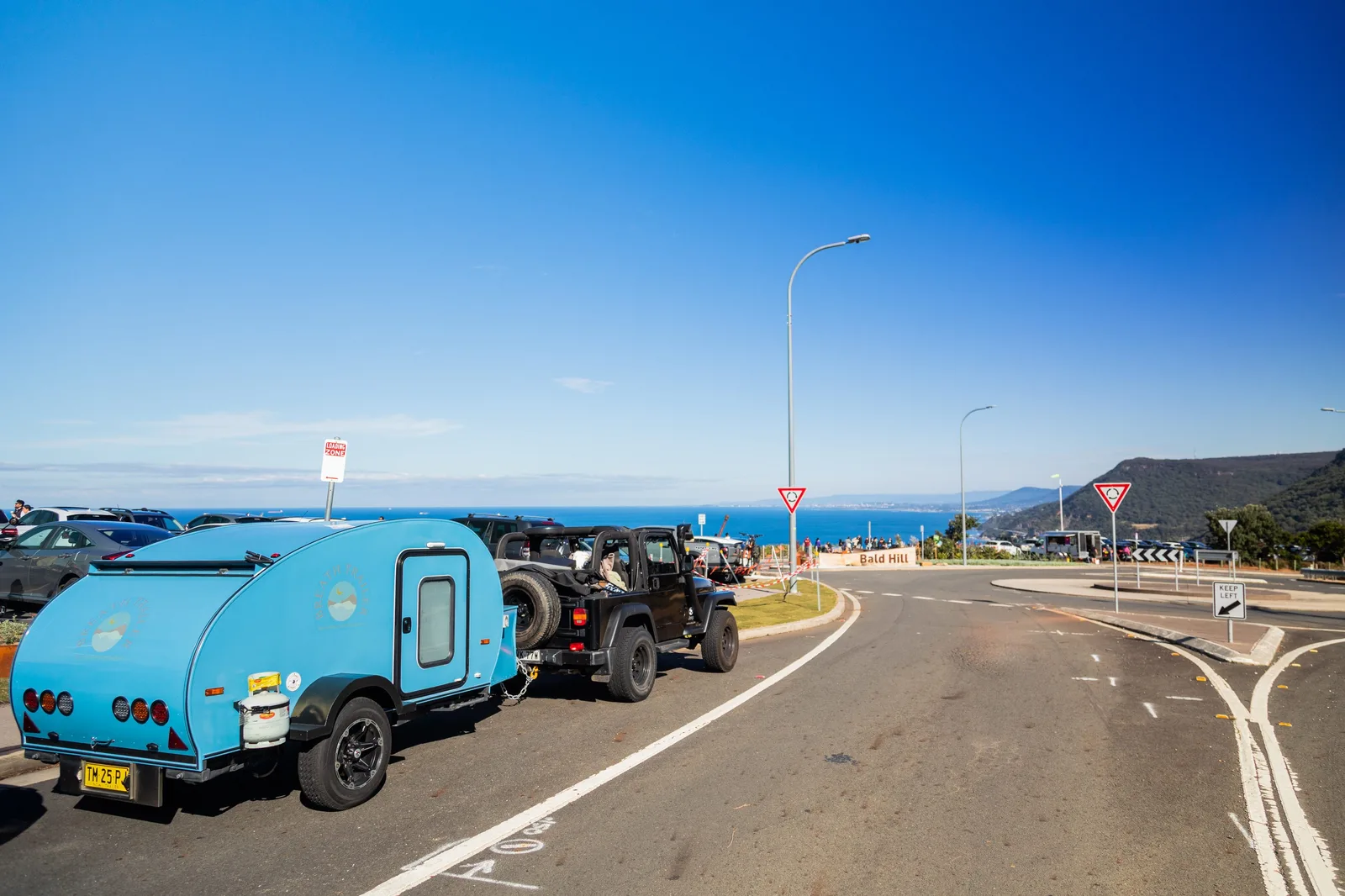
More than 5.5 million Australians go camping every year, and 2026 is shaping up as the biggest camping season on record. But if you have never slept under canvas — or inside an insulated hard-shell — the sheer volume of advice, gear lists and booking systems can feel overwhelming. This guide cuts through the noise.
You will find everything you need to plan your first camping trip in Australia: how to choose a campsite, what to pack, how to stay safe in the bush, what it costs, and how the right shelter choice can make or break your experience. If you are ready to step up to a camper trailer at any point, we will tell you exactly what to look for.
Why Australia Is One of the World’s Best Camping Destinations
Australia is uniquely well set up for beginners. The reasons go beyond scenery.
Scale and variety. Australia has more than 500 national parks and 2,000+ state forests, covering every terrain from tropical rainforest to red desert. Somewhere in the country is always in its best camping season.
Infrastructure. Decades of investment in campground amenities means most national park campgrounds now have composting toilets, picnic tables and fire rings. Holiday parks add hot showers, powered sites and camp kitchens. You do not need to “rough it” on your first trip.
Community. The camping culture is deeply embedded in Australian life. Fellow campers are overwhelmingly helpful — ask anyone and they will share a tip, a spare gas canister or directions to the nearest dump point.
Affordability. Nightly fees in state and national parks typically run $7–$35 per night per person or per site. Free camping on crown land and state forests is legal in most states with the right vehicle setup.
The main thing standing between you and your first trip is preparation. The sections below give you exactly that.
Step 1 — Choose Your Camping Style
The single most important decision for a first-time camper in Australia is what you sleep in. This drives everything else: gear needed, campsite choice, setup time and total cost.
| Style | Setup time | Weather protection | Cost to start | Best for |
|---|---|---|---|---|
| Dome tent (2-person) | 15–30 min | Moderate (no insulation) | $80–$400 | True budget start; walking/cycling trips |
| Canvas wall tent / swag | 20–45 min | Good but heavy | $200–$1,200 | Solo travellers, static camp |
| Soft-floor camper trailer (canvas fold-out) | 20–45 min | Good if canvas sealed | $10,000–$25,000 | Families with larger vehicles |
| Hard-shell teardrop camper | 5 min | Excellent (rigid, insulated) | $23,320–$42,900 | Couples, families, retirees, first-time trailer owners |
| Full caravan | 10 min | Excellent | $35,000–$150,000+ | Long-term travellers, large families |
For many beginners, start with a tent at a powered holiday park site. It is the lowest-risk way to find out which camping style suits you before committing to equipment. If you love it and do it more than four or five times a year, the economics of a camper trailer stack up quickly — even when you factor in finance, insurance and registration.
For the comparison between hard-shell and canvas in more detail, see Soft Floor vs Hard Floor Camper Trailer Australia.
Step 2 — Pick Your First Campsite
Not all campsites are created equal. Beginners consistently make the mistake of booking a remote, facilities-free site as their first trip. The result is an unnecessarily difficult experience that puts them off camping permanently.
| Campsite type | Facilities | Typical fee (2026) | Booking system | Best for beginners? |
|---|---|---|---|---|
| Holiday park (powered) | Showers, toilets, camp kitchen, WiFi, BBQ | $35–$80/site/night | Direct, booking.com | ✅ Yes — easiest start |
| National park campground | Pit/composting toilets, tables, fire rings; some with running water | $7–$35/adult/night | State-specific (see below) | ✅ Yes — book well in advance |
| State forest | Basic to none (BYO water, shovel for waste) | Free–$15/night | Often no booking required | ⚠️ More experienced campers |
| Free camp (crown land/road rest area) | Minimal | Free | Apps (WikiCamps, CamperMate) | ⚠️ Requires self-contained setup |
| Showground / recreational reserve | Toilets, sometimes showers | $10–$25/site/night | Often no booking | ✅ Good backup |
First trip recommendation: Book a national park campground or holiday park within two hours of your home city, in a shoulder season (late April–May or September–October). Avoid school holidays for your debut — campgrounds are full and sites are harder to access. For campsite ideas near major cities, see our guides:
Booking systems by state:
| State | System | Advance window |
|---|---|---|
| NSW | NPWS GateWay (nationalparks.nsw.gov.au) | Up to 12 months |
| VIC | Parks Victoria (parkweb.vic.gov.au) | Up to 12 months |
| QLD | QPWS (parks.des.qld.gov.au) | Up to 12 months |
| WA | ParkStay (exploreparks.dbca.wa.gov.au) | Up to 180 days |
| SA | SA Parks (parks.sa.gov.au) | Up to 12 months |
| TAS | Tasmania Parks (parks.tas.gov.au) | Up to 12 months |
| NT | NT Parks (nt.gov.au/parks) | Varies by park |
| ACT | Parks ACT (act.gov.au) | Up to 12 months |
Book as soon as you know your dates. Popular sites in Victoria and NSW fill six to eight weeks in advance during school holidays.
Step 3 — Build Your Beginner Gear Kit
You do not need to spend a fortune on your first camping kit. The rule of thumb: buy quality where it touches your sleep (sleeping bag, mat) and buy cheap or borrow everything else until you know what you actually use.
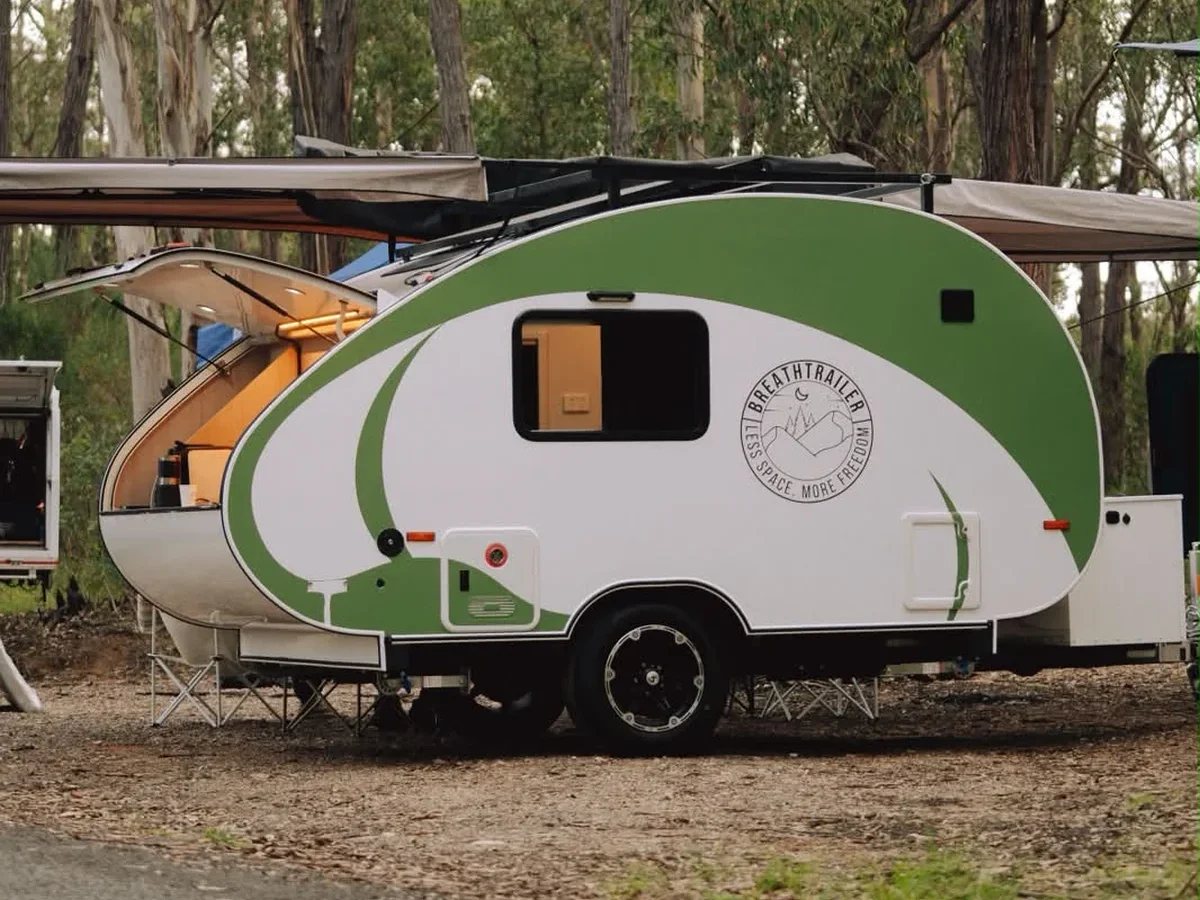
A hard-shell teardrop arrives at camp already packed — no assembly required, no poles to lose.
Gear checklist by category
| Category | Essentials | Nice-to-have (later) |
|---|---|---|
| Shelter | Tent (waterproof, for your season) or camper trailer | Footprint / groundsheet, vestibule |
| Sleep | Sleeping bag rated for the lowest forecast temp; sleeping mat (self-inflating or foam) | Pillow, eye mask, earplugs |
| Kitchen | 2-burner camp stove + gas canisters; medium pot + pan; plates/cups/cutlery; can opener; biodegradable soap | Dutch oven or camp oven, cast iron skillet |
| Food storage | 12V compressor fridge or quality 3-day esky with ice; dry-food bins with lids | Extra cooler, separate ice for fridge zone |
| Water | 10 L per person per day minimum (20 L/pp for hot weather); collapsible water jerry cans | Inline filter (Sawyer or Katadyn) |
| Lighting | Headtorch (primary); camp lantern (ambient); power bank | String lights, fire pit lantern |
| Safety | First aid kit; fire extinguisher for cooking; whistle | PLB (for remote travel — mandatory in our view) |
| Navigation | Offline maps downloaded (Hema Explorer, GaiaGPS); phone charge cable + adapter | Paper maps of the target area |
| Comfort | Folding chairs (2+); folding table; tarp for extra shade | Camp mat, hammock, camp rug |
| Toiletries | Biodegradable soap and shampoo; hand sanitiser; toilet trowel or portable toilet | Portable shower |
| Clothing | Layers (mornings are cold even in summer); rain jacket; closed-toe shoes for firewood | Gaiters for long-grass walking |
Weight discipline from day one. Many first-timers overpack by 15–25 kg on their first trip and then throw half of it away on their second. Write the list, then cut 30% before you load the car.
Step 4 — Pack and Load Correctly
The 60/40 loading rule
Whether you are loading a roof rack, car boot or camper trailer, weight distribution matters. Place heavier items low and forward (over the axle in a trailer). Target 60% of load weight over the front half and 40% over the rear. An unbalanced trailer will sway at highway speed.
Know your tow vehicle’s limits
If you are towing a camper trailer, you need four numbers before you leave your driveway:
- Tow ball mass (TBM) — how much weight the ball can carry (typically 130–350 kg)
- Towing capacity — the maximum trailer ATM your vehicle can tow
- GVM — your car’s total allowable loaded weight
- GCM — the combined total of car + trailer
These are stamped on the compliance plate and in the owner’s manual. Exceeding any of them voids your insurance and is a criminal offence under Australian road rules. See How to Choose the Right Tow Vehicle for full guidance.
The 750 kg rule
Any trailer with an ATM (aggregate trailer mass) over 750 kg requires electric brakes fitted to at least one axle (ADR 38/04). Breath Trailer’s Essential at 700 kg tare sits just below this threshold; the Plus (800 kg), Ultra (900 kg) and Max (1,200 kg) all require a brake controller in the tow vehicle.
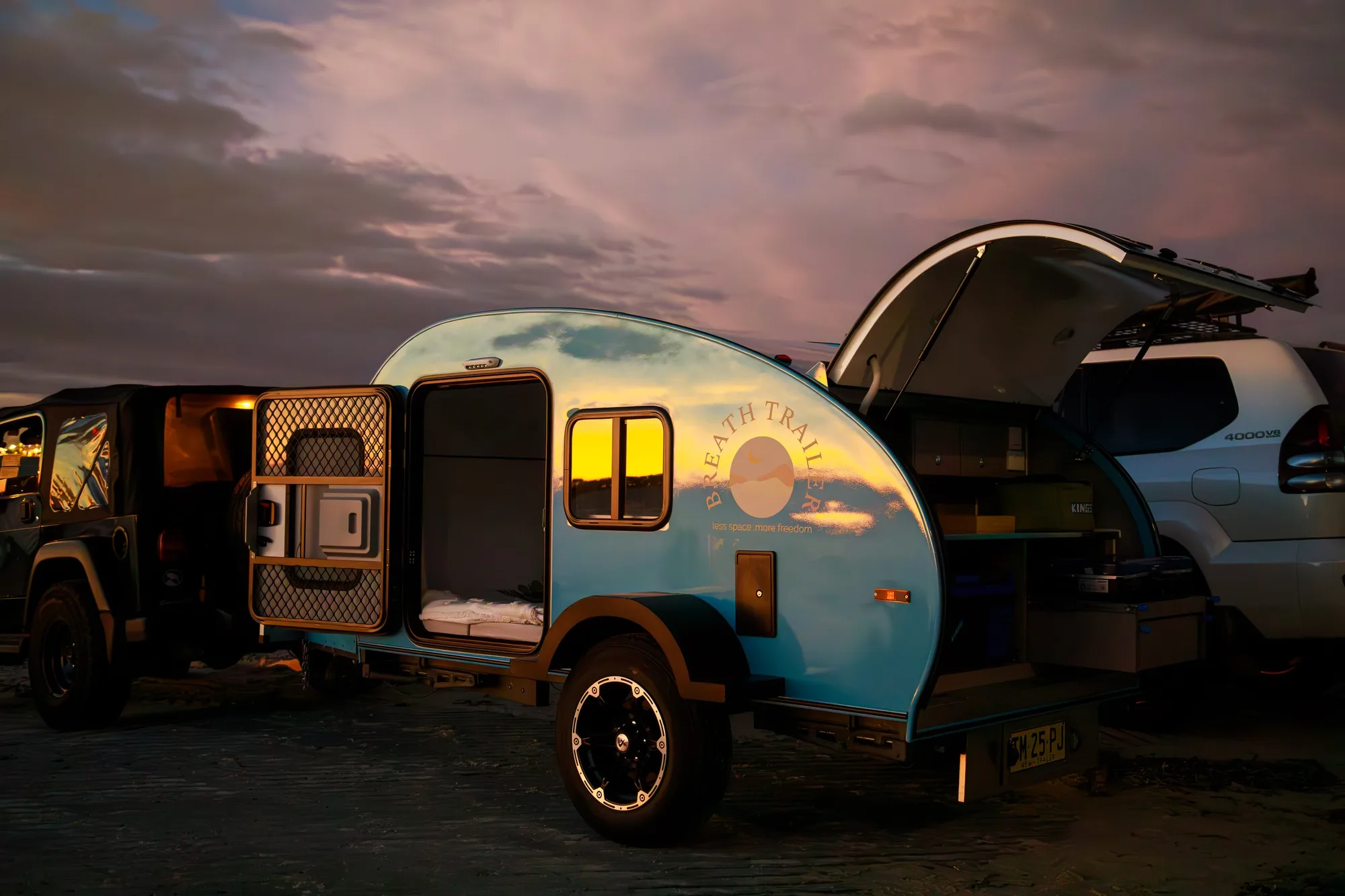
The rear kitchen hatch opens in seconds — no canvas unfolding, no guy ropes, no poles.
Step 5 — Set Up Camp Like You Have Done It Before
Arriving at your campsite and moving efficiently impresses fellow campers and, more importantly, gets you sitting in a chair with a cold drink faster.
- Arrive before dark. Always. Setting up a tent or a trailer by head torch is miserable and leads to mistakes.
- Check ground conditions. Level is more important than perfectly flat. A slight slope toward your feet is acceptable; side-to-side slope is not.
- Face into the prevailing breeze. Your awning/tarp should be on the windward side so it acts as a wind break. If you are in a valley, expect cold air to pool overnight.
- Identify natural shade. Morning sun is welcome; afternoon shade (especially in summer) is essential. Note where the sun will be at 2 pm and orient accordingly.
- Set a “dirty zone” and a “clean zone.” Shoes come off at the trailer door. All food prep happens at a designated surface. All waste goes to a single bag.
- Water before anything else. Fill your drink containers. Know where the campsite water point is. If on tank water, taste it before using it without treatment.
- Check fire restrictions before lighting anything. More on this below.
For a hard-shell teardrop, steps 1–6 typically take under 15 minutes: unhitch, level, extend jockey wheel, connect water if available, open the rear hatch and you are cooking. For a tent-based setup, allow 30–60 minutes for your first few attempts.
Step 6 — Stay Safe in the Australian Bush
Australia’s camping environments can be hazardous for the unprepared. These are not reasons to avoid camping — they are reasons to understand your environment.
Fire restrictions
Every state and territory has a fire danger rating system. Lighting a campfire on a Total Fire Ban (TFB) day is illegal and can result in fines of up to $5,500 (NSW) or $50,000+ for land managers. Before every trip:
- Download your state’s app: Hazards Near Me (NSW), VicEmergency (VIC), MyFireWatch (WA), Fires Near Me (QLD).
- Know the fire danger rating for your destination on the day.
- Have a plan to leave early if conditions deteriorate.
Wildlife
| Hazard | Risk level | Action |
|---|---|---|
| Eastern brown snake | High (most envenomations in AU) | Freeze, don’t run; apply pressure-immobilisation bandage immediately |
| Red-back spider | Moderate | Shake boots and clothing every morning; seek medical attention if bitten |
| Paralysis tick (East Coast, Sep–Jan) | Moderate | Check daily; remove with fine-tip tweezers, never twist |
| Saltwater crocodile (NT, FNQ north of Proserpine) | Serious | Stay 5 m from water’s edge; never camp on river banks |
| Funnel-web spider (Sydney Basin + surrounds) | Moderate | Enclose food, check gear before packing; apply pressure-immobilisation bandage |
The single best safety item for remote camping: an EPIRB or personal locator beacon (PLB). Registering a free account with the Australian Maritime Safety Authority (amsa.gov.au) connects your PLB to emergency services. A GME MT610G costs around $389 and is a one-time purchase that can save your life. Once you are camping more than two hours from mobile coverage, carry one.
Heat and dehydration
Australia’s summers kill more people than any other natural hazard. A minimum of 10 L of water per person per day is recommended for warm conditions; 15 L in temperatures over 35°C. Keep water in jerry cans in the shade, not in a hot car boot.
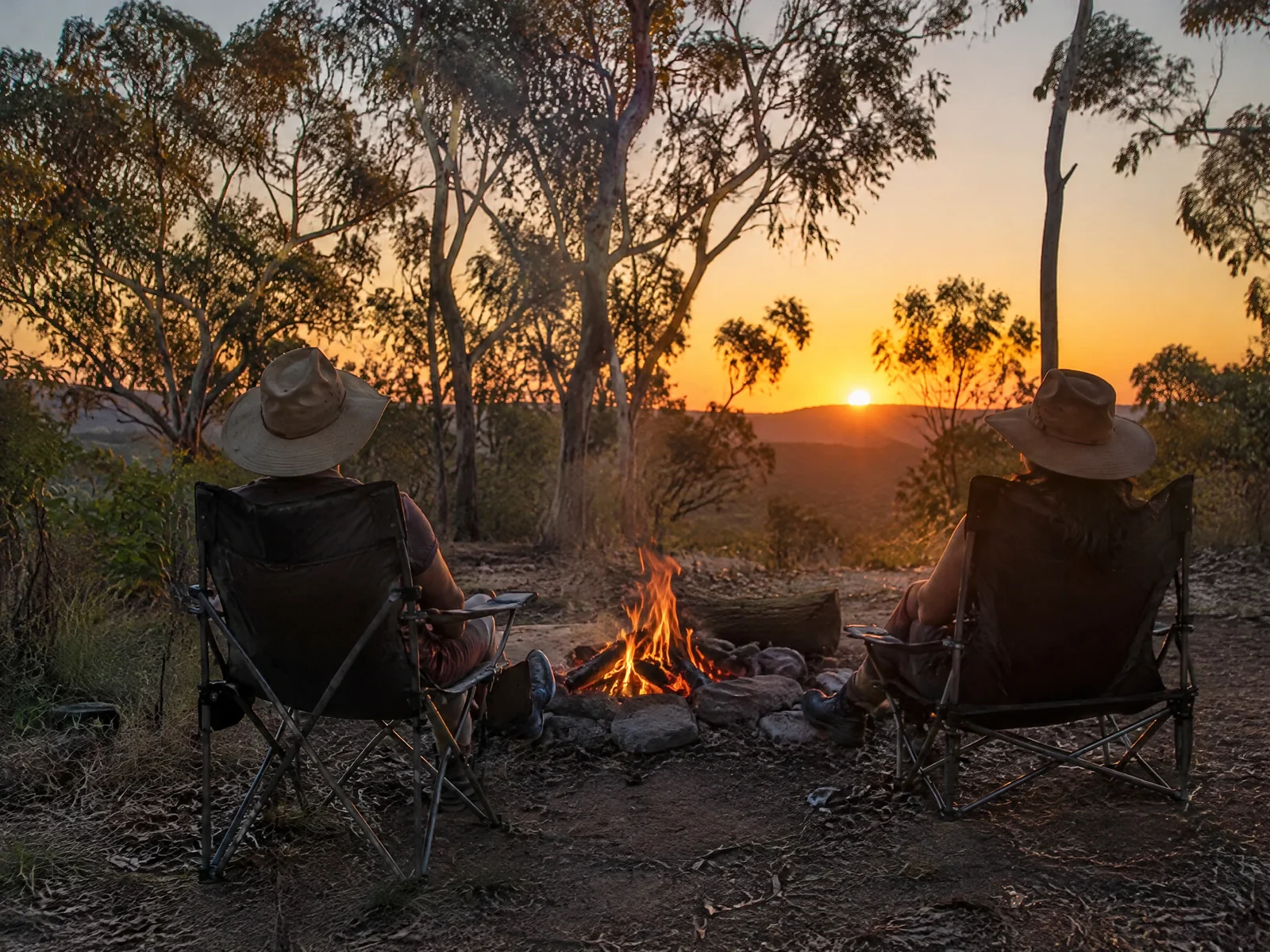
Illustration: An afternoon campfire is one of camping’s great pleasures — just check restrictions before you light one.
Step 7 — Understand Campsite Costs
Camping in Australia can be nearly free or comparable to a budget hotel night, depending on where you go and how you travel.
| Setup | Nightly cost (couple) | Annual cost (10 nights) | Annual cost (30 nights) |
|---|---|---|---|
| Tent + free camping | $0–$18 | ~$100 | ~$300 |
| Tent + national park ($14/adult × 2) | $28 | $280 | $840 |
| Tent + holiday park (powered) | $45–$70 | $500 | $1,650 |
| Hard-shell teardrop + national park | $28 | $280 | $840 |
| Hard-shell teardrop + free camping | $0–$18 | ~$100 | ~$300 |
| Canvas camper trailer + holiday park | $45–$70 | $500 | $1,650 |
The teardrop advantage for frequent campers: a hard-shell trailer without canvas has no annual canvas maintenance cost ($200–$500/year for re-proofing on a canvas unit). Over five years and 30 nights per year, that is $1,000–$2,500 saved on maintenance alone, in addition to the setup time advantage.
For free camping specifically — where you need a self-contained vehicle — the Breath Max’s built-in grey water tank and composting toilet option opens up state forests and crown land across Australia. Read our full guide to Free Camping Australia for state-by-state rules.
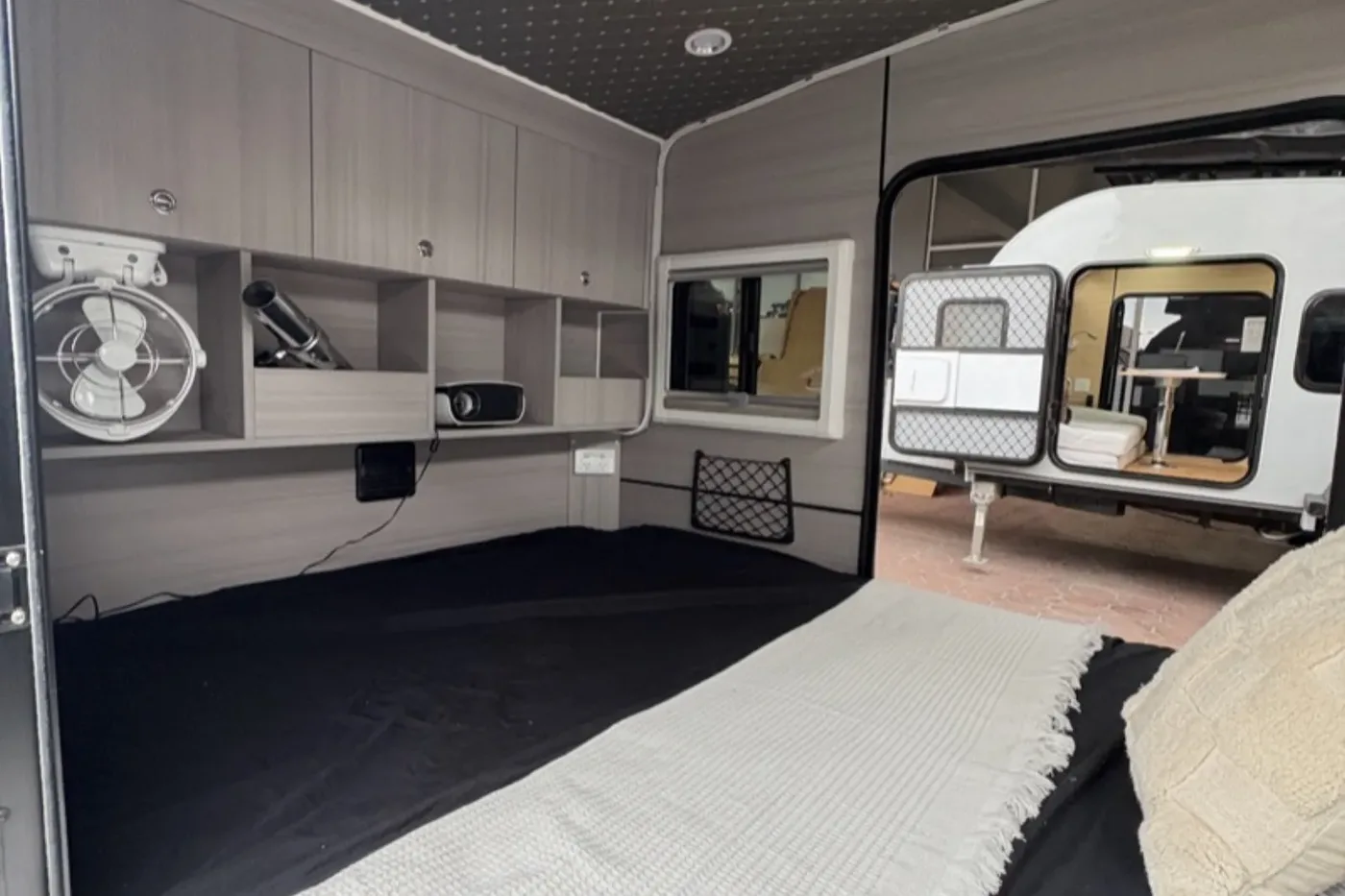
A well-insulated hard-shell keeps you warm in winter and significantly cooler in summer than a tent or canvas.
Step 8 — Campsite Etiquette: The Unwritten Rules
Most campsite conflicts come from people who simply did not know the norms. Follow these and you will be welcomed back.
- Noise: Most campgrounds enforce a 10 pm–7 am quiet period. In national parks it is often stricter. Generator use is typically limited to 7 am–8 pm or 9 pm.
- Generator placement: At least 20 m from neighbouring sites where possible. Run it early, not late.
- Space: Do not set up across the boundary of your allocated site. If you are at a free camp, leave a gap of at least one vehicle length between yourself and other campers.
- Fires: Existing fire rings only. Never ring your own fire. Extinguish fully with water, not just ash-smothered — you should be able to put your hand on the coals.
- Leave No Trace: Pack out everything you bring in. Bury human waste at least 15 cm deep and 50 m from water sources if there are no facilities. Carry a trowel.
- 72-hour rule: Most free camps and rest areas have a 72-hour maximum stay. Move on after three nights.
- Respect wildlife: Do not feed wildlife. Dingoes in Queensland and WA in particular can become aggressive when conditioned to human food. Fines for feeding dingoes at K’gari reach $2,763.
When You Are Ready for a Camper Trailer
If you have done two or three camping trips on this guide and you are thinking “this would be better if I did not have to spend 45 minutes wrestling with a tent in the dark” — you are ready for a camper trailer.
Hard-shell teardrop campers have become the fastest-growing segment of the Australian camping market because they solve the three biggest complaints first-timers have about tent camping: setup time, weather resilience and sleeping comfort.
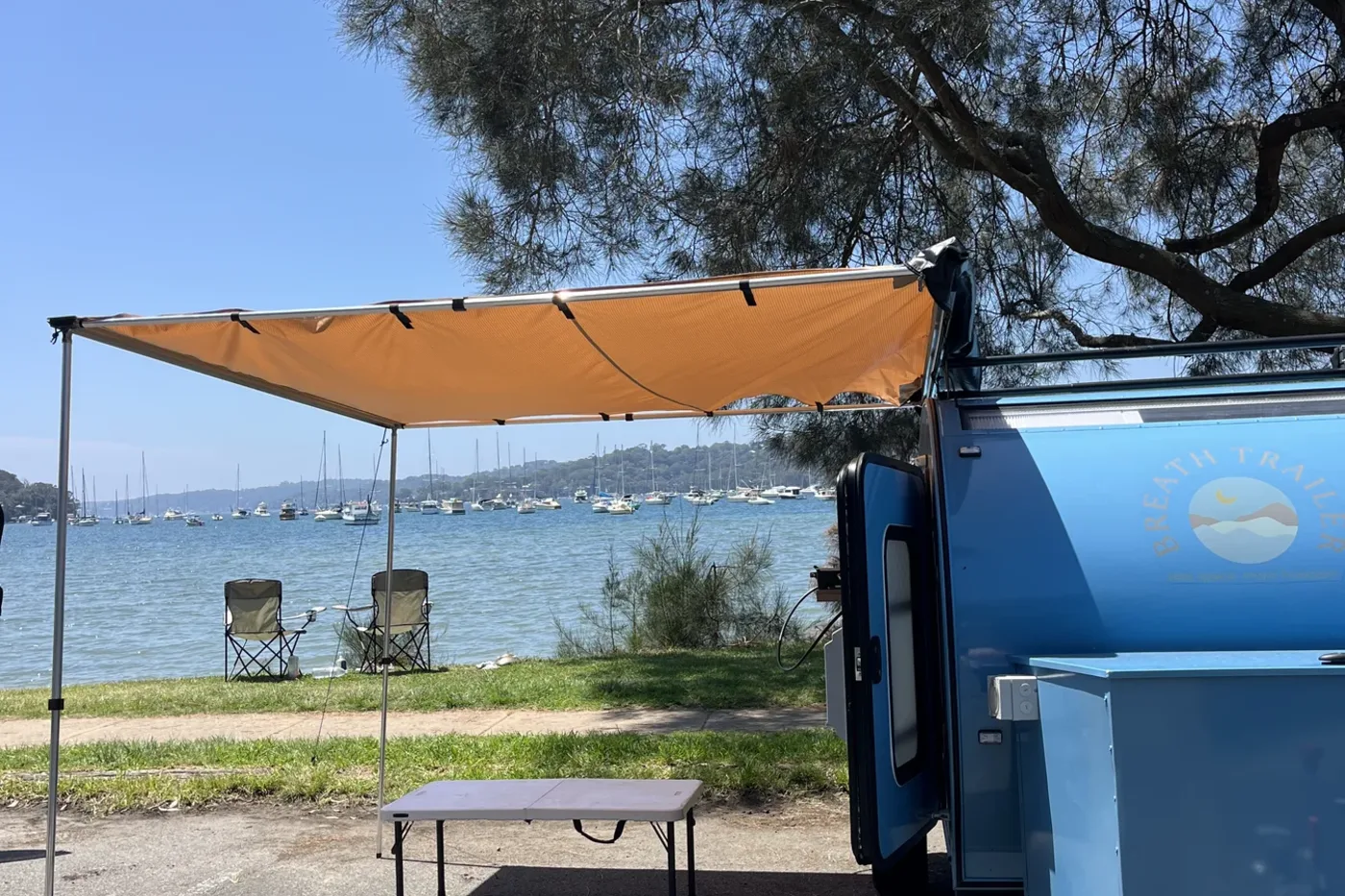
A compact teardrop at a bayside campsite: awning deployed, table out, chairs ready — the whole setup in five minutes.
Breath Trailer manufactures four hard-shell teardrop campers in Sydney, built to Australian conditions:
| Model | Tare weight | ATM | Key features | Price (from) |
|---|---|---|---|---|
| Essential | 700 kg | 900 kg | Queen bed, rear slide-out galley, 12V system | $23,320 |
| Plus | 800 kg | 1,050 kg | As above + 40 L compressor fridge included | $29,766 |
| Ultra | 900 kg | 1,150 kg | As above + external shower, roof rack | $34,749 |
| Max | 1,200 kg | 1,600 kg | As above + full interior bathroom, 2.1 m headroom, self-contained | $42,900 |
All four models are towable by a standard mid-size SUV (Subaru Outback, Toyota RAV4, Mitsubishi Outlander). Setup takes five minutes and requires no assembly or canvas. Choose from 100+ custom colours, delivered from the Sydney workshop in 3–4 months.
For a detailed model comparison, visit the Comparison page or see all models.
5 Mistakes Every First-Time Camper Makes (and How to Avoid Them)
| Mistake | Why it happens | Fix |
|---|---|---|
| Booking a remote, facilities-free site as first trip | ”Adventures are rougher!” | Start at a holiday park or well-equipped national park campground |
| Arriving after dark | Late checkout, underestimating drive time | Add 90 min to Google Maps estimate; target arrival by 4 pm |
| Not checking fire restrictions | Only thinking about gear, not conditions | Add a calendar reminder the night before every trip |
| Overpacking the car (over GVM) | Never weighed the loaded vehicle | Visit a weighbridge. $20. Worth it |
| No backup plan for rain | ”It never rains in October” | Pack a tarp and know your rain plan. It always rains |
Frequently Asked Questions
What is the best campsite type for a complete beginner in Australia? A powered site at a holiday park. You get hot showers, flushing toilets, a nearby camp kitchen, and the ability to plug in a fan or heater. Once you are comfortable with the rhythm of camp life, move to unpowered national park sites.
Do I need a 4WD to go camping in Australia? No. The vast majority of national park campgrounds in Australia are accessible by 2WD. A standard Hyundai Tucson or Toyota Corolla can reach most of the best beginner-friendly campgrounds. A 4WD unlocks more remote destinations but is not a prerequisite for your first trips.
What is a PLB and do I need one? A personal locator beacon (PLB) transmits your GPS coordinates to emergency services when activated. Registration is free with AMSA. From around $389 for a GME MT610G, a PLB is the most important safety item for any camping trip more than two hours from mobile coverage. You can hire them from some outdoor retailers or camping clubs.
How do I find dump points for my camper trailer? The WikiCamps Australia app ($9.99 one-off) and CamperMate (free) both have dump point maps. The CMCA/KEA network operates 500+ affiliated dump point locations nationally. See Camper Trailer Water System Australia for full grey water and dump point guidance.
What insurance do I need for a camper trailer? At minimum: comprehensive caravan and trailer insurance, registered with agreed value. Most policies cover theft, accidental damage and storm. The trailer’s ATM affects the premium — for guidance on what to expect to pay, see Teardrop Camper Insurance Australia.
How much should I budget for a first camping trip? A weekend trip for two at a national park campground costs roughly $60–$90 in site fees. Add food ($80–$150), fuel, and one-time gear costs (tent, sleeping bags, stove: $300–$600 for a quality budget kit). Total for a first trip: around $500–$900 all-in with new gear, or $150–$250 if you already own or borrow the main items.
Recommended Reading
- Camper Trailer Packing List Australia — the complete gear checklist, including weight and space calculations
- Free Camping Australia — State-by-State Guide — rules, apps and best spots for free camping
- Teardrop Camper Towing Tips Australia — pre-trip hitching checklist and reversing technique
- Soft Floor vs Hard Floor Camper Trailer — full canvas vs hard-shell comparison with 5-year TCO
- Is a Teardrop Camper Worth It? — cost-per-trip maths for first-time buyers
Ready to book your first trip? Start with the Breath Trailer model comparison or book a factory viewing in Sydney.