Off-Road Camper vs Hybrid Caravan: 2026 Australian Guide
Off-road camper vs hybrid caravan in Australia: real 2026 prices, ATM and tow vehicle limits, storage heights, fuel costs and who each option truly suits.
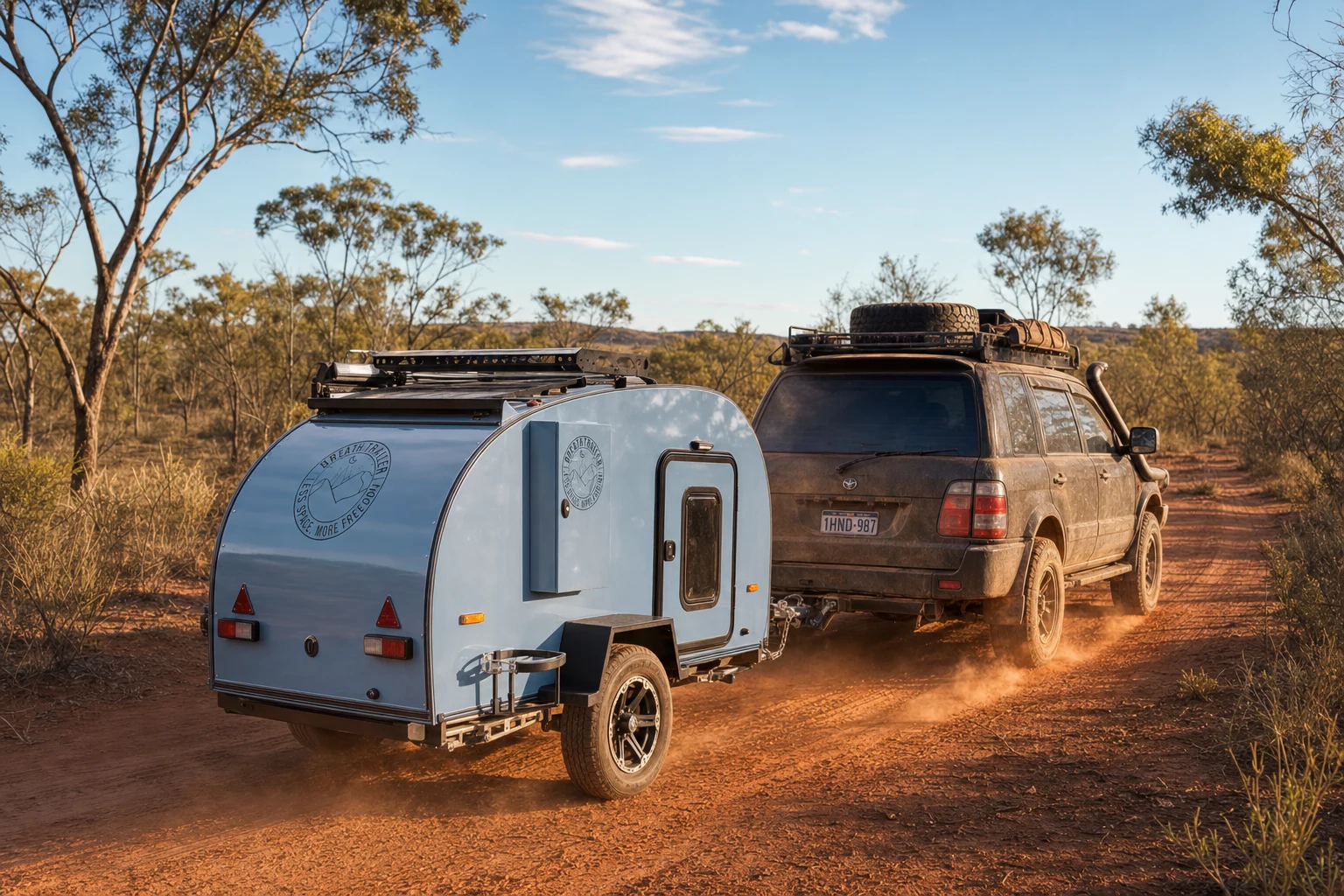
The off-road camper vs hybrid caravan decision is the most expensive fork in the road an Australian traveller faces — and most buyers make it looking at floorplans instead of numbers. In 2026 the average hybrid caravan in Australia costs around $70,000, spans 5.4 to 6.9 metres long, and carries an ATM between 2,250 kg and 3,000 kg. A capable off-road camper trailer sits at $24,000 to $53,000 with a tare closer to 1,600 kg. A hard-shell teardrop lands lower again, from $23,320 at 700 kg.
Those gaps are not just money. They decide which vehicle in your driveway can legally tow the thing, whether it fits under your garage door, how much you burn in diesel at 250.1 cents per litre (the national average on 21 August 2026), and how many tracks you can actually get down once you leave the bitumen.
This guide compares the two categories on the numbers competitors skip: real 2026 prices with named models, tow vehicle eligibility maths, travel height versus Australian garage standards, five-year running costs, and an honest account of where each one wins. If you want the terminology behind the figures first, start with our explainer on teardrop camper weights in Australia.
Off-Road Camper vs Hybrid Caravan: The Short Answer
| If this is you | The better buy | Why |
|---|---|---|
| You tow with a mid-size SUV (RAV4, Forester, CX-5, Tucson) | Off-road camper or hard-shell teardrop | Most hybrids exceed a 1,500–2,000 kg braked towing limit before you load a thing |
| You tow with a dual-cab ute or large 4WD and travel 3+ months a year | Hybrid caravan | The internal ensuite, big water tanks and indoor living space earn their weight on long trips |
| Your rig lives at home in a standard 2.1 m garage or carport | Off-road camper or teardrop | Most hybrids are 2.35–3.13 m tall in travel mode and need paid storage |
| You want remote tracks, tight bush campsites and river crossings | Off-road camper or teardrop | Shorter overall length and lower centre of mass beat interior space on corrugations |
| You travel with kids and need four or five berths | Hybrid caravan | Very few campers and no teardrop sleeps five under a hard roof |
| Fuel and storage costs matter more than floorspace | Off-road camper or teardrop | The five-year gap runs to roughly $16,000 (see the ownership table below) |
There is no universally correct answer. There is a correct answer for your tow vehicle, your driveway and your trip length — and that is what the rest of this article works out.
What Each Category Actually Is in 2026
First, a definition trap worth clearing up: in Australian RV language, a hybrid caravan has nothing to do with a hybrid engine. It is a hybrid of a camper trailer and a caravan — off-road chassis and suspension underneath, hard walls and an internal bed above, usually with a pop-top or fixed roof, an ensuite, and enough tank capacity to sit off-grid for a week.
| Category | Body | Typical ATM | Typical 2026 price | Setup time | Sleeps |
|---|---|---|---|---|---|
| Off-road camper trailer | Hard floor or forward-fold with canvas walls | 1,800–2,500 kg | $24,000–$53,000 | 5–30 min | 2–6 |
| Hybrid caravan | Hard walls, pop-top or fixed roof, internal ensuite | 2,250–3,000 kg | $49,000–$165,000 | Under 10 min | 2–5 |
| Hard-shell teardrop | Full composite hard shell, zero canvas, external or internal galley | 700–1,500 kg | $23,320–$47,190 | ~5 min | 2 |
The third row matters, because most “camper vs hybrid” articles pretend the market has only two options. It does not. The hard-shell teardrop borrows the hybrid’s zero-canvas, hard-walled body and drops the camper trailer’s weight by half — and in the case of the Breath Max, it does it while keeping a full interior bathroom.
Real 2026 Prices: What You Actually Pay
Australian hybrid caravans start around $36,000 and run to $200,000 for fully specified expedition builds, with the market average sitting near $70,000. Here are named, current models with published figures:
| Hybrid caravan (2026) | Price from | Length | Height | ATM |
|---|---|---|---|---|
| Eagle Warrior 10 | $48,990 | 5.42 m | 2.475 m | 2,250 kg (GTM) |
| Fantasy Expedition 14L | $52,990 | 6.10 m | 2.16 m | 2,800 kg |
| Jayco Crosstrak | $55,379 | 6.54 m | 2.60 m | 1,620 kg (tare) |
| Mars Campers 13X MKII | $55,990 | 6.30 m | 2.35 m | 2,990 kg |
| MDC XT12HR MKII | $59,990 | 5.58 m | 3.00 m | 2,800 kg |
| EzyTrail Parkes 15 MK3 Quad | $59,990 | 6.90 m | 2.70 m | 3,000 kg |
| Stoney Creek Scout-14 | $61,990 | 6.85 m | 2.60 m | 2,800 kg |
| Signature Iridium 13 Gen 2 | $64,990 | 5.40 m | 2.36 m | 2,500 kg |
| Austrack Tanami X15L | $65,990 | 6.70 m | 2.65 m | 3,000 kg |
| MDC XT16HR Island (2025) | $69,990 | — | — | — |
| Bruder EXP-4 (MY24) | $126,500 | — | — | — |
| Track Trailer T4 Series 2 | $164,900 | 6.625 m | 2.55 m | 2,850 kg |
Specifications compiled from manufacturer listings and the Ben & Michelle 2026 hybrid caravan roundup.
Now the other side of the ledger:
| Off-road camper / teardrop (2026) | Price from | Tare | Body |
|---|---|---|---|
| Breath Essential | $23,320 | 700 kg | Hard-shell teardrop, 3.9 × 2.0 × 1.6 m |
| CUB Weekender | $23,990 | — | Australian-made fold |
| Breath Plus | $29,766 | 800 kg | Hard shell, fridge and solar included |
| CUB Explorer | $26,990 | — | Australian-made fold |
| Breath Ultra | $34,749 | 900 kg | Hard shell, external shower, awning, 2 × 80 L water |
| Breath Max | $47,190 | 1,200 kg | Hard shell with interior bathroom, 2.1 m standing height |
| CUB Frontier | $47,990 | — | Forward fold, hard floor |
| EzyTrail Stirling GT MK2 | ~$40,000s | 1,600 kg | Forward fold, ATM 2,250–2,500 kg |
| CUB Drifter | $52,990 | — | Hard floor |
The headline is blunt: the dearest Breath model costs $6,090 less than the cheapest hybrid caravan in the table above, and weighs roughly a third as much loaded.
Weight and Tow Vehicle: The Question That Decides It for Most Buyers
This is where the off-road camper vs hybrid caravan choice is usually settled before anyone gets to talk about layouts. A hybrid caravan at 2,800 kg ATM is not a “bit heavier” than a camper trailer — it is a different licensing class of tow job.
The number on your tow bar sticker is a legal ceiling, not a comfort zone. Experienced tourers apply the 80% rule: keep the loaded trailer under 80% of your braked towing capacity for sane stopping distances on a wet Hume.
| Tow vehicle | Braked towing capacity | 80% practical limit | Hybrid caravan (2,500–3,000 kg)? | Off-road camper (1,800–2,500 kg)? | Hard-shell teardrop (700–1,500 kg)? |
|---|---|---|---|---|---|
| Toyota RAV4 Hybrid | 1,500 kg | 1,200 kg | ✗ No | ✗ No | ✓ Yes |
| Subaru Forester 2.5i | 1,500 kg | 1,200 kg | ✗ No | ✗ No | ✓ Yes |
| Hyundai Tucson (diesel) | 1,650 kg | 1,320 kg | ✗ No | ✗ No | ✓ Yes |
| Mazda CX-5 2.5 Turbo | 2,000 kg | 1,600 kg | ✗ No | ✗ Marginal | ✓ Yes |
| Kia Sorento (diesel) | 2,000 kg | 1,600 kg | ✗ No | ✗ Marginal | ✓ Yes |
| Mitsubishi Pajero Sport | 3,000 kg | 2,400 kg | ✗ Marginal | ✓ Yes | ✓ Yes |
| Ford Everest | 3,100 kg | 2,480 kg | ✓ Marginal | ✓ Yes | ✓ Yes |
| Ford Ranger / Toyota HiLux | 3,500 kg | 2,800 kg | ✓ Yes | ✓ Yes | ✓ Yes |
| Isuzu MU-X | 3,500 kg | 2,800 kg | ✓ Yes | ✓ Yes | ✓ Yes |
Read the columns rather than the rows. Six of the nine most common Australian tow vehicles cannot legally tow a typical hybrid caravan — and every single one of them can tow a hard-shell teardrop.
The GCM trap nobody mentions in the showroom
Even when your vehicle is rated to 3,500 kg, Gross Combined Mass (GCM) usually stops you using it. GCM caps the vehicle at GVM plus the trailer at ATM, and the two numbers rarely add up.
| Worked example: Nissan Navara ST-X | Figure |
|---|---|
| Kerb weight | 1,921 kg |
| GVM | 2,910 kg |
| GCM | 5,910 kg |
| Towing a 3,500 kg van leaves for people, gear and accessories | 489 kg |
| Typical tow ball weight of that van (8–15% of ATM) | 300–350 kg |
| Payload left after tow ball download alone | ~139–189 kg |
Two adults and a full tank of diesel will eat that. As carsales has documented, a large share of Australian caravans on the road are overweight and their owners have no idea — which also means their insurance would not respond in a claim. Our camper trailer towing guide walks through the full calculation for your own rig.
By contrast, a 900 kg Breath Ultra carries a tow ball weight around 90 kg. That difference — roughly 250 kg of reclaimed vehicle payload — is worth more on a long trip than any floorplan feature.
Height, Length and the Storage Problem Nobody Mentions
Here is the cost that never appears in a brochure. The standard Australian garage door is 2,100 mm high. Taller 2,400 mm and 2,700 mm doors exist, and purpose-built caravan doors are typically 3,000 × 2,500 mm — but almost no suburban home has one.
| Rig | Travel height | Fits a standard 2.1 m garage? | Storage cost |
|---|---|---|---|
| Breath Essential / Plus | 1.60 m | ✓ Yes | $0 |
| Breath Ultra | 1.85 m | ✓ Yes | $0 |
| Folded off-road camper trailer | 1.5–1.8 m | ✓ Usually | $0 |
| Breath Max | 2.35 m | ✗ Needs a 2.4 m door | $0 if a carport or 2.4 m door |
| Fantasy Expedition 14L (lowest hybrid) | 2.16 m | ✗ No | $35–50/week |
| Typical hybrid caravan | 2.35–2.70 m | ✗ No | $35–50/week |
| Jayco CrossTrak 17.51-5 (MY26) | 3.135 m travel height, 7.855 m travel length | ✗ No | $45–60/week |
Paid caravan storage in Australia runs $22 to $60 a week — around $35/week open-air, $45/week undercover, $50/week undercover with power. At $45 a week, that is $2,340 a year and $11,700 over five years for a rig you use six weekends and one long trip annually.
The Jayco CrossTrak’s published travel height of 3,135 mm also has a second consequence: shopping-centre carparks, drive-throughs, low-clearance ferries and overhanging bush tracks all become obstacles. A 1.6 m teardrop sits below the roofline of the 4WD towing it, which means if the vehicle fits, the trailer fits.
Setup Time and How You Actually Travel
Both categories have moved fast here. Modern hybrids pop the roof in under two minutes and are camp-ready in under ten. Traditional canvas camper trailers still take 20–30 minutes, though the best quick-setup models are under five. Hard-shell teardrops are effectively instant — around five minutes on every Breath model, because there is nothing to unfold.
But setup time only matters because of what it lets you do:
| Travel style | What it demands | Best fit |
|---|---|---|
| One-night hops on a relocation leg (300–400 km/day) | Sub-10-minute setup, no canvas to dry | Hybrid or hard-shell teardrop |
| Base camp for 3–5 nights, day trips from there | Ability to detach fast and drive the tow vehicle unencumbered | Any — but detach time decides |
| Remote free camping | Water, power, and legal self-containment | Hybrid or Breath Max |
| Wet-weather touring | No canvas to pack away soaked | Hybrid or hard-shell teardrop |
The canvas issue is the honest weak point of traditional camper trailers, and we cover it in detail in soft floor vs hard floor camper trailers: re-proofing and repairs typically cost $200–$500 a year, and packing wet canvas is how mould claims start.
Fuel and Running Costs Over 10,000 km
Towing increases fuel use by 30–50% depending on trailer size, road conditions and driving style. Height and frontal area matter as much as mass — which is why a 2.6 m hybrid punishes you harder than its weight alone suggests.
The figures below model a diesel 4WD wagon returning 9.5 L/100 km solo, at the national average diesel price of 250.1 c/L recorded on 21 August 2026 by the ACCC’s weekly fuel price monitoring. Treat them as indicative modelling rather than measured test results — your rig, right foot and headwind will move them.
| Configuration | Est. L/100 km | Fuel over 10,000 km | Fuel over a 25,000 km lap |
|---|---|---|---|
| Tow vehicle alone | 9.5 | $2,376 | $5,940 |
| + hard-shell teardrop (1.6–1.85 m high) | 12.0 | $3,001 | $7,503 |
| + off-road camper trailer (folded, ~1,600 kg) | 13.5 | $3,376 | $8,441 |
| + hybrid caravan (2.6 m, ~2,800 kg) | 15.5 | $3,877 | $9,691 |
Over a single lap of Australia, the fuel gap between a teardrop and a hybrid is roughly $2,190. Over five years of typical touring it compounds — and it stacks on top of the storage line above.
Five-year ownership cost, side by side
| Cost over 5 years | Off-road camper trailer | Hard-shell teardrop (Ultra) | Hybrid caravan |
|---|---|---|---|
| Purchase price | $47,990 | $34,749 | $69,990 |
| Towing fuel above solo driving (50,000 km) | $5,002 | $3,126 | $7,503 |
| Storage (fits standard garage?) | $0 | $0 | $11,700 |
| Canvas care and re-proofing | $1,000–$2,500 | $0 | $0–$1,000 |
| Five-year total (indicative) | $53,992–$55,492 | $37,875 | $89,193–$90,193 |
The spread between the cheapest and dearest column is roughly $52,000 — enough to fund the entire trip most people buy the rig for. For a broader breakdown by weight class, see lightweight vs heavy camper trailers.
Off-Road Capability: Where the Categories Really Split
Both categories advertise independent coil suspension, off-road couplings and all-terrain tyres. The difference is geometry and mass, not brochure hardware.
| Factor | Off-road camper trailer | Hybrid caravan | Hard-shell teardrop |
|---|---|---|---|
| Overall length | 4.5–6.0 m | 5.4–7.9 m (travel) | 3.9–4.5 m |
| Reversing into tight bush sites | Manageable | Difficult | Easy |
| Centre of mass | Low when folded | High (walls, roof, ensuite) | Very low |
| Corrugation load on chassis | Moderate | High — mass amplifies every hit | Low |
| Water crossings | Good | Depends on the build | Good |
| National park sites with length caps | Usually fits | Often excluded | Always fits |
Mass is the quiet villain on corrugated roads: every kilogram is a kilogram being slammed into the chassis a few times a second for 200 km. That is why suspension quality matters more on an off-road camper trailer than almost any other component — and why the lighter rig survives the Gibb River Road with less rattled hardware.
Where Hybrid Caravans Genuinely Win
An honest comparison has to concede the wins, and hybrids have real ones.
| Hybrid advantage | Why it matters |
|---|---|
| Internal ensuite with a proper shower | A hot shower behind a door, not a bag under an awning — the single biggest comfort upgrade for long trips |
| Indoor living space | Three wet days in the Otways with a book and a heater beats three wet days in a swag |
| 4–5 berths | Families with two or three kids have almost no teardrop options |
| 150–200 L water tanks | Longer off-grid range without a resupply run |
| Bigger battery and solar systems | 48 V lithium packs around 5 kWh with 4 kW inverters are now available factory-fitted |
| Full-size fridge and internal kitchen | Cooking indoors in the rain or in blackfly country |
If you are travelling six months a year with a family, those advantages are not luxuries — they are the reason the trip stays enjoyable past week three. That is the honest case for spending $70,000 and towing with a ute.
Where a Hard-Shell Teardrop Sits Between the Two
The teardrop is not a compromise category — it takes the hybrid’s hard-walled, zero-canvas body and the camper trailer’s weight and access, then accepts a smaller footprint in exchange.
| Model | Price | Tare | Dimensions (L × W × H) | Water | Bathroom | Tows behind |
|---|---|---|---|---|---|---|
| Breath Essential | $23,320 | 700 kg | 3.9 × 2.0 × 1.6 m | 80 L | None | Any modern SUV |
| Breath Plus | $29,766 | 800 kg | 3.9 × 2.0 × 1.6 m | 80 L | External shower | Any modern SUV |
| Breath Ultra | $34,749 | 900 kg | 3.9 × 2.0 × 1.85 m | 2 × 80 L | External shower | Any modern SUV |
| Breath Max | $47,190 | 1,200 kg | 4.5 × 2.1 × 2.35 m | 2 × 80 L | Interior toilet + shower, 2.1 m standing height | Mid-size SUV or larger |
The Max is the interesting one in this comparison: it is the only teardrop on the Australian market under $50,000 with a full interior bathroom, which puts it in direct competition with hybrids costing about $23,000 more — at less than half their loaded weight. Combined with 160 L of onboard water, that is what makes it genuinely self-contained for free camping.
What it does not do: sleep four, give you an indoor lounge, or carry 200 L of water. Those remain hybrid territory, and no amount of marketing changes it.
Five Mistakes Buyers Make Choosing Between the Two
| Mistake | What it costs you |
|---|---|
| Shopping floorplans before checking GCM | A signed contract on a van your ute cannot legally tow loaded |
| Assuming “3,500 kg braked” means you can tow 3,500 kg | Tow ball download alone can consume 300–350 kg of vehicle payload |
| Forgetting storage in the budget | $11,700 over five years, invisible at purchase |
| Buying for the once-a-year trip, not the twelve weekends | An oversized rig that never leaves the storage yard |
| Ignoring travel height | Blocked carparks, low-clearance ferries and a garage you can no longer use |
Which One Should You Buy? A Decision Path
- Check your GCM first, not your towing capacity. Subtract the trailer’s ATM from your GCM, then subtract your vehicle’s kerb weight. What is left is what you can carry — people included.
- Measure your garage door. If it is 2,100 mm and you are not prepared to pay $35–60 a week forever, most hybrids are out.
- Count the berths you actually need. Two adults? Everything is open. Four or five? You are shopping hybrids.
- Count your nights per year. Under 30 nights, the hybrid’s comfort premium is hard to justify against the ownership cost. Over 90 nights with a family, it starts paying for itself.
- Decide on the bathroom. If a private, plumbed toilet and shower is non-negotiable, your choices narrow to a hybrid caravan or the Breath Max.
- Weigh the loaded rig on a public weighbridge before your first long trip — whichever you buy.
Work through those six in order and the decision usually makes itself. Our model comparison page lays the four Breath configurations side by side if a hard-shell teardrop is the direction you land on, and the Big Lap preparation guide covers what changes when the trip runs to months rather than weekends.
Frequently Asked Questions
Is a hybrid caravan better than an off-road camper trailer? Neither is universally better. A hybrid caravan gives you hard walls, an internal ensuite and 4–5 berths for roughly $70,000 and 2,500–3,000 kg ATM. An off-road camper trailer gives you lighter towing, easier access to remote sites and free home storage for $24,000–$53,000. The right answer depends on your tow vehicle’s GCM, your storage situation and how many nights a year you actually travel.
Can a mid-size SUV tow a hybrid caravan in Australia? Almost never. Common mid-size SUVs are rated between 1,500 kg and 2,000 kg braked, and typical hybrid caravans carry an ATM of 2,250–3,000 kg. Even applying no safety margin, the numbers do not work. A hard-shell teardrop at 700–1,200 kg tare is the practical option for a RAV4, Forester, CX-5, Tucson or Sorento.
Does a hybrid caravan fit in a normal Australian garage? Rarely. The standard Australian garage door is 2,100 mm high, and hybrid caravans typically measure 2.16–2.70 m in travel mode, with some full-height models over 3 m. Expect to budget $22–$60 a week for external storage — around $2,340 a year at the $45/week undercover rate.
How much more fuel does a hybrid caravan use than a camper trailer? Towing adds 30–50% to fuel consumption overall, and taller, heavier trailers sit at the top of that band. On indicative modelling at 250.1 c/L, a hybrid costs roughly $876 more than a hard-shell teardrop over 10,000 km, and about $2,190 more over a 25,000 km lap of Australia.
Is a hybrid caravan the same as a hybrid-powered vehicle? No. In Australian RV terminology, “hybrid” describes a body style — a cross between a camper trailer and a caravan — not a drivetrain. Hybrid caravans have no engine and no electric motor; the name refers to hard walls on an off-road camper chassis.
What is the cheapest way to get an interior toilet and shower? The cheapest hybrid caravans with an internal ensuite start around $49,000–$56,000 at 2,250–2,800 kg ATM. The Breath Max delivers an interior toilet and shower with 2.1 m standing headroom at $47,190 and 1,200 kg tare, which is why it is often the answer for buyers who want the bathroom without the tow vehicle upgrade.
Recommended Reading
- Caravan vs Teardrop Camper in Australia — the full-size caravan side of the same question
- Small Camper Trailer vs Large Caravan — sizing, access and campsite reality
- How to Choose the Right Off-Road Camper Trailer — a build-quality checklist before you sign
- Breath Trailer vs Patriot Campers — an honest brand-to-brand price comparison
- Complete Guide to Camper Trailer Power Systems — batteries, solar and inverters explained
Choosing between an off-road camper and a hybrid caravan comes down to three numbers most buyers never check: your GCM, your garage door height, and your nights on the road per year. Get those right and the rest is preference. If a hard-shell body without the hybrid’s weight is what you are after, compare the four Breath models or book a viewing to see one in person before you commit.