Small Camper Trailer vs Large Caravan: The Honest 2026 Guide for Australians
Small camper trailer vs large caravan Australia 2026: purchase price, tow vehicle, running costs, 5-yr TCO, off-road access and free camping — the numbers honest buyers need.
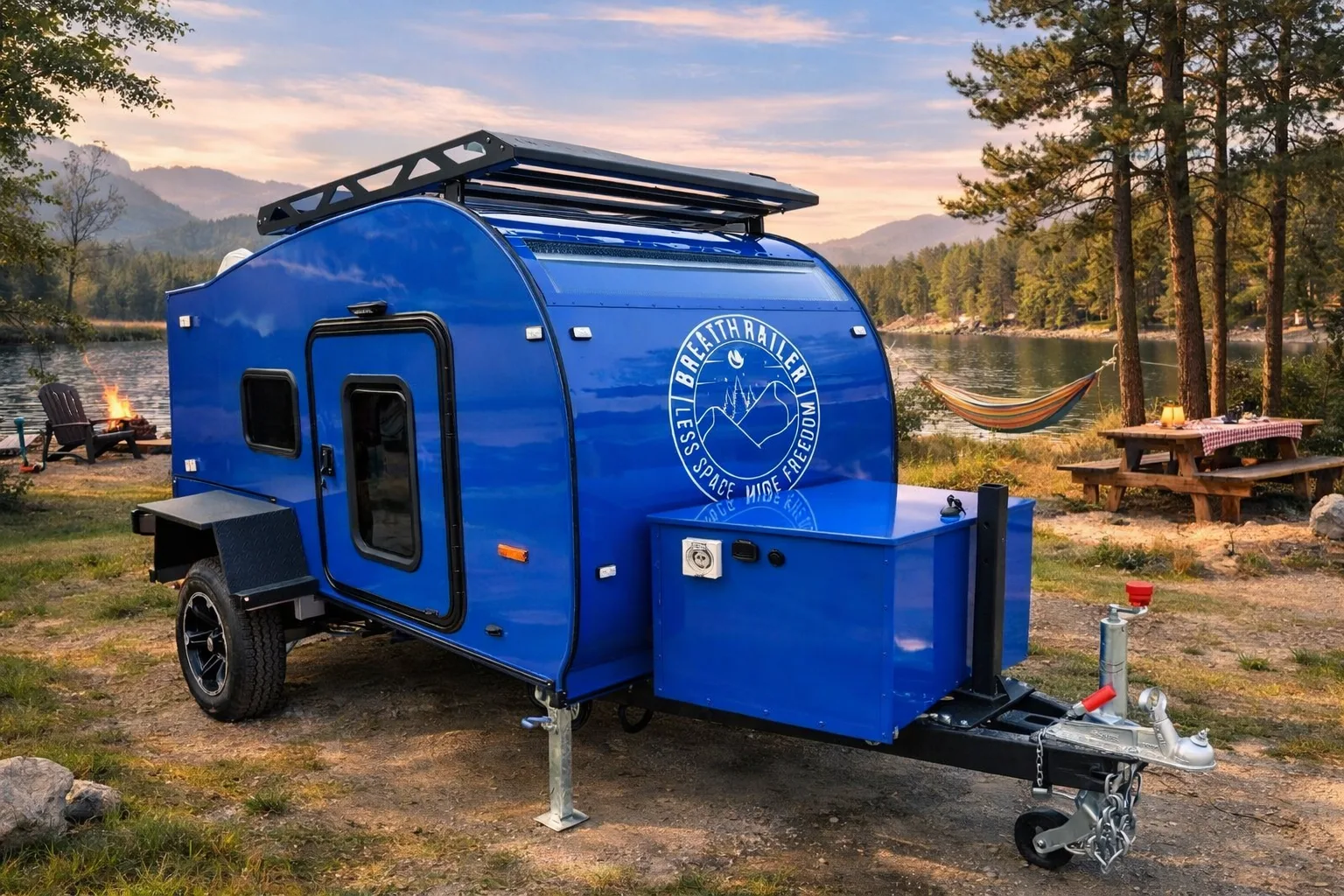
Two Australians walk into the same caravan show. One leaves with a 23-foot touring van and a finance contract. The other leaves with a compact hard-shell teardrop and the keys already in hand. Five years later, the first person has spent roughly $180,000 all up — purchase price, interest, tow vehicle upgrade, storage, insurance, registration, and fuel penalty — and used the van about forty nights. The second has spent $58,000 and logged over 200 nights of camping.
Neither decision is irrational. But the gap in outcome is predictable — and the comparison most buyers are shown at dealerships glosses over the numbers that actually matter.
This guide runs the honest side-by-side comparison of small camper trailers versus large caravans in Australia in 2026: what they cost to buy, what they cost to run, what vehicles they need, where they can go, and which setup genuinely suits which buyer.
Quick Comparison: Small vs Large at a Glance
| Small camper trailer (teardrop/hard-shell) | Large caravan (18–25 ft) | |
|---|---|---|
| Purchase price (AUD) | $19,990–$39,000 | $75,000–$150,000+ |
| Tare weight | 500–1,200 kg | 2,000–3,500 kg |
| ATM (max loaded) | 700–1,400 kg | 2,500–4,000 kg |
| Tow vehicle required | Mid-size SUV ($35k–$55k) | Diesel ute / large 4WD ($55k–$110k+) |
| Fuel penalty (L/100 km) | +1–2 L | +5–8 L |
| Setup time | 3–5 minutes | 20–60 minutes |
| Garage-storable | Yes (most models) | No — needs commercial storage |
| Storage cost/year | $0 (home garage) | $1,800–$3,600/year |
| Annual rego + insurance | ~$450–$850 | ~$900–$2,100 |
| Interior bathroom | Breath Max ($39k) only | Standard on most models |
| Free camping (self-contained) | Breath Max — yes | Varies by model and fitout |
| Off-road trail access | Excellent | Limited to sealed/graded roads |
| Length | 3.5–5.0 m | 5.5–8.0 m |
The single number most people don’t run before buying: cost per night used. A $120,000 caravan taken out 20 nights a year costs $6,000 a night before you factor in fuel. A $30,000 teardrop used 60 nights a year costs $500 a night — and every year you use it more, that number falls.
What “Small” and “Large” Actually Mean in Australia
Terminology matters, because “camper trailer” covers everything from a canvas swag-on-wheels to a hard-shell pod that sleeps two in air-conditioned comfort.
Small camper trailers (under ~1,400 kg ATM) include:
- Teardrop campers — hard-shell, 500–1,200 kg, fixed queen or double bed, galley kitchen at rear, no or optional bathroom. Price range: $19,990–$45,000.
- Soft-floor/canvas camper trailers — pop-out canvas sleeping quarters, often with an annexe. Weight typically 400–900 kg. Price range: $10,000–$28,000.
- Forward-fold/hard-floor camper trailers — hard-shell sleeping pod folds down for towing, opens into a larger sleeping area. Weight 600–1,400 kg. Price range: $18,000–$40,000.
Large caravans (over ~1,800 kg ATM) include:
- Pop-top caravans — hard floor, roof raises for transit. ATM 1,400–2,200 kg. Entry: ~$36,000.
- Full-height caravans — typical family touring van, 18–25 feet long. ATM 2,200–3,500 kg. Price: $60,000–$150,000.
- Off-road caravans — heavy-duty chassis, airbag suspension, large-bore tyres. ATM often 2,800–4,000 kg. Price: $80,000–$200,000+.
This guide compares the teardrop / compact hard-shell category (the fastest-growing segment in Australia) against full-height caravans 18 feet and over — the traditional family touring van that most buyers picture when they say “caravan.”
For a deeper look at weight categories within the camper trailer world, see our teardrop camper weight guide for Australia.
Purchase Price — The Obvious Gap and What’s Hidden Beneath It
Large caravans in 2026
Entry-level Jayco Journey pop-top: from $36,000 drive-away. That gets you a 12-foot caravan with no off-road capability, no air-conditioning, and a basic kitchen. Step up to a Jayco Silverline or Coromal Element and you’re at $65,000–$90,000. A premium off-road build from Lotus Caravans, Avida, or Newlands pushes $100,000–$150,000 before options.
The average Australian caravan purchase in 2026 sits around $75,000–$90,000 for a full-height model with the features buyers actually want — air-con, ensuite, separate bedroom zone.
Small hard-shell camper trailers in 2026
| Model | Price (AUD) | ATM | Bathroom |
|---|---|---|---|
| Breath Essential | $19,990 | 700 kg | External — caravan park |
| Breath Plus | $25,740 | 800 kg | External — caravan park |
| Breath Ultra | $30,290 | 900 kg | External shower included |
| Breath Max | $39,000 | 1,200 kg | Full interior bathroom + toilet |
| JAG Glider | ~$22,000–$27,000 | 550–700 kg | No |
| Cool Beans Campers | $28,000–$38,000 | 750–1,000 kg | Optional |
The Breath Max at $39,000 is the only teardrop on the Australian market under $50,000 with a full interior bathroom — making it genuinely competitive with entry caravans on the amenity front, at roughly half the price of a comparably specced van.
The purchase price gap is $35,000–$80,000. But that’s before the second purchase most caravan buyers have to make.
Tow Vehicle Cost — The Number Dealers Don’t Mention
This is the most expensive comparison point in any camper purchase, and the one most consistently skipped in showroom conversations.
What a small trailer needs
A teardrop or compact hard-shell under 1,200 kg ATM can be towed by virtually any mid-size SUV in Australia’s current market:
| Vehicle | Braked towing capacity | Price new |
|---|---|---|
| Toyota RAV4 (diesel/hybrid) | 1,500–2,000 kg | $41,000–$56,000 |
| Mazda CX-5 (diesel) | 2,000 kg | $42,000–$55,000 |
| Hyundai Tucson (diesel) | 1,650 kg | $37,000–$50,000 |
| Mitsubishi Outlander | 1,500–2,000 kg | $35,000–$52,000 |
| Kia Sorento (diesel) | 2,000 kg | $43,000–$62,000 |
Many buyers towing a teardrop can use the car they already own. That $0 upgrade is enormous.
What a large caravan needs
A full-height caravan at 2,500–3,500 kg ATM requires a diesel ute or large 4WD with a high braked towing rating — and ideally rated well above the van’s ATM to allow a safety margin:
| Vehicle | Braked towing capacity | Price new |
|---|---|---|
| Toyota LandCruiser 300 | 3,500 kg | $109,000+ |
| Ford Ranger (3.0 V6 diesel) | 3,500 kg | $56,000–$75,000 |
| Toyota HiLux (diesel) | 3,500 kg | $55,000–$72,000 |
| RAM 1500 TRX | 4,535 kg | $180,000+ |
| Toyota LandCruiser Prado 250 | 3,500 kg | $79,000+ |
If you don’t already own one of these vehicles, add $55,000–$110,000 to the true cost of buying a large caravan. That’s before you start driving it.
Combined purchase cost (trailer + tow vehicle):
- Teardrop + existing car: $25,000–$39,000
- Large caravan + new ute: $125,000–$230,000+
For a full breakdown of what tow vehicles pair with which trailer sizes, see our camper trailer towing guide for Australia.
Annual Running Costs — The Gap That Grows Every Year
Registration
In most Australian states, registration is based on tare weight (sometimes ATM). Using NSW as a benchmark:
| Vehicle | Annual rego (approx.) |
|---|---|
| 700 kg teardrop | ~$150–$200 |
| 1,200 kg teardrop | ~$200–$280 |
| 2,500 kg caravan | ~$400–$560 |
| 3,500 kg caravan | ~$550–$750 |
Insurance
| Type | Annual premium (agreed value, 2026) |
|---|---|
| Teardrop <$30k | $250–$450 |
| Teardrop $30–$40k | $350–$600 |
| Caravan $75k | $700–$1,200 |
| Caravan $120k | $1,000–$1,800+ |
For details on what affects teardrop insurance premiums, read our teardrop camper insurance guide for Australia.
Storage
A teardrop fits in a standard Australian double garage (usually under 5 metres long). Cost: $0.
A 20-foot caravan does not. Commercial storage runs $150–$300 per month in capital cities — or $1,800–$3,600 per year, indefinitely. Over a 10-year ownership period, that’s $18,000–$36,000 in storage fees alone, not including the hassle of travelling to collect it each trip.
Fuel penalty
At 2.00 AUD/L diesel and 7,500 km towed per year:
| Trailer type | Fuel penalty | Annual extra fuel cost |
|---|---|---|
| 700–900 kg teardrop | +1.5 L/100 km | ~$225 |
| 1,200 kg teardrop | +2.0 L/100 km | ~$300 |
| Pop-top (~1,800 kg ATM) | +4.0 L/100 km | ~$600 |
| Large caravan (2,500 kg+) | +6.0 L/100 km | ~$900 |
| Large off-road caravan (3,500 kg) | +8.0 L/100 km | ~$1,200 |
These numbers scale hard over long-distance touring. A 10,000 km Big Lap segment with a large caravan at +6 L/100 km adds $1,200 in fuel penalty over the same trip with a teardrop.
Five-Year Total Cost of Ownership
This table captures the most honest comparison available. It assumes 7,500 km towed per year, $0 interest on a cash purchase (if financed, add interest costs to the caravan column), and realistic usage patterns.
| Cost item | Teardrop (Breath Plus $25,740) | Large caravan ($85,000 Jayco) |
|---|---|---|
| Purchase price | $25,740 | $85,000 |
| Tow vehicle upgrade | $0 (RAV4 sufficient) | $30,000–$55,000 |
| Rego × 5 years | $1,000 | $2,500 |
| Insurance × 5 years | $2,000 | $5,000 |
| Storage × 5 years | $0 | $9,000–$18,000 |
| Fuel penalty × 5 years | $1,500 | $4,500 |
| Servicing × 5 years | $1,000 | $2,000 |
| Total 5-year cost | ~$31,000–$32,000 | ~$108,000–$171,000 |
The gap is $77,000–$139,000 over five years — the difference between a modest investment in weekend freedom and a major financial commitment that, for many families, doesn’t deliver proportionally more value.
Setup Time and Camping Convenience
Setup is the daily experience of camping, and it’s one of the biggest lifestyle differentiators.
Small hard-shell camper trailer (teardrop):
- Pull up on site
- Unhitch or leave hitched
- Open the galley hatch
- Open the roof ventilation
- You’re done — about 3–5 minutes
No poles. No canvas. No annexe pegs. No tent flooring to unroll. Arrive at 8 pm after a long drive and you’re in bed by 8:10.
Large caravan (full-height):
- Level the van on site (chocks, stabiliser legs, auto-levelling if equipped)
- Slide out the annexe awning and peg it
- Connect water, power (or set up solar)
- Set up the outdoor furniture
- Connect the grey water hose
Realistic setup: 30–90 minutes, depending on the site and the occupants. Pack-down on a cold morning is similarly involved. For retirees doing long-haul touring with weeks between sites, this overhead is manageable. For weekend escape buyers who arrive Friday night after work, it’s often the thing that kills camping frequency.
Off-Road Access — Where You Can Actually Go
Australia’s best free camping and most remote national parks are behind tracks that exclude large caravans.
Small camper trailers have a physical advantage that money can’t buy: they’re short enough to negotiate single-lane fire trails, light enough for soft-surface desert crossings, and compact enough for national park sites sized for two vehicles parked nose-to-tail.
Breath Trailer’s four models share a galvanised hot-dip chassis, coil-sprung independent suspension, and a choice of 15-inch or 17-inch off-road tyres — giving real access to corrugated dirt roads, river crossings under 350 mm, and National Park sites rated for “camper trailers only.”
Large caravans are broadly limited to:
- Sealed roads and well-graded dirt roads
- Sites with reverse access of 8+ metres
- Commercial caravan parks with hardstand pads
Even dedicated “off-road” caravans — Lotus, Reconn, MDC — are physically long (5.5–7 m) and heavy (2,500–3,500 kg ATM), which rules out most Category 4 and Category 5 tracks regardless of their suspension rating.
For a guide to where small camper trailers can go across Australia, see our best teardrop camper destinations by state guide.
Self-Containment and Free Camping
Free camping (bush camping, roadside camps, Crown land) is one of Australia’s most compelling travel options — and it requires self-containment in many states.
Breath Max ($39,000): certified self-contained under CMCA standards — full interior bathroom with toilet and shower, 80L fresh water tank, dedicated grey water storage. Eligible for free camping in all states and territories that require self-containment. This is the only teardrop on the Australian market under $50,000 that achieves this.
Breath Essential, Plus, Ultra: not self-contained (no interior toilet). Suitable for national park campgrounds with pit toilets, bush camps where BYO is acceptable, and caravan parks. Still access thousands of free camp sites across Australia that don’t require self-containment.
Large caravans: most models 18 feet and above include an interior toilet and shower, giving them self-containment credentials — but buyers should verify each model has a dedicated grey water tank (not just an onboard tank that drains to the ground). CMCA self-containment certification is required in some states for free camping on managed land.
For the full rules by state, see our self-contained camper guide for Australia.
Who Should Buy a Small Camper Trailer?
A compact teardrop or hard-shell camper trailer is the stronger choice when:
- You already own a mid-size SUV (RAV4, CX-5, Santa Fe, Prado) and don’t want to buy a ute
- You camp frequently — 20+ nights a year — and need fast setup each time
- You camp as a couple — two people, fixed queen bed, simple galley kitchen is genuinely all you need
- You value off-road access — you want to reach remote sites, beach access tracks, and national park campgrounds with size restrictions
- Your home has a garage — storing a teardrop at home saves $1,800–$3,600 per year compared to commercial caravan storage
- Budget matters — you want to spend $25,000–$40,000, not $120,000–$170,000 all in
- Weekend escape is the priority — not long-haul multi-month touring
Read our detailed breakdown: is a teardrop camper worth it in Australia?
Who Should Buy a Large Caravan?
A full-size caravan delivers genuine advantages in specific situations:
- Full-time or long-term touring — if you’re on the road 6–12 months straight (Grey Nomad lap of Australia), a larger living space pays dividends over time. See our teardrop camper for retirees and grey nomads guide.
- Families of 4–6 — bunks, separate bedroom for parents, internal living area for wet days are harder to replicate in a compact trailer
- You need air conditioning as standard — large caravans typically include a roof-mounted A/C; small teardrops can add one but it’s an option
- You already own a suitable tow vehicle — if you have a diesel ute or large 4WD and won’t need to upgrade, the vehicle cost equalises
- Extended off-grid capability matters most — a large caravan has room for 300–400 Ah of lithium and 600W of solar; a teardrop maxes out at 100–200 Ah
If the large caravan still interests you, we’d suggest reading new vs used camper trailer Australia before committing — used market pricing changes the equation dramatically for the caravan category.
Key Questions to Ask Before You Decide
1. How often will you realistically use it? If the honest answer is 10–15 nights a year, a large caravan’s per-night cost becomes very hard to justify.
2. Do you have a garage? Storage fees for a large caravan can add $18,000–$36,000 over 10 years. That pays for a second teardrop.
3. What does your tow vehicle already handle? If your current car can tow 1,500–2,000 kg, a teardrop works. Upgrading to tow a large caravan is a $30,000–$55,000 decision on top of the caravan price.
4. Are you camping as a couple or a family of 5? For couples, a teardrop is size-appropriate. For families with three kids, a large van’s space is harder to replicate.
5. Do you prioritise accessibility over comfort? Remote national parks and bush tracks favour compact, light trailers. Caravan parks and resorts favour the full comfort of a large van.
FAQ — Small Camper Trailer vs Large Caravan Australia
Can a small camper trailer tow with a Subaru Forester or similar? Yes. A Subaru Forester rates for up to 1,500 kg braked towing — sufficient for the Breath Essential (700 kg ATM) and Breath Plus (800 kg ATM). Check your vehicle’s specific tow rating, ball download limit, and ensure a brake controller is fitted if the trailer exceeds 750 kg ATM.
Are teardrop campers considered camper trailers for national park booking purposes? Yes. In all Australian states, hard-shell teardrops are classified as camper trailers and can book sites designated for “camper trailers” and “caravans.” Some remote or restricted sites cap overall length — teardrops (3.5–5 m) rarely exceed these limits where larger caravans do.
Does a small camper trailer need electric brakes? Under Australian road rules, any trailer with an ATM over 750 kg must have an electric or hydraulic braking system. The Breath Plus (800 kg ATM), Ultra (900 kg), and Max (1,200 kg) all require a brake controller. The Essential (700 kg ATM) sits just below the threshold but Breath Trailer recommends a brake controller for safety at any speed.
Can you stand up inside a small camper trailer? Most teardrops have a sleeping height of 900–1,100 mm — fine for sleeping but not for standing. The Breath Max is the exception, with 2.1 m standing headroom throughout, a stand-up kitchen, and a full walk-in bathroom. Most large caravans offer standing room of 1,950–2,100 mm.
Is a teardrop self-contained without the Max model? No. The Essential, Plus, and Ultra models have no interior toilet, so they do not meet CMCA self-containment standards. They can still access thousands of free camps that permit non-self-contained camping (pit toilets, public land, Crown land in many areas). Only the Breath Max qualifies for restricted self-containment-required free camping in states like Victoria’s declared camping areas.
What is the resale value of a teardrop vs a large caravan? Quality teardrops depreciate more slowly than large caravans. Australian data suggests teardrops retain 60–75% of purchase price over five years, versus 45–55% for full-size caravans. For the full analysis, see our teardrop camper resale value guide.
The Bottom Line
Choosing between a small camper trailer and a large caravan is ultimately a question of how you want to camp and how honestly you’ll commit to it.
If you camp frequently, value fast setup, own or plan to own a mid-size SUV, and want to access Australia’s remote national parks and bush tracks — a compact hard-shell teardrop is the financially and experientially superior choice. The five-year cost gap of $75,000–$140,000 is real, and it’s money that could fund decades of actual trips.
If you’re planning full-time or semi-permanent touring as a couple or family, have the tow vehicle already, and value the full amenity of a home-away-from-home — a large caravan delivers something a teardrop doesn’t: genuine long-term living space.
The mistake most buyers make is imagining their best-case usage (12-month Big Lap) and buying for that, when their actual usage is 15 nights a year on weekends. That gap, multiplied by $80,000 more than they needed to spend, is what fills commercial storage yards across Australia.
Explore the Breath Trailer range — from the garage-storable $19,990 Essential to the self-contained $39,000 Max — at our model comparison page. Or book a no-pressure walk-through at breathtrailer.com/booking/.