Best 7-Day Road Trips in Australia: Eight Routes You Can Actually Tow
Eight routes across every state, with day-by-day distances, campsite fees, and what a week of towing adds to the fuel bill at 225c a litre.
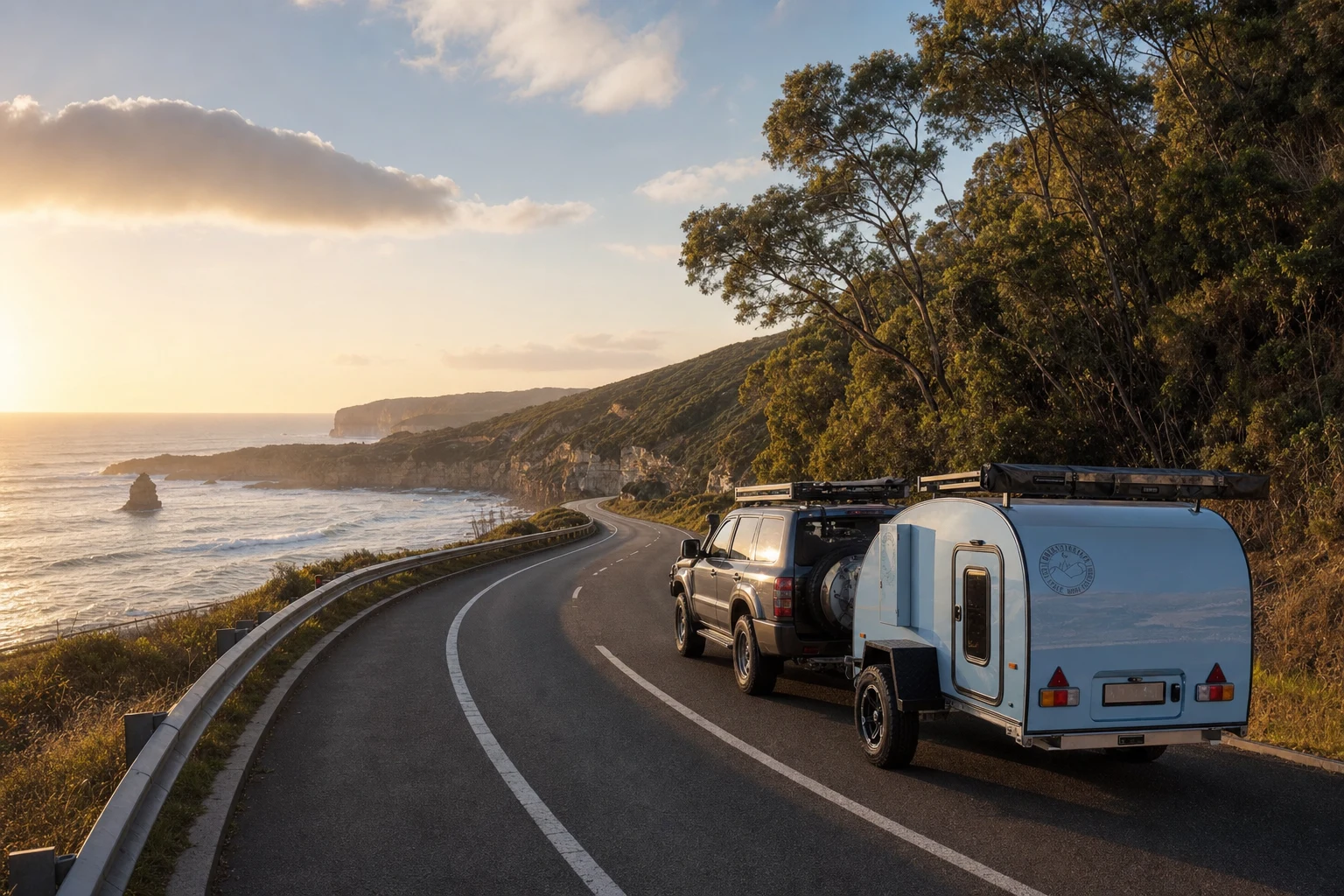
Most seven-day road trip itineraries in Australia are written for someone driving a hire car or a campervan. They tell you the Sydney to Byron Bay run is 965 kilometres and about 11.5 hours of driving, and they leave it there. Tow a camper trailer along the same road and that number behaves differently: you drive slower, you stop more often, you burn more fuel, and — this is the part nobody writes down — you can unhitch and leave the trailer behind while you explore.
That last point quietly rewrites every itinerary on this page. A camper trailer is not a motorhome. Set it up once and your tow vehicle becomes a normal car again, which means the “best” seven-day route for a trailer is rarely the route with the most kilometres. It is the route with the best base camps.
This guide gives you eight seven-day routes, one for each mainland state plus Tasmania and the Territory, with real distances, honest driving times, 2026 campsite fees and what the week costs in fuel at the national average diesel price of 225.4 cents per litre (23 July 2026, NRMA weekly fuel report). It also tells you which two of these routes are commonly sold as seven-day trips and genuinely are not.
How far you can actually drive in seven days with a trailer
The single most common mistake in a week-long trip is planning it around a map instead of around a driving budget. Towing legally caps you at 100 km/h in NSW, WA and the NT under most conditions, and in practice a loaded teardrop sits happiest between 90 and 100 km/h on the highway. Add fuel stops, a lunch break and a look at something, and a “3.5 hour” leg becomes five hours of your day.
| Day type | Realistic towing distance | Time on the road | How many per week |
|---|---|---|---|
| Relocation day (get somewhere) | 300–400 km | 4.5–6 hrs | Maximum 3 |
| Short hop (move base camp) | 100–180 km | 2–3 hrs | As many as you like |
| Base-camp day (trailer stays put) | 0–200 km unladen | Your choice | Aim for 3–4 |
| Arrival/departure day | 150–250 km | 2.5–4 hrs | 2 (first and last) |
The rule that holds up across all eight routes below: never schedule two relocation days back to back, and never more than three in a week. A week with four 400 km towing days is not a holiday, it is a delivery run.
What towing actually costs over a week
A hard-shell teardrop is the cheapest thing you can put behind a car precisely because it is small and aerodynamic. A 2,650 kg caravan pushed a LandCruiser 200 from 12.6 L/100 km to 23.5 L/100 km in one Australian test — an 87% penalty. A 700–1,200 kg teardrop that sits below the tow vehicle’s roofline typically adds 15–25%.
Over 1,000 km — roughly one of these weeks — at 225.4c/L:
| Setup | Consumption | Fuel for 1,000 km | Cost at 225.4c/L | Extra vs no trailer |
|---|---|---|---|---|
| 4WD, no trailer | 9.5 L/100 km | 95 L | $214 | — |
| 4WD + teardrop camper (700–1,200 kg) | 11.5 L/100 km | 115 L | $259 | +$45 |
| 4WD + forward-fold camper (1,400 kg) | 13.0 L/100 km | 130 L | $293 | +$79 |
| 4WD + 2,000 kg caravan | 15.5 L/100 km | 155 L | $349 | +$135 |
A week of towing a teardrop costs about $45 more in fuel than driving the same route with nothing behind you, and about $90 less than the same week behind a caravan. In the Northern Territory, where diesel averages 266.3c/L, add roughly 18% to every figure in that table. The full breakdown of what weight does to consumption is in our teardrop camper weight guide.
The base-camp rule that changes every itinerary
Here is the structural advantage nobody writing campervan itineraries can use. A campervan is your bed and your car at the same time. Every side trip drags your kitchen, your water tank and your wardrobe along with it. A camper trailer detaches in under a minute once it is level.
| One-night hops (move daily) | Base camps (2–3 nights each) | |
|---|---|---|
| Setup/pack-down per week | 7 × both | 3 × both |
| Time lost to camp admin | ~3.5 hrs (teardrop) | ~1.5 hrs |
| Fuel penalty on side trips | Every kilometre towed | Zero — unladen tow car |
| Campsites needed | 7 bookings | 3 bookings |
| Nights you sleep in the same bed | 1 | 2–3 |
On a route like the Great Ocean Road, three base camps instead of seven overnight moves saves roughly two hours of setup, four bookings and around $25–35 of fuel on the day trips alone. It also means the good bits — the walk, the swim, the winery — happen with an empty tow ball.
Setup time is what makes or breaks this. A hard-shell teardrop opens in about five minutes because there is no canvas to peg out; a soft-floor camper can take 30–40. If you are still choosing a setup, our rooftop tent vs hard floor comparison covers the trade-offs.
The eight routes at a glance
| # | Route | State | Total distance | Towing days | Terrain | Best window |
|---|---|---|---|---|---|---|
| 1 | Great Ocean Road & the Otways | VIC | ~900 km loop | 3 | Sealed, steep, winding | Mar–May, Sep–Nov |
| 2 | Sydney to Byron Bay | NSW | 965 km one way | 4 | Sealed highway + gravel spurs | Apr–Jun, Sep–Nov |
| 3 | Top End Loop (Litchfield–Kakadu–Nitmiluk) | NT | ~1,300 km loop | 4 | Sealed + optional 4WD | May–Oct (dry) |
| 4 | Perth to Kalbarri & Shark Bay | WA | ~1,600 km return | 4 | Sealed, remote | Apr–Oct |
| 5 | Adelaide to the Flinders Ranges | SA | ~1,100 km loop | 3 | Sealed + gravel | Apr–Jun, Sep–Oct |
| 6 | Tasmania’s East Coast | TAS | ~700 km | 4 | Sealed, tight, hilly | Nov–Apr |
| 7 | Brisbane to 1770 & Bundaberg | QLD | ~1,000 km return | 4 | Sealed + soft sand spurs | Apr–Oct |
| 8 | Great Alpine Road & High Country | VIC/NSW | ~950 km loop | 4 | Sealed, high altitude | Nov–Apr |
1. Great Ocean Road and the Otways (VIC) — ~900 km
The road itself is only 243 km from Torquay to Allansford, which is exactly why it works so well as a seven-day trailer trip: you spend almost none of the week towing. Three base camps put every attraction within 30 minutes of the trailer.
| Days | Leg | Towed distance | Base camp |
|---|---|---|---|
| 1 | Melbourne → Anglesea | 115 km / 1.75 hrs | Anglesea or Torquay |
| 2–3 | Anglesea → Apollo Bay | 90 km / 1.5 hrs | Apollo Bay (Otways day trips) |
| 4–5 | Apollo Bay → Port Campbell | 95 km / 1.5 hrs | Port Campbell (Twelve Apostles) |
| 6–7 | Port Campbell → Melbourne | 285 km / 3.5 hrs | Home |
Watch for: the section between Lorne and Apollo Bay is genuinely tight and cambered. It is fine with a short trailer and mirrors, unpleasant with a long one. Booking note: from 1 July 2026, several Great Ocean Road campsites moved from Parks Victoria to the Great Ocean Road Coast and Parks Authority (GORCAPA) and must be booked on their own system — check before you assume a Parks Vic booking covers you.
Fuel estimate: ~$235 towing, at Victoria’s 220.4c/L average diesel.
2. Sydney to Byron Bay (NSW) — 965 km
The classic east coast run. Straight through it is 11.5 hours; over seven days it becomes four short towing days and three days of doing nothing in particular, which is the correct way to do it.
| Days | Leg | Towed distance | Where to stay |
|---|---|---|---|
| 1–2 | Sydney → Port Stephens | 210 km / 2.75 hrs | Beachside holiday parks, $30–60/night |
| 3 | Port Stephens → Crowdy Bay NP | 160 km / 2.5 hrs | Diamond Head campground, ~$24/night for two |
| 4–5 | Crowdy Bay → Crescent Head | 90 km / 1.5 hrs | Crescent Head Holiday Park |
| 6 | Crescent Head → Dorrigo | 105 km / 1.75 hrs | Dorrigo Mountain, powered sites |
| 7 | Dorrigo → Byron Bay | 210 km / 3.5 hrs | Reflections Clarkes Beach, $40–65/night |
The catch nobody mentions: this is a one-way route. Either budget a second week to come home down the New England Highway (~800 km inland), or accept that day eight is a long day. Diamond Head and the NPWS coastal campgrounds are the highlight and the hardest to book — see our NSW camping spots guide for the 2026 fee tiers and which sites take trailers.
Fuel estimate: ~$225 one way at NSW pricing.
3. Top End Loop: Litchfield, Kakadu, Nitmiluk (NT) — ~1,300 km
Seven days is the sweet spot here, and the loop shape means no backtracking: Darwin south to Litchfield, east to Katherine, north through Kakadu, back to Darwin on the Arnhem Highway.
| Days | Leg | Towed distance | Highlight |
|---|---|---|---|
| 1–2 | Darwin → Litchfield NP | 120 km / 1.5 hrs | Wangi, Florence, Buley Rockhole |
| 3 | Litchfield → Katherine | 260 km / 3 hrs | Nitmiluk Gorge |
| 4–5 | Katherine → Kakadu (Cooinda) | 300 km / 3.5 hrs | Yellow Water, Nourlangie rock art |
| 6 | Cooinda → Jabiru/Ubirr | 55 km / 1 hr | Ubirr sunset |
| 7 | Jabiru → Darwin | 250 km / 3 hrs | Arnhem Highway |
Season is not negotiable. Go May to October. In the wet, roads close, swimming holes are off limits and crocodile risk changes everything. You do not need a 4WD for the main sites in the dry, but Jim Jim Falls, Twin Falls and Maguk do — and those tracks are no place for a trailer, which is another argument for leaving it at a base camp.
Fuel warning: NT diesel averages 266.3c/L, the dearest in the country. Budget around $390 for the loop, and fill up in Darwin and Katherine rather than at roadhouses.
4. Perth to Kalbarri and Shark Bay (WA) — ~1,600 km return
Here is the honest version of a trip that gets sold badly. Perth to Exmouth is about 1,270 km each way — 2,540 km return. Doing that in seven days while towing means four days of 600 km-plus driving. It is a 10 to 14-day trip, not a seven-day one.
The seven-day version that works stops at Shark Bay:
| Days | Leg | Towed distance | Highlight |
|---|---|---|---|
| 1 | Perth → Jurien Bay | 220 km / 2.75 hrs | Pinnacles Desert |
| 2–3 | Jurien Bay → Kalbarri | 350 km / 4 hrs | Nature’s Window, coastal cliffs |
| 4–5 | Kalbarri → Denham (Shark Bay) | 390 km / 4.5 hrs | Shell Beach, Monkey Mia |
| 6–7 | Denham → Perth | 830 km over 2 days | Overnight at Geraldton |
Distances between fuel stops are the real constraint on the Coral Coast, not the driving. Towing cuts your range by roughly a fifth — a 700 km tank becomes 560 km. Carry water for the gaps too; our guide on how long you can stay off-grid covers the maths for a couple on an 80 L tank.
Fuel estimate: ~$390 return.
5. Adelaide to the Flinders Ranges (SA) — ~1,100 km
Wilpena Pound sits about 430 km north of Adelaide, roughly five hours via the Barrier Highway through Quorn and Hawker. That is a single relocation day, which leaves five days in one of the best base-camp regions in the country.
| Days | Leg | Towed distance | Base camp |
|---|---|---|---|
| 1 | Adelaide → Clare Valley/Melrose | 220 km / 2.5 hrs | Melrose |
| 2–4 | Melrose → Wilpena Pound | 210 km / 2.5 hrs | Wilpena Pound Campground |
| 5 | Wilpena → Rawnsley Park/Blinman | 60–100 km / 1–1.5 hrs | Optional second base |
| 6–7 | Return via Port Augusta | 480 km over 2 days | Home |
2026 costs: Ikara-Flinders Ranges National Park requires a SA Parks Pass; expect a $12.50 vehicle entry fee plus $24 per night for a one-vehicle site ($34.50 for two vehicles). Wilpena Pound Campground powered sites run from $43–50 per night, unpowered from $30–31.
The gravel roads out to Brachina and Bunyeroo gorges are graded but corrugated. Corrugations are what kill trailers — why suspension matters explains what 1,300 impacts per kilometre does to a chassis, and why independent coil is not a luxury out here.
6. Tasmania’s East Coast (TAS) — ~700 km
The shortest route on this list and, per kilometre, the densest. Devonport to Bay of Fires to Freycinet to Hobart covers about 700 km in a week, which is barely 100 km a day.
| Days | Leg | Towed distance | Highlight |
|---|---|---|---|
| 1 | Devonport → Launceston | 100 km / 1.25 hrs | Cataract Gorge |
| 2–3 | Launceston → Bay of Fires | 190 km / 2.7 hrs | Binalong Bay to Eddystone Point (50 km of coast) |
| 4 | Bay of Fires → Bicheno | 110 km / 1.5 hrs | Penguin colony |
| 5–6 | Bicheno → Freycinet NP | 45 km / 1 hr | Wineglass Bay lookout, 60–90 min return |
| 7 | Freycinet → Hobart | 195 km / 2.5 hrs | Ferry or fly home |
Budget the ferry properly. A car towing a caravan or trailer on the Spirit of Tasmania runs $224–452 one way depending on season and sailing time, plus passenger fares from around $100 each, plus the 15% fuel surcharge applied to bookings made from 31 March 2026. Round trip for two with a trailer: realistically $900–1,400 before you have bought a litre of diesel.
That cost is exactly why Tasmania rewards a small trailer. Fare bands are driven by length.
7. Brisbane to 1770 and Bundaberg (QLD) — ~1,000 km return
Brisbane to Agnes Water/1770 is 380 km, around 5.5 hours. Strung over a week with Noosa and Bundaberg, it becomes a relaxed coastal loop with the Southern Great Barrier Reef at the far end.
| Days | Leg | Towed distance | Highlight |
|---|---|---|---|
| 1–2 | Brisbane → Noosa/Sunshine Coast | 150 km / 2 hrs | Noosa NP coastal walk |
| 3 | Noosa → Rainbow Beach | 130 km / 2 hrs | Carlo Sand Blow |
| 4–5 | Rainbow Beach → Agnes Water/1770 | 300 km / 3.5 hrs | Lady Musgrave Island day trip |
| 6 | 1770 → Bundaberg | 130 km / 1.75 hrs | Mon Repos turtles (Nov–Mar) |
| 7 | Bundaberg → Brisbane | 370 km / 4.25 hrs | Home |
Queensland national park camping is the cheapest in the country at $7.75 per person per night through QPWS. Beach access at Rainbow Beach and Inskip is soft sand and tidal — a place to leave the trailer, not tow it. More detail in our Queensland camping spots guide and, if the reef is the point, the best beach camping destinations guide.
8. Great Alpine Road and the High Country (VIC/NSW) — ~950 km
The Great Alpine Road runs 339 km from Wangaratta to Bairnsdale and is Australia’s highest year-round sealed road. As a loop from Melbourne it makes a superb summer week — and a genuinely demanding towing week.
| Days | Leg | Towed distance | Base camp |
|---|---|---|---|
| 1 | Melbourne → Bright | 310 km / 3.5 hrs | Bright |
| 2–3 | Bright (base camp) | 0 km towed | Mt Buffalo, Harrietville day trips |
| 4 | Bright → Omeo via Mt Hotham | 110 km / 2.25 hrs | Omeo or JB Plain |
| 5–6 | Omeo → Lakes Entrance | 160 km / 2.25 hrs | Gippsland Lakes |
| 7 | Lakes Entrance → Melbourne | 320 km / 3.75 hrs | Home |
The Hotham climb is the hardest towing on this page. Sustained 8–10% grades, and fuel use on steep grades can rise 40% above the flat-road figure. Trailer brakes are not optional: any trailer over 750 kg GTM needs them under ADR38, and here you will actually use them — see our electric brakes guide. Between Omeo and Harrietville you must carry snow chains in winter, which is a decent reason to keep this one to November–April.
What to book, and what to wing
Seven-day trips fail on bookings far more often than on driving. Australian park systems release inventory on wildly different schedules.
| System | Booking window | 2026 notes |
|---|---|---|
| Parks Victoria | Rolling; summer released ~5–6 months ahead | Summer 2026–27 opened 6 July 2026, 10am AEST |
| GORCAPA (Great Ocean Road) | Separate system since 1 July 2026 | Do not assume Parks Vic covers it |
| NSW NPWS | Up to 12 months | 6-tier fee structure; coastal sites go fast |
| QPWS (Queensland) | Up to 6 months | $7.75 per adult per night |
| SA Parks | Up to 12 months | Parks Pass + vehicle entry fee separate |
| NT Parks | Mostly first-come | Dry season only for most Kakadu sites |
| Private holiday parks | 6–12 months for school holidays | $30–65/night typical |
Practical rule: book the two or three nights that are non-negotiable (Wilpena, Freycinet, Byron in peak) and leave the rest loose. A self-contained trailer is what buys you that flexibility — it means a free camp or a roadside rest area is a genuine option rather than a compromise. Our self-contained camper guide covers the CMCA rules and grey-water requirements state by state.
Matching the route to the trailer
Not every route needs the same setup. The honest version:
| Route | Minimum sensible setup | Why |
|---|---|---|
| Great Ocean Road, East Coast NSW, QLD coast | Any hard-shell teardrop (from Breath Essential, $23,320, 700 kg) | Sealed roads, facilities everywhere |
| Tasmania | Short and light — ferry fares are length-banded | Cost, plus tight coastal roads |
| Flinders Ranges, Top End | Off-road suspension, dust sealing, 100 L+ water | Corrugations, gravel, distance between towns |
| High Country | Electric brakes, decent tow vehicle, low-range useful | Sustained 8–10% grades |
| Any route with no amenities | Interior bathroom — Breath Max, $47,190, the only teardrop in Australia under $50k with a full internal bathroom | Free camping without an amenities block |
For a week away, the bathroom question decides more itineraries than terrain does. If your route depends on booked caravan parks because someone in the car needs a toilet at 2am, you are locked into the busiest and most expensive sites on the coast. If the trailer carries its own, the Breath Max and the free-camping options it unlocks change what a seven-day route can even look like. The full spec-by-spec breakdown across all four models is on our comparison page.
The seven-day prep list
Short trips get under-prepared precisely because they are short. The five that matter:
- Tyre pressures, trailer included — check cold, before you leave, every time.
- Wheel bearings if you are doing gravel: a Flinders or Top End week is a bearing-service week, not a “she’ll be right” week.
- Water — 10 L per person per day is the working number. A couple for seven days is 140 L, which is more than most single tanks hold, so plan a refill.
- Fridge and power — a 12V compressor fridge pulls 45–60 Ah a day in summer. Seven days off-grid needs solar, not just a battery. See how much solar you need.
- The shakedown — if the trailer is new, do one local overnight before a seven-day trip. It is the cheapest fault-finding you will ever do.
If your week is a rehearsal for something longer, the Big Lap preparation guide covers the admin, budgets and service intervals that a seven-day trip lets you skip.
Frequently asked questions
How many kilometres a day should I drive when towing a camper trailer?
Plan on 300–400 km on a relocation day and no more than three of those in a week. Towing adds time in ways the map does not show: slower speeds, longer overtaking, more frequent fuel stops. A leg that Google says is 3.5 hours will occupy about five hours of your day.
Is seven days enough for the Great Ocean Road?
Comfortably, yes — the road is only 243 km. Seven days lets you use three base camps and still spend most days out of the car. Three to five days is the common recommendation for driving it; a week is what makes it a holiday rather than a drive.
Can you do Perth to Exmouth in seven days?
Not well. It is roughly 1,270 km each way, so a return trip means four days of long driving out of seven. Perth to Kalbarri and Shark Bay is the honest seven-day version; save Exmouth and Ningaloo for a 10 to 14-day trip.
How much extra fuel does a teardrop camper use?
Typically 15–25% more than driving unladen — around 2 L/100 km on a mid-size 4WD. Over a 1,000 km week at the July 2026 national average of 225.4c/L, that is about $45 extra. A 2,000 kg caravan on the same week costs roughly $135 extra.
Do I need a 4WD for these routes?
For routes 1, 2, 6 and 7, no — a competent 2WD SUV with the right tow rating is fine. For the Flinders gorge roads, Top End side tracks and anything unsealed after rain, a 4WD is the sensible choice. The tow rating matters more than the drivetrain: check the towing guide before you commit.
What does a week of camping cost in park fees?
Somewhere between $54 and $450 for two people, depending entirely on where you sleep. Queensland national parks are $7.75 per adult per night ($108 for a week for two); coastal holiday parks in peak season run $40–65 a night ($280–455). Mixing the two is how most people do a week.
The short version
Seven days is enough for any of these eight routes if you plan around driving days rather than destinations. Three relocation days, three base camps, and a trailer that sets up in five minutes rather than forty is the shape that works — and the fuel difference between doing it behind a teardrop and doing it behind a caravan is roughly $90 a week, which pays for two nights of camping.
If you are weighing up which setup makes those weeks possible, the model comparison lays out weights, tow ratings and prices side by side, or you can book a viewing and hitch one to your own car before you decide.
Recommended reading
- Camper Trailer Towing Guide (Australia) — tow ratings, ball weight and the legal limits that govern every route above.
- Teardrop Camper Towing Tips — load distribution, sway control and reversing, for the days you do have to move.
- Top 20 National Parks to Visit with a Camper Trailer — the parks these routes pass through, with access and booking notes.
- Best Teardrop Camper Destinations by State — 18 destinations with terrain ratings, if you want to build your own route.
- Must-Have Accessories for Off-Road Adventures — recovery gear, comms and tyre kit for the unsealed sections.