Breath Trailer vs Patriot Campers: Honest 2026 Comparison
Breath Trailer vs Patriot Campers compared on 2026 prices, tare weight, setup, sleeping capacity and bathrooms. Two Australian-made brands, two very different categories.
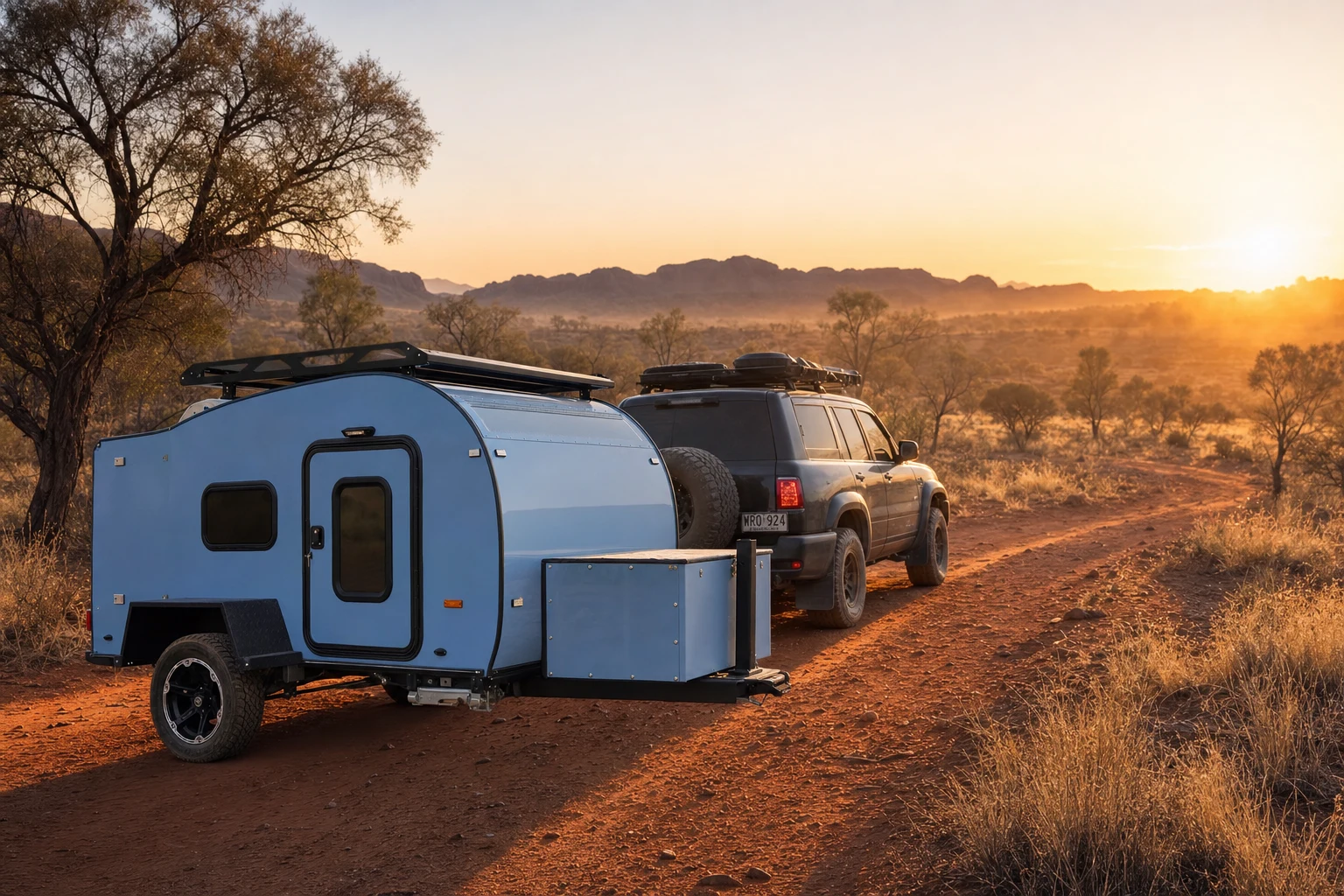
Here is the number that frames this entire comparison: in 2026, the cheapest camper in the Patriot Campers range costs $1,710 more than the most expensive Breath Trailer. The Patriot X2 Tourer starts at $48,900. The Breath Max — our flagship, with a full interior bathroom — is $47,190.
That single figure tells you these two brands are not really fighting over the same buyer. And yet Australians compare them constantly, because from a distance they look like the same thing: two Australian-owned manufacturers building premium, hot-dipped-galvanised, off-road-capable campers with proper 12V systems, sold direct, with waiting lists.
The distance is the problem. Up close, a Patriot X1 and a Breath Ultra are different categories of camper that happen to share a price bracket with each other’s extremes. One is a fold-out canvas expedition rig that turns into a small house. The other is a sealed hard-shell teardrop you level and open in five minutes.
This guide compares them honestly — real 2026 prices from both manufacturers’ own sites, real tare weights, real ATMs — and tells you plainly where Patriot is the better buy. Because on several measures, it genuinely is.
The short answer
If you want the conclusion before the detail:
| You are… | Buy | Why |
|---|---|---|
| A family of 4–6 doing remote touring | Patriot X1 Gen2 | Sleeps up to 6; nothing in the teardrop category does |
| A couple who want a bathroom inside, under $50k | Breath Max | The only teardrop under $50k in AU with a full interior bathroom |
| Towing with a mid-size SUV (CX-5, Outback, RAV4) | Breath Essential / Plus | 700–800 kg tare vs Patriot’s 1,600 kg ATM ceiling |
| Doing the Canning, the Simpson, hardcore remote work | Patriot X1 / X3 | Airbag suspension, 33in MTs, 36° departure angle |
| Camping 6–15 nights a year, hate packing up wet canvas | Breath (any model) | Zero canvas; 5-minute setup, 5-minute pack-down |
| Budget is genuinely $150k+ and you want a hybrid | Patriot ST5 / ST7 | Breath doesn’t compete in that segment at all |
Now the detail.
2026 prices side by side
Both brands publish their pricing openly, which makes this comparison unusually clean. These are the manufacturers’ own listed starting prices in 2026, before on-road costs and before options.
| Model | Brand | Starting price (AUD) | Category |
|---|---|---|---|
| Breath Essential | Breath Trailer | $23,320 | Hard-shell teardrop |
| Breath Plus | Breath Trailer | $29,766 | Hard-shell teardrop, off-grid ready |
| Breath Ultra | Breath Trailer | $34,749 | Hard-shell teardrop, dual water tanks |
| Breath Max | Breath Trailer | $47,190 | Hard-shell teardrop + interior bathroom |
| Patriot X2 Tourer | Patriot Campers | $48,900 | Hard-shell rooftop tent camper |
| Patriot X1 Gen2 | Patriot Campers | $74,900 | Fold-out hard-roof camper, sleeps 6 |
| Patriot X3 Gen2 | Patriot Campers | $77,900 | Fold-out hard-roof camper, sleeps 2 |
| Patriot ST5 Supertourer | Patriot Campers | $168,900 | 5.2 m hybrid pop-top |
| Patriot ST7 Supertourer | Patriot Campers | $224,900 | 6.8 m dual-axle hybrid |
The ranges barely overlap. Breath Trailer runs $23,320–$47,190. Patriot runs $48,900–$224,900. There is a $1,710 gap between the top of one range and the bottom of the other.
This is not a criticism of Patriot’s pricing. Their founder Justin Montesalvo has publicly defended it in detail, pointing to a custom hot-dipped galvanised Rigilite chassis, patent-pending weld-free bonded aluminium panel construction, Queensland-made rotomoulded water tanks, Cruisemaster suspension, Redarc electronics and ISO certification through SAI Global — and summarising the philosophy as “this thing is going to outlast you and me.” That’s a coherent argument, and the componentry backs it up. It is simply a different answer to a different question.
Where the money actually goes: Patriot is buying you expansion — a camper that unfolds into a multi-room living space with a change room and, on the X1, bunks. Breath Trailer is buying you compression — the smallest, lightest sealed box that still contains a real bed, a real galley and (on the Max) a real bathroom. Neither is objectively better. They’re opposite engineering bets.
Weight and tow vehicle: the surprising bit
Most brand comparisons assume the more expensive camper is the heavier one. That’s not what the numbers say here.
| Model | Tare | ATM | Ball weight |
|---|---|---|---|
| Breath Essential | 700 kg | — | — |
| Breath Plus | 800 kg | — | — |
| Breath Ultra | 900 kg | — | — |
| Breath Max | 1,200 kg | — | — |
| Patriot X2 Tourer | 850 kg | 1,600 kg | 140 kg |
| Patriot X1 Gen2 | 1,130 kg | 1,600 kg | 140 kg |
| Patriot X3 Gen2 | 1,160 kg | 1,600 kg | 140 kg |
| Patriot ST7 Supertourer | ~2,500 kg | 3,500 kg | — |
At tare, the Patriot X2 Tourer (850 kg) is within 50 kg of a Breath Plus, and the X1 Gen2 (1,130 kg) is lighter than a Breath Max (1,200 kg). Patriot’s weld-free bonded aluminium construction genuinely works. Anyone telling you Patriots are heavy for what they are hasn’t read the spec sheets.
The real difference is at the other end of the scale. Every camper in Patriot’s X range carries a 1,600 kg ATM, and ATM — not tare — is the number your tow vehicle has to be rated for, because it’s the legal maximum the trailer may weigh fully loaded. That 1,600 kg ceiling, plus a 140 kg ball weight, quietly rules out a chunk of the mid-size SUV market.
A Breath Essential at 700 kg tare sits in completely different territory. It’s towable by a RAV4, a CX-5, a Subaru Outback — the cars people already own. That’s not an accident; it’s the whole design brief. We’ve written the full method for checking your own vehicle in our camper trailer weight guide, and it’s worth doing properly before you fall in love with either brand.
Do this before anything else: open your driver’s door, read the compliance plate, and find your braked towing capacity, your ball-weight limit and your GCM. If a 1,600 kg ATM plus 140 kg on the ball doesn’t fit inside those numbers, the Patriot X range is off your list regardless of budget — and vice versa, if you’re already driving a 3,500 kg-rated Ranger, the weight argument for a teardrop disappears entirely.
Setup, canvas, and the 5-minute question
This is the deepest structural difference between the two brands, and it has consequences that go well past setup time.
Every camper in Patriot’s X range uses fabric. The X2 Tourer deploys an A-frame hard-shell rooftop tent integrated into the body. The X1 Gen2 uses a remote-controlled composite hard roof that raises at the press of a button, then an integrated CS3 tent with a main cabin, a change room and an optional kids’ room. The X3 Gen2 works similarly. The hard roof does the heavy lifting; the walls are canvas.
No Breath Trailer has any fabric at all. The shell is the shell. You level the trailer, drop the stabiliser legs, open the rear galley hatch, and you’re done — typically inside five minutes, in any weather, in the dark.
| Patriot X range | Breath Trailer | |
|---|---|---|
| Setup | Powered roof + tent deploy | Level, legs, hatch |
| Typical time | ~10–15 min (X1 with full tent) | ~5 min |
| Pack up wet? | Canvas must be dried later | Nothing to dry |
| Living space created | Large — cabin + change room | None — you use an awning |
| Canvas re-proofing | Periodic, ongoing | N/A |
| Mould risk in storage | Real, needs management | N/A |
Read that table twice, because it cuts both ways. The canvas is what creates Patriot’s living space. A change room you can stand up and get changed in, out of the wind, is a genuinely different camping experience from a teardrop cabin. If you’re touring for three months with kids, that space is not a luxury.
But canvas is also the single most common source of camper trailer grief in Australia — mould from packing away damp, seam leaks, UV degradation, re-proofing. It’s the first item in our rundown of common camper trailer problems, and it’s the failure mode a hard-shell design eliminates by construction rather than by maintenance discipline.
The honest framing: Patriot trades ongoing canvas care for living space. Breath trades living space for zero canvas care. Which trade is right depends almost entirely on how many nights a year you camp and how much of that is with children.
Sleeping capacity: Patriot wins, clearly
There is no way to spin this one.
| Model | Sleeps | Bed |
|---|---|---|
| Patriot X1 Gen2 | Up to 6 | Queen upstairs + bunks for up to 4 kids downstairs |
| Patriot X3 Gen2 | 2 | Queen 2030 × 1380 mm |
| Patriot X2 Tourer | 2 (+ swag/tent space) | Rooftop tent |
| Breath Max | 2 | Queen |
| Breath Ultra / Plus / Essential | 2 | Double / queen |
If you have two or three kids and you want them sleeping inside the camper rather than in a separate tent, the X1 Gen2 does something no teardrop on the Australian market does. Full stop. A teardrop is a two-person vehicle with an annexe strategy bolted on — we’ve documented exactly how that works in our guide to teardrop campers for families, and we’re upfront there that families of five are better served elsewhere.
If you’re a couple, this advantage evaporates, and you’re paying $74,900 for bunks you’ll never unfold.
Bathroom and self-containment: Breath wins, clearly
The mirror image of the previous section.
Patriot’s X3 Gen2 — their $77,900 two-person flagship camper trailer — provides a storage compartment for a portable toilet, and offers a gas hot water system with a shower kit as an option. That is a well-executed version of the standard camper trailer answer: your toilet is a cassette you carry, and your shower is outside under a nozzle.
The Breath Max at $47,190 has a full interior bathroom — toilet and shower, inside the sealed shell, with 2.1 m of standing headroom, a queen bed and dual 80 L tanks (one fresh, one grey). It remains the only teardrop on the Australian market under $50,000 with a genuine interior bathroom.
| Patriot X3 Gen2 | Breath Max | |
|---|---|---|
| Price | $77,900 | $47,190 |
| Toilet | Portable, stored in a compartment | Interior, fixed |
| Shower | Optional gas HWS + external kit | Interior |
| Standing headroom | No | 2.1 m |
| Grey water tank | — | 80 L |
| Fresh water | 150 L | 80 L |
| Sleeps | 2 | 2 |
Note the water row honestly: Patriot carries 150 L to Breath’s 80 L of fresh water across the X range, which is a real advantage for extended remote touring. But 150 L with no grey tank and no interior bathroom is a different proposition to 80 L fresh + 80 L grey inside a self-contained shell — the grey tank is what unlocks the free-camping sites that require self-containment, as we explain in our guide to self-contained campers in Australia.
For the retiree couple who bought a camper specifically so they’d never walk 80 m to an amenities block at 2 am in the rain, this section is the whole decision. The Breath Max exists because that customer kept asking and nobody under $50k was answering.
Off-road capability: where Patriot’s money shows
If you strip out price and look purely at what each camper can survive, Patriot is built to a harder standard, and it would be dishonest to claim otherwise.
| Spec | Patriot X2 Tourer | Patriot X1 / X3 Gen2 | Breath Trailer |
|---|---|---|---|
| Chassis | Hot-dipped galv Rigilite | Hot-dipped galv Rigilite | Hot-dipped galvanised |
| Suspension | X-Cruise off-road coil | X-Cruise dual-shock airbag | Independent, off-road rated |
| Coupling | Cruisemaster DO35 | Cruisemaster DO35 | Off-road coupling |
| Brakes | 12in electric | 12in electric | Electric |
| Tyres | 33in mud terrain, 17in steel | 33in mud terrain | Alloy, all-terrain |
| Departure angle | 36° | — | — |
| Recovery points | Twin 800 kg rated | Twin rated | — |
Dual-shock airbag suspension, 33in muddies and a 36-degree departure angle are corrugation-and-dune specifications. Patriot has been product-tested in 4X4 Australia and CaravanCampingSales for years, and the X1-H review gives you a sense of the intended use case.
Breath Trailers are off-road capable — hot-dipped galvanised chassis, independent suspension, off-road coupling — and they’ve done Cape York and the Gibb. But they are engineered as touring campers that handle rough access tracks, not as expedition trailers designed around the Canning Stock Route. If your realistic plan involves 1,000 km of severe corrugation a year, buy the suspension that’s designed for it; our article on why suspension matters off-road explains what that specification actually buys you.
If your realistic plan is Booderee, the Grampians, the Flinders and a run up to Cape York once, you are paying a $35,000–$55,000 premium for engineering headroom you will use twice.
Power and water systems
| Patriot X2 Tourer | Patriot X1 Gen2 | Patriot X3 Gen2 | Breath Plus / Ultra / Max | |
|---|---|---|---|---|
| Battery | 100 Ah lithium | 2 × 150 Ah | 2 × 150 Ah | 120 Ah lithium |
| Solar | 2 × 120 W fixed | 200 W fixed | 120 W optional (240 W max) | Fixed panel included |
| Management | Redarc Rogue | Redarc Rogue RedVision | Redarc Rogue RedVision | Battery box + solar controller |
| Inverter | — | — | — | Included (1000 W on Max) |
| Fresh water | 150 L | 150 L | 150 L | 80 L (+80 L grey on Ultra/Max) |
Patriot’s electrical package is bigger, and on the X1/X3 substantially so — 300 Ah of storage with Redarc RedVision monitoring is a serious system. The catch worth knowing: the X1 Gen2’s 300 Ah is quoted with AGM or gel options, and AGM gives you roughly half its nameplate capacity as usable, whereas 120 Ah of lithium gives you 100–110 Ah usable. The gap between “300 Ah AGM” and “120 Ah lithium” is narrower than the numbers suggest — we’ve run the arithmetic in AGM vs lithium for camper trailers.
Water is Patriot’s clean win: 150 L versus 80 L is roughly two extra days off-grid for a couple at the standard 10 L per person per day planning figure.
Five-year cost of ownership
Purchase price is where most comparisons stop. Here’s the fuller picture for a couple camping around 25 nights a year, comparing the two most realistic head-to-head candidates.
| Cost over 5 years | Patriot X3 Gen2 | Breath Max |
|---|---|---|
| Purchase | $77,900 | $47,190 |
| Insurance (~$400–600/yr) | $2,500 | $2,000 |
| Registration (5 yr) | ~$1,500 | ~$1,500 |
| Servicing (bearings, brakes, seals) | ~$1,200 | ~$1,000 |
| Canvas care / re-proofing | ~$400 | $0 |
| Estimated resale at 5 yr | ~55–70% | ~60–75% |
| Approx. net 5-yr cost | $32,000–$42,000 | $16,000–$23,000 |
Two caveats, stated plainly. First, resale percentages are estimates based on Australian market behaviour for quality campers — Patriot’s brand strength in the used market is genuinely excellent and may well land at the top of that band. Second, these are indicative running costs, not quotes; insurance in particular varies enormously by postcode and storage. Our resale value analysis explains the depreciation curve behind these numbers.
The point isn’t that Patriot is expensive to own. Proportionally, it holds value about as well as anything in the category. The point is that the gap in purchase price is large enough that it survives even a favourable resale assumption.
What both brands genuinely share
It’s worth being clear about this, because plenty of comparison content pretends the competitor is cutting corners. Patriot isn’t, and neither are we.
- Australian owned and Australian built. Patriot from the Gold Coast, Breath Trailer from Sydney. Both are answerable locally when something goes wrong — which matters more than buyers realise, as we argue in why local support matters.
- Hot-dipped galvanised chassis. Both. This is the single most important corrosion decision in an Australian camper and both brands make the right call.
- Direct-to-customer with a build queue. Neither brand is a lot full of stock; both build to order with lead times measured in months.
- Proper 12V engineering. Redarc on Patriot’s side; a designed and compliance-tested system on ours. Both are a long way from the import-grade wiring that produces most of the field failures described in our piece on why quality control matters.
If you’re choosing between these two brands, you’re choosing between two good answers. That’s a much better position than most buyers are in.
Which one should you buy?
Work through these in order and you’ll have your answer in about ninety seconds.
-
Do you need to sleep more than two people inside the camper? Yes → Patriot X1 Gen2. Stop here; nothing in the teardrop category competes.
-
Is your tow vehicle rated below 2,000 kg braked, or below 140 kg ball weight? Yes → Breath Trailer. Patriot’s 1,600 kg ATM won’t work for you.
-
Do you want a toilet and shower inside the camper, for under $50,000? Yes → Breath Max. It’s currently the only Australian teardrop that does this under $50k.
-
Is your annual driving genuinely severe — Canning, Simpson dune crossings, extended corrugation? Yes → Patriot X1 or X3. Buy the airbag suspension.
-
Do you camp fewer than 20 nights a year and hate pack-down? Yes → Breath Trailer, any model. Canvas maintenance is a cost you pay whether you camp or not.
-
Is your budget above $150,000 and you want a hybrid with a full ensuite? Yes → Patriot ST5 or ST7. Breath Trailer doesn’t build in that segment, and we’d rather say so than pretend otherwise.
If you’re still deciding, our model comparison page puts the four Breath Trailers side by side, and our off-road teardrop guide is honest about what a teardrop will and won’t handle.
Frequently asked questions
Is Patriot Campers worth the money? For its intended buyer, yes. Patriot builds a hot-dipped galvanised Rigilite chassis with weld-free bonded aluminium panels, X-Cruise airbag suspension, Cruisemaster DO35 couplings and Redarc electronics, and the campers are product-tested in the Australian 4WD press. If you need a camper that sleeps six or that handles sustained severe corrugation, the price is defensible. If you’re a couple doing formed dirt roads twenty nights a year, you’re paying for capability you won’t use.
Why is the cheapest Patriot more expensive than the dearest Breath Trailer? Because they’re different categories. Patriot’s X2 Tourer at $48,900 is a fold-out expedition camper with 150 L of water, 33in mud terrains and a 36° departure angle. The Breath Max at $47,190 is a sealed teardrop with an interior bathroom. Neither is overpriced for what it is; they solve different problems.
Can a Toyota RAV4 or Mazda CX-5 tow a Patriot camper? Generally no. Every camper in Patriot’s X range carries a 1,600 kg ATM with a 140 kg ball weight, which sits at or beyond the limit of most mid-size SUVs once you account for GCM. A Breath Essential at 700 kg tare is the category built for those vehicles. Always check your compliance plate rather than a brochure.
Does any Patriot camper have an interior bathroom? Not in the X range. The X3 Gen2 provides a portable toilet compartment and an optional gas hot water system with an external shower kit. Interior ensuites appear in the Supertourer ST5 and ST7, which start at $168,900 and $224,900 respectively. The Breath Max delivers an interior bathroom at $47,190.
Which holds its value better, Patriot or Breath Trailer? Both hold value well by category standards — Australian-built campers with galvanised chassis and quality componentry consistently outperform imports on resale. Patriot has exceptional brand recognition in the used market. Breath Trailer benefits from a lower entry price, so the dollar depreciation is smaller even at a similar percentage.
Is a teardrop tough enough for outback Australia? For formed dirt, gravel, beach tracks and moderate corrugation, yes — hard-shell teardrops with galvanised chassis and independent suspension do the Gibb River Road and Cape York regularly. For sustained severe corrugation and dune work, buy purpose-built expedition suspension. Be honest with yourself about which trips you’ll actually do.
The bottom line
Patriot Campers builds some of the best expedition camper trailers in Australia, and the price reflects genuine engineering rather than a badge. If you need six berths, or airbag suspension under a trailer that lives on corrugation, buy one and don’t look back.
Breath Trailer exists for the other half of the market: couples and solo travellers who want a sealed, hard-shell camper that any decent SUV can tow, that sets up in five minutes, that has no canvas to manage, and — on the Max — that puts a real bathroom inside for $47,190 rather than $168,900.
The mistake isn’t choosing the wrong brand. It’s choosing based on which looks tougher in a photo, rather than on the compliance plate in your own driveway and the number of nights you’ll genuinely camp.
Want to see the difference in person before you commit? Book a viewing or compare all four Breath Trailer models on our comparison page.
Recommended reading
- Teardrop Camper vs Camper Trailer: The 2026 Comparison
- What Makes a Premium Camper Trailer Different?
- Camper Trailer Weight Explained: Tare, ATM, GTM and Payload
- Is a Teardrop Camper Worth It?
- Best Camper Trailer for Families in Australia
Prices in this article are the manufacturers’ own listed 2026 starting prices, before on-road costs and options. Patriot Campers specifications are drawn from patriotcampers.com.au product pages and Australian press reviews, and were accurate at the time of writing. Verify current pricing directly with each manufacturer.