K'gari (Fraser Island) Camping Guide for Camper Trailers: Permits, Barges, Tides and the Sites That Take a Trailer
Which K'gari camps take a trailer, the $230 barge tier every teardrop lands in, $61.80 permits, $7.75 camping fees, tide windows and the tracks to skip.
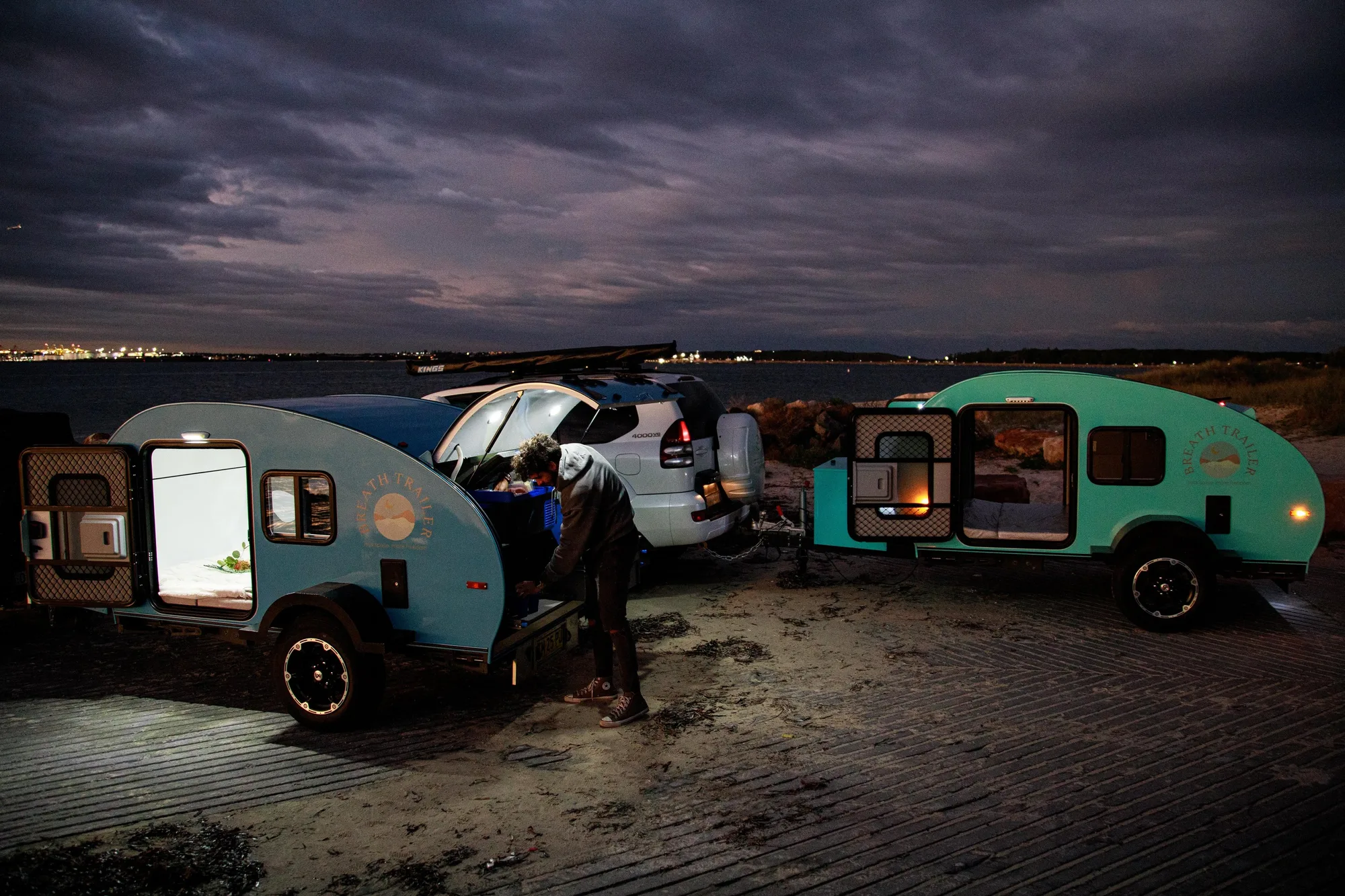
K’gari is 123 km of sand with a gazetted highway running down its eastern beach, a UNESCO World Heritage listing, more than 40 perched freshwater lakes and roughly 200 wongari (dingoes) that have never been fed by anyone who read the rules. It is also the one destination in Queensland where the question “can I bring my camper trailer?” gets a genuinely different answer depending on what you tow. The Queensland Parks and Wildlife Service (QPWS) line is precise: high-clearance, off-road camper trailers matched to a capable 4WD are welcome; conventional caravans and all-wheel-drive SUVs are not recommended; and if you get bogged, rangers will not pull you out.
That makes weight the single most important number on your K’gari trip sheet. A 700–900 kg hard-shell teardrop behind a mid-size 4WD asks very little of soft sand. A 2.5-tonne hybrid asks a lot. The rest — permits, tide windows, which of the nine beach camping zones actually have room for a trailer, which inland tracks to leave it behind for — is logistics, and logistics is what this guide is for.
Below you will find the 2026 fee table for camping and vehicle permits (they changed on 1 July 2026), the Manta Ray and SeaLink barge fares including the trailer tiers, a campground-by-campground table showing exactly where trailer sites exist, the 2026 closures at Central Station and Waddy Point, a sand-driving section written for lightweight trailers, distances along 75 Mile Beach, and a five-night itinerary that uses the trailer as a base camp rather than dragging it to Lake McKenzie (where it is not allowed anyway).
Can You Take a Camper Trailer to K’gari?
Yes — with conditions. The QPWS K’gari FAQ sets them out plainly: camper trailers must be high-clearance, off-road units suited to the vehicle towing them; other trailers and caravans are not recommended; all-wheel-drive vehicles are not recommended; and some inland tracks are not suitable for towing at all. The second half of the rule matters as much as the first. K’gari’s beach is generally manageable at low tide; the cuttings between beach and inland tracks are where trailers get stuck, and the inland tracks themselves are narrow, two-way, deeply rutted in places and occasionally crossed by tour buses.
The practical consequences for a trailer owner:
- Your tow vehicle must be a proper 4WD with low range — a Subaru Outback or a soft-roader on all-season tyres is exactly what QPWS means by “not recommended”.
- Coupling articulation matters. QPWS specifically warns that a coupling which cannot adjust to changing levels and tight turns will jam on K’gari’s tracks. An off-road coupling is a sensible spec for any trailer heading over.
- Self-recovery is mandatory. Rangers cannot recover you; the risk of snatch-strap injuries is the stated reason. You carry the boards, the shovel, the strap and the compressor, and you know how to use them before you board the barge.
- Lighter is easier. Every kilogram you tow through the Hook Point cutting or the Middle Rocks bypass is a kilogram the sand has to support. This is the part of the K’gari story where a sub-tonne teardrop is not a compromise but an advantage.
| Trailer type | K’gari suitability | Why |
|---|---|---|
| Hard-shell teardrop, 700–1,200 kg, off-road spec | Good | Low tare, short overall length, easy to reverse in campground loops, food locked inside a solid shell (dingo-relevant) |
| Soft-floor camper trailer, 1,000–1,500 kg | Good to moderate | Low and light, but long setup and canvas that dingoes have been documented tearing into |
| Hard-floor / forward-fold camper, 1,400–2,000 kg | Moderate | Capable, but heavy in soft cuttings and long behind the axle for the Inskip Point approach |
| Hybrid caravan, 2,000–3,000 kg | Marginal | QPWS does not recommend it past the southern fenced areas; the inland tracks are the problem |
| Conventional caravan | Not recommended | Officially discouraged by QPWS; low clearance, wide track, on-road coupling |
If you are still deciding what to tow, our guide to choosing the right off-road camper trailer for Australia works through the clearance, suspension and weight trade-offs in more detail. For K’gari specifically, treat “off-road spec” as non-negotiable: Breath trailers ship semi off-road as standard and are upgradeable — if K’gari is on your list, tell the team at ordering time so the off-road upgrade is fitted before handover.
K’gari Camping Costs in 2026
Queensland’s camping and vehicle permit fees were indexed on 1 July 2026. These are the current figures.
| Item | 2026 cost (AUD) | Notes |
|---|---|---|
| QPWS camping permit | $7.75 per person per night or $31 per family per night | Family = 1–2 adults plus children under 18, max 8 people; under-5s free. Source: Queensland camping fees |
| Vehicle Access Permit (VAP) — K’gari only | $61.80 for up to 1 month; $311 for more than 1 month (up to 12 months) | Required for every vehicle, even day visitors. Buy online before you board |
| VAP — K’gari + Cooloola Recreation Area combined | $99.25 (≤1 month) / $498.10 (up to 12 months) | 20% discount on buying both; worth it if you are also camping Teewah Beach or Inskip Point |
| Manta Ray barge (Inskip Point), 4WD + trailer | $230 return (4WD + trailer up to 3.4 m: $200 return) | Every Breath model is longer than 3.4 m, so budget the $230 tier — see below |
| SeaLink ferry (River Heads), 4WD + camper trailer | $230 return | Bookings mandatory; 30–50 min crossing |
| Cathedrals on Fraser (private campground) | $45 unpowered / $64 powered per night for 2 people | Max 6 people per site, 1 vehicle + trailer |
| Hot showers at Central Station, Dundubara, Waddy Point | $2 coin-operated | Bring a roll of $2 coins |
| Diesel on the island (August 2026) | $3.80–$3.99 per litre | Eurong, Happy Valley, Cathedrals, Kingfisher Bay, Orchid Beach store |
Put together, a couple crossing from Inskip Point with a teardrop for five nights in QPWS camping areas pays $61.80 (VAP) + $77.50 (10 person-nights) + $230 (barge) = $369.30 before fuel. A family of four on the same trip pays $61.80 + $155 + $230 = $446.80. That is cheaper than most powered caravan parks on the mainland — the money on K’gari goes into fuel and the tyre-pressure gauge, not into the campsite.
Two practical points on the permits. First, your camping permit must name the camping area you are sleeping in each night; you cannot buy a generic permit and roam. Bookings can be changed up to two days before arrival, and for peak periods (September school holidays through to Easter, and every long weekend) the recommended lead time is six to eight weeks. Second, the VAP is a windscreen sticker plus a digital record; print the confirmation, because phone coverage on the island is patchy exactly where the ranger stops you.
Getting There: The Two Barge Routes Compared
| Manta Ray Barge — Inskip Point (Rainbow Beach) | SeaLink — River Heads (Hervey Bay) | |
|---|---|---|
| Lands at | Hook Point, southern tip | Kingfisher Bay Resort (west coast) or Wanggoolba Creek via the Fraser Venture |
| Crossing time | ~10 minutes | ~50 min (Kingfisher Bay) / ~30 min (Wanggoolba Creek) |
| Booking | None — turn up, pay, drive on; 2–3 barges run continuously in peak periods | Mandatory; timetabled sailings |
| Hours | First barge ~6:00 am; last departure from Inskip mid-to-late afternoon (around 4:45–5:15 pm depending on season) | Scheduled, typically morning and mid-afternoon sailings; check the SeaLink fare and timetable page |
| 4WD only, return | $130 | From about $123 one way |
| 4WD + trailer up to 3.4 m (tow ball to taillights), return | $200 | — |
| 4WD + trailer, return | $230 | $230 |
| Sand on arrival | Immediate — soft sand at Inskip Point before you even reach the barge, then beach or the Hook Point inland road | Hard-packed landing at Kingfisher Bay; Wanggoolba Creek is 9 km of inland track from Central Station |
| Best for | Brisbane and Sunshine Coast departures; east-coast beach camping; flexibility | Hervey Bay departures; Central Station and the western lakes; anyone nervous about the Inskip approach |
Prices are current as of July 2026 and are set per vehicle, not per passenger; the Manta Ray Barge publishes its own table and updates it seasonally. The 3.4 m trailer tier is measured from your tow ball to the trailer’s taillights, which is why a 3.9 m Breath Essential, Plus or Ultra — and the 4.5 m Max — all land in the $230 bracket. It is a $30 difference, not a reason to change trailers, but it belongs in the budget.
The Inskip Point warning. The sand between the bitumen at Inskip and the barge ramp is soft and churned, and it is the single most common place first-timers bog a trailer — before they have even paid the fare. Drop your tyre pressures at the end of the sealed road, not on the barge. Engage low range for the approach. Keep momentum, steer in the existing wheel tracks and do not stop on the loose section. On the K’gari side, QPWS recommends using the Hook Point inland road rather than the beach for the first stretch north; its surface changes with the seasons, but it removes the tide from the equation for the first 20 minutes of your trip.
Tides: The Rule That Runs Your Whole Trip
75 Mile Beach is a highway with a timetable set by the moon. The working rule from QPWS and every operator on the island is the same: drive the beach in the window of roughly two hours either side of low tide, and avoid the two hours either side of high tide entirely. That gives you around four usable driving hours per cycle, with the sand at its hardest and widest in the middle of the window. Tide predictions for K’gari are published by the Bureau of Meteorology for the Waddy Point station, and every barge operator and resort prints a monthly tide card — pick one up at Rainbow Beach or River Heads.
With a trailer the window is worth treating as tighter than four hours, for two reasons. First, you cannot turn around on the beach as easily if you hit a washout at a creek mouth (Eli Creek is notorious). Second, your average speed is lower — most people towing settle at 40–60 km/h on the beach even where 80 km/h is permitted — so a 60 km leg that a solo 4WD covers in 50 minutes takes you closer to 80. Plan every beach leg to finish an hour before the end of the low-tide window, and keep the day’s driving to a single tidal cycle.
| Tide state | Beach condition | Trailer plan |
|---|---|---|
| Low tide ± 1 h | Widest, firmest sand; creek crossings shallow | Cover the long legs now (Eurong ↔ Dundubara, Dundubara ↔ Waddy Point) |
| Low tide ± 2 h | Still good; soft patches appearing above the wet line | Short hops only; finish the leg, do not start a new one |
| Mid tide, rising | Narrowing fast; soft upper beach | Be at camp or on an inland road |
| High tide ± 2 h | Sections impassable; waves to the dunes at Yidney Rocks, Poyungan Rocks and the Indian Head approach | Do not drive the beach with a trailer |
Night driving on the beach with a trailer is a bad idea in any tide. Washouts, logs and other people’s recovery scenes appear without warning, and the 80 km/h limit does not mean the beach is safe at 80 km/h.
Camping Areas on K’gari That Take a Trailer
K’gari has four kinds of camping: fenced QPWS camping areas with facilities, smaller fenced beach-side camping areas, open beach camping zones (numbered 1 to 9 along the east coast, no facilities, no fences) and private campgrounds. Not all of them accept trailers, and the ones that do book trailer sites separately from tent sites — you cannot put a trailer on a tent site even if it fits. The QPWS camping zones summary is the authoritative list; the table below is the trailer-relevant version.
| Camping area | Location | Trailer sites | Dingo fence | Toilets / showers | Fires | 2026 note |
|---|---|---|---|---|---|---|
| Central Station | Inland, 8 km west of Eurong, ~45 km from Hook Point, 9 km from Wanggoolba Creek | 15 trailer sites + 40 tent sites | Yes | Flush toilets, $2 hot showers, water taps (treat), bins, 9 pm curfew | No | Closed 13 July – 8 November 2026 for wastewater and power upgrades |
| Dundubara | Eastern beach, 41.4 km north of Eurong, 26.9 km south of Waddy Point | 5 defined trailer sites + 42 tent sites | Yes | Flush toilets, coin showers, water taps | Communal fire rings only (bring your own untreated milled timber) | Open; the best all-round trailer base on the east coast |
| Waddy Point (top) | North-east coast, ~100 km from Hook Point, 5 km north of Indian Head via the 5.7 km Middle Rocks bypass | Trailer and tent sites | Yes | Flush toilets, $2 showers, gas BBQs, water taps | Communal fire rings only | Closed 27 April – 31 August 2026; reopens 1 September |
| Waddy Point (beachfront) | Below the headland, same access | 6 trailer sites + tent sites | Yes | Toilets; showers at the top area | No | Open; soft sand between Indian Head and here — experienced towing only |
| Eli (fenced) | Eastern beach near Eli Creek, ~26 km north of Eurong | 3 trailer sites + 3 tent sites | Yes | Basic | No | Small, central, books out fast |
| One Tree (fenced) | South of Eurong, near One Tree Rocks | 2 trailer sites + 8 tent sites | Yes | Basic | No | Close to the Lake McKenzie turn-off — leave the trailer here and drive in solo |
| Cornwells (fenced) | South of Eurong | 3 trailer sites + 8 tent sites | Yes | Basic | No | Cornwells Road partially closed 12 March – 30 September 2026 — check the conditions report |
| Wongai (fenced) | Southern east coast, beach camping zone 1 | 3 trailer sites + 6 tent sites | Yes | Basic | No | Beachfront access ~2 h either side of low tide only |
| Coolooloi Creek | South-west, via the Hook Point inland road (also boat access) | “Small camper trailers” — park-and-walk style | No | None — portable toilet required | No | Generators allowed (conditions apply); no phone coverage |
| Beach camping zones 1–9 | Behind the foredune along the entire east coast, Govi in the south to Diray and Carree in the north | Open zones; trailer access depends on the specific cutting | No | None | No | Zone closures happen at short notice after dingo incidents — always check before booking |
| Cathedrals on Fraser (private) | East coast between the Maheno wreck and Dundubara, ~18 km south of Indian Head | Powered and unpowered sites for trailers and vans | Yes | Free hot showers, camp kitchens, laundry, shop and fuel | No | $45 unpowered / $64 powered per night for 2 |
| Lake Boomanjin | Southern inland lakes | Not suitable for trailers | — | — | — | Go in without the trailer |
Central Station
The rainforest campground on Wanggoolba Creek is the island’s most sheltered and most formal — a fenced loop with defined trailer bays, flushing toilets and coin showers, a 9 pm noise curfew and a public phone at the day-use area. It is 8 km of inland track from Eurong and 9 km from the Wanggoolba Creek barge landing, which makes it the obvious first night if you cross from River Heads. In 2026 it is out of action from 13 July to 8 November while new wastewater treatment goes in; if your trip falls in that window, Dundubara or Cathedrals are the fenced alternatives.
Dundubara
For most trailer owners this is the base camp. It sits mid-way up the eastern beach (41.4 km north of Eurong), is fenced, has the only communal fire rings on the island apart from Waddy Point, and has five defined trailer sites large enough to leave the trailer for the day and run north to Indian Head, the Champagne Pools and Waddy Point without it. Book those five sites early — they are the most contested trailer bays on K’gari in the September–October window.
Waddy Point
The northern fenced camping area, 5 km beyond Indian Head, is reached via the Middle Rocks bypass — 5.7 km of soft, rough, low-range sand that QPWS explicitly flags as difficult for trailers. Experienced tow drivers do it regularly with lightweight trailers; if it is your first trip, base at Dundubara and day-trip north. Note the 2026 closure of the top camping area until 31 August; the beachfront trailer sites below the headland stay open.
Cathedrals on Fraser
The private campground is fenced, has powered sites with 24-hour 240 V supply, free hot showers, camp kitchens, a shop and fuel, and sits within a short beach run of the Maheno wreck, the Pinnacles and Eli Creek. At $64 a night for a powered site it is still cheap by mainland standards, and it is the only place on the island to plug a trailer in. It is also the sensible fall-back when the QPWS trailer sites are full.
2026 Closures and Alerts You Need to Know
K’gari’s conditions change weekly, and the QPWS park alert system is the only reliable source. As of late August 2026 the confirmed items that affect trailer owners are:
- Waddy Point (top) camping area closed 27 April – 31 August 2026 — all sites — for power and wastewater upgrades. Reopens 1 September.
- Central Station tent and trailer sites closed 13 July – 8 November 2026 for the same programme. The Great Walk walkers’ camp stays open.
- Cornwells Road partially closed 12 March – 30 September 2026.
- Moon Point Road and Bullock Road closed after weather damage — Moon Point is boat-access only.
- Beach conditions notice, Ngkala Rocks to Sandy Cape, 20 June 2025 – 29 January 2027 — the far north is not trailer territory in any case.
- Dingo whelping season, 1 June – 31 August, brings heightened wongari activity and, in previous years, short-notice closures of open beach camping zones between Poyungan Rocks and the Pinnacles after negative interactions.
Campers with bookings inside a closure window can modify or refund through their online booking account. The lesson for a trailer owner is to hold two plans: a first-choice fenced site and a fall-back, because a closure notice can arrive after you have paid the barge.
Tracks and Sections to Leave the Trailer Behind For
The beach is the easy part. These are the places where the trailer stays at camp:
- Central Lakes scenic drive — Lake McKenzie (Boorangoora), Lake Birrabeen, Lake Boomanjin. QPWS states the drive is not suitable for trailers, and the Lake McKenzie car park has no room to turn one around. Base at Central Station (when open), One Tree or Eurong and drive in solo — it is about 15 km from Eurong.
- Indian Head to Waddy Point — the Middle Rocks bypass. 5.7 km of deep, soft, corrugated sand. Manageable with a light trailer and low range, but not with a first-time driver and a full water tank.
- North of Orchid Beach — Ngkala Rocks and Sandy Cape. Rock shelves, soft cuttings and a standing beach-conditions notice through to January 2027. Solo 4WD only.
- Yidney Rocks, Poyungan Rocks and the creek mouths at high tide. Not track problems but tide problems — see above.
- Lake Wabby. Not a track issue: the lake is a 3 km walk from the beach car park about 4 km north of Eurong, and the car park is a simple pull-off. Park the rig, walk.
The strategy that works is the one every experienced K’gari trailer camper uses: choose one or two fenced base camps, unhitch, and explore the inland lakes and the far north with the 4WD alone. The five-minute setup time of a hard-shell teardrop is the reason this strategy costs you nothing — you are not folding a camper away every time you want to see a lake.
Sand Driving With a Lightweight Teardrop
Everything in our camper trailer towing guide for Australia still applies on K’gari; the sand simply adds tyre pressure and momentum to the list.
| Setting | Tow vehicle | Lightweight trailer (700–1,200 kg) | Notes |
|---|---|---|---|
| Starting pressure on the beach | 18–20 psi | 20–25 psi | QPWS suggests around 20 psi for vehicles. A light trailer can safely run 2–4 psi above the vehicle rather than the 25–30 psi heavier vans need |
| Soft cuttings and bypasses | 15–16 psi | 18–20 psi | Drop further only when bogging; re-inflate to at least 20 psi before any distance at speed |
| Beach highway at 60–80 km/h | 20–25 psi | 25–28 psi | Low pressures plus speed overheat tyres; 80 km/h is a limit, not a target |
| Back on bitumen | Full road pressure | Full road pressure | Re-inflate at Inskip Point or Rainbow Beach servo — never drive the Rainbow Beach road on 20 psi |
Beyond pressures:
- Low range, second gear, steady throttle. Momentum is your recovery tool; stopping in soft sand with a trailer is how you get stuck.
- Turn wide. A trailer cuts the corner and ploughs the soft inside sand. Take every cutting and beach exit as wide and straight as the track allows.
- Never reverse up a soft cutting. If you cannot make it, stop, drop pressures, dig the trailer wheels, boards under the drive wheels, and go again.
- Brake controller gain down. On sand a trailer’s electric brakes lock long before the vehicle’s — set the gain lower than your road setting so the trailer does not skid and jack-knife on a downhill beach exit. Our electric brakes explainer covers the controller settings.
- Jockey wheel and stabiliser legs on sand. Carry a 300 × 300 mm board for the jockey wheel or it will sink to the axle overnight.
- Recovery kit, non-negotiable: traction boards, long-handled shovel, rated snatch strap and shackles, tyre gauge, 12 V compressor, tyre repair kit, and a second rated recovery point on the trailer’s drawbar. The must-have accessories for off-road adventures list has a full version.
- Rinse everything on the way home. Salt spray and wet sand get into bearings, brake drums and coupling pivots. A thorough fresh-water flush of the underbody at Rainbow Beach or Hervey Bay is the cheapest bearing service you will ever do; the teardrop maintenance guide explains the post-beach routine.
Why the weight matters in numbers: a 900 kg Breath Ultra on 15-inch tyres at 22 psi puts roughly a third of the load on each tyre’s sand footprint that a 2,500 kg hybrid at 28 psi does. That is the whole difference between a trailer that floats over the Hook Point cutting and one that acts as an anchor. Our teardrop camper weight guide has the tare and ATM figures for the sub-tonne class.
Distances Along 75 Mile Beach
Distances below are approximate beach kilometres north from Eurong, using QPWS campground spacing (Dundubara 41.4 km north of Eurong; Waddy Point 26.9 km north of Dundubara and 42.4 km north of Eli Creek). Hook Point to Eurong is about 40 km via the Hook Point inland road and beach. Times assume a towing average of 50 km/h inside the low-tide window.
| Point | km north of Eurong | Towing time from Eurong | What it is |
|---|---|---|---|
| Hook Point barge landing | −40 | 50 min | Southern tip, Manta Ray arrival |
| Dilli Village | −16 | 20 min | Former sand-mining camp, university research station |
| Central Station | 8 (inland, west) | 20 min | Rainforest campground; closed until 8 Nov 2026 |
| Lake Wabby car park | 4 | 5 min | 3 km walk to the lake |
| Happy Valley | 20 | 25 min | Fuel, store, meals |
| Eli Creek | 26 | 30 min | Freshwater creek; deep washouts at the mouth — cross with care |
| Maheno wreck | 30 | 35 min | 1935 shipwreck; no vehicles on the wreck side |
| The Pinnacles | 32 | 40 min | Coloured sand cliffs |
| Cathedrals on Fraser | 37 | 45 min | Private campground, fuel |
| Dundubara | 41 | 50 min | Fenced QPWS camping, trailer sites |
| Indian Head (Tukkee Wurroo) | 63 | 1 h 15 | Headland lookout, whales July–November |
| Champagne Pools | 66 | 1 h 20 | Rock pools — the only safe ocean swim on the island |
| Waddy Point | 68 | 1 h 25 | Northern fenced camping (via Middle Rocks bypass) |
| Orchid Beach | 73 | 1 h 30 | Store, fuel, last supplies before the far north |
The important number is not any single distance but the total: Eurong to Waddy Point is a 68 km beach run, which with a trailer and a margin for creek mouths is a full low-tide window. Do not plan to do Hook Point to Waddy Point in one day with a trailer — stop at Dundubara.
When to Go: Season, Whales and School Holidays
| Season | Temperatures | Conditions | Crowds and bookings | Trailer verdict |
|---|---|---|---|---|
| Spring (Sep–Nov) | Average 27°C, lows around 16°C | Dry, calm, warm lakes | September school holidays busy; October–November the sweet spot; book 6–8 weeks ahead | Best — firm beach, long days, whale season still running |
| Summer (Dec–Feb) | 29–31°C | Wettest season; afternoon storms, occasional barge delays; humid nights | December–January the busiest weeks of the year; Cathedrals and the fenced sites book out months ahead | Good for lake swimming; plan around storms; a hard-shell with a fan beats canvas in humidity |
| Autumn (Mar–May) | 24–28°C | Storm season tails off; beach conditions can be eroded after cyclone-season swells | Easter and April holidays busy, otherwise quiet | Very good from mid-April |
| Winter (Jun–Aug) | 21–24°C days, cool nights | Driest months; hard, wide beach; whale migration peaks August–October off Indian Head and in Hervey Bay | Quietest camping; dingo whelping season 1 June – 31 August; 2026 upgrades closed Waddy Point top and, from July, Central Station | Excellent driving; bring a diesel heater or a good quilt |
For whale-watching from the beach, August to October is the window — humpbacks pass Indian Head close enough to see from the headland without binoculars. For swimming, the perched lakes are warmest from December to March. If you want both, late September is the compromise most repeat visitors settle on.
Dingo (Wongari) Safety With a Trailer
K’gari’s wongari are a protected, genetically distinct population, and the rules exist because the animals that learn to associate people with food are the ones later removed. The current penalties, per the QPWS dingo management page, are an on-the-spot fine of $2,763 for feeding or making food available to a dingo, and a maximum court penalty of $28,495. Rangers issued repeated warnings in 2025 after dingoes were filmed tearing into tents and gorging on unsecured food.
The rules that apply to everyone: keep at least 20 metres away, never feed or leave food or scraps accessible, never run (it triggers a chase), walk in pairs, keep children within arm’s reach on the beach and at the lakes, and do not prepare or eat food at Eli Creek or on lakeshores. Families with children 14 and under are advised by QPWS to camp only in fenced areas.
Where a hard-shell trailer changes the calculation:
- Food lives inside a locked shell, not in a tent or a tub under an awning. A teardrop galley with a latching hatch and a fridge is a sealed food store; a soft camper’s annexe is not.
- You sleep behind a solid door. Every documented tent intrusion involved canvas or mesh.
- Rubbish goes in the trailer, not beside it. Bins are provided at Central Station and the Orchid Beach waste transfer station; everywhere else you carry it out, and the trailer’s sealed tub is the right place until you do.
- Dishes done immediately, water thrown well away from camp, and the galley hatch closed the moment you finish cooking.
None of this replaces the fence for families — the fence is the rule for a reason — but it does make an unfenced beach zone night materially safer for two adults than the same night in a tent.
Water, Power, Fuel and Phone on the Island
Water. Central Station, Dundubara and Waddy Point have taps, but QPWS requires the water to be treated before drinking. The open beach zones have nothing; QPWS and every operator recommend at least 20 litres per person for the trip. A Breath Essential or Plus carries 80 L; the Ultra and Max carry 2 × 80 L (fresh plus grey), which covers a couple for four to five days of drinking, cooking and quick showers without a refill. Our guide to how long you can stay off-grid has the per-day arithmetic.
Power. There are no powered QPWS sites; the only mains power for campers is at Cathedrals on Fraser. Generators are permitted only in a handful of designated areas (Coolooloi Creek among them, with conditions) and are banned in every fenced camping area. Solar does the work here: with a 120 Ah lithium battery, a roof panel and a compressor fridge, a Plus, Ultra or Max runs indefinitely in K’gari’s spring and winter sun. The solar sizing guide explains how much panel a fridge actually needs.
Fuel. Diesel is sold at Eurong (K’gari Beach Resort), Happy Valley, Cathedrals on Fraser, Kingfisher Bay Resort and the Orchid Beach store. In August 2026 it sat between $3.80 and $3.99 a litre — around double the mainland. Fill up at Rainbow Beach or Hervey Bay, and remember that sand towing roughly doubles consumption: a 4WD that returns 12 L/100 km on the highway will use 20–25 L/100 km on the beach with a trailer. Budget on that basis and carry a jerry can for the far north.
Phone. Telstra is the only network with useful coverage: reliable around Eurong and the south-east and south-west coasts, weakening steadily north of Happy Valley and largely absent in the north-east. Optus is patchy on the south-west coast and absent in the north-east. There is a public phone at the Central Station day-use area and a pay phone at the Orchid Beach store. Download tide tables, maps and your permits before you board.
Rubbish. Bins at the Central Station entrance and the QPWS waste transfer station at the southern entrance to Orchid Beach. Everything else leaves the island with you.
Swimming. QPWS advises against ocean swimming on the eastern beach — rips, sharks and no patrols. Swim in the lakes, Eli Creek and the Champagne Pools.
Which Breath Trailer for K’gari?
All four Breath models are longer than the 3.4 m Manta Ray tier and lighter than any hybrid or caravan on the barge queue. Within the range, the choice comes down to water, bathroom and how far north you intend to tow.
| Model | Tare | Overall size | Water | Barge tier (Manta Ray return) | K’gari fit |
|---|---|---|---|---|---|
| Breath Essential — $23,320 | 700 kg | 3.9 × 2.0 × 1.6 m | 80 L | $230 | Lightest option; ideal for fenced sites with taps (Dundubara, Central Station, Cathedrals). Add solar and fridge for beach zones |
| Breath Plus — $29,766 | 800 kg | 3.9 × 2.0 × 1.6 m | 80 L | $230 | Fridge, solar and 120 Ah lithium standard — the entry point for open beach zones on a couple’s trip |
| Breath Ultra — $34,749 | 900 kg | 3.9 × 2.0 × 1.85 m | 2 × 80 L (fresh + grey) | $230 | External shower, awning, roof rack and two tanks — the model most suited to a Dundubara base camp and a run to Waddy Point |
| Breath Max — $47,190 | 1,200 kg | 4.5 × 2.1 × 2.35 m | 2 × 80 L | $230 | Full interior bathroom with toilet and shower, 2.1 m standing headroom — the answer for anyone who will not camp a week without a toilet, and still 1.2 t behind the vehicle |
Two honest notes. First, Breath trailers are built semi off-road as standard with an off-road upgrade available; for K’gari, specify the upgrade and an articulating off-road coupling at ordering time — the beach highway is forgiving, the Middle Rocks bypass and the Inskip approach are not. Second, the Max is the only model that removes the toilet question entirely, which is worth more on K’gari than on most trips: the fenced areas have flushing toilets, but the beach zones have nothing, and a self-contained trailer is what makes those zones comfortable for more than a night. Our self-contained camper guide explains what “self-contained” actually requires.
For the full specification side by side, the model comparison page lists tare, ATM, water, battery and bathroom for all four.
A Five-Night K’gari Itinerary With a Trailer
Built around two fenced base camps and solo 4WD day trips, timed to one low-tide window per day. Adjust the order to the tide card.
| Day | Base | Beach leg (with trailer) | Solo day trip (trailer at camp) |
|---|---|---|---|
| 1 | Central Station (or One Tree if closed) | Inskip → Hook Point → Hook Point inland road → Eurong → Central Station (~50 km) | Wanggoolba Creek boardwalk on arrival |
| 2 | Central Station | None | Lake McKenzie (Boorangoora) early, Lake Birrabeen after — Central Lakes drive, no trailer |
| 3 | Dundubara | Eurong → Happy Valley (fuel) → Eli Creek → Maheno → Pinnacles → Dundubara (~41 km) | Lake Wabby walk on the way past (park at the beach car park) |
| 4 | Dundubara | None | Indian Head lookout, Champagne Pools, Waddy Point and back (~55 km return) |
| 5 | Dundubara or Cathedrals | Short hop south to Cathedrals if you want a powered night and free showers | Eli Creek float, Maheno at sunset |
| 6 | — | Dundubara → Eurong → Hook Point inland road → Inskip (~80 km, needs a full low-tide window — leave at the start of it) | Rinse the trailer at Rainbow Beach |
Total towing: roughly 175 km on sand across four legs, none of them longer than one tide cycle, and the trailer never sees the Central Lakes drive or the Middle Rocks bypass. For a longer trip, add two nights at Waddy Point from September onward and take the bypass on a falling tide, early, with pressures already down.
Frequently Asked Questions
Can I take a teardrop camper to K’gari (Fraser Island)?
Yes. QPWS permits high-clearance, off-road camper trailers behind a capable 4WD with low range. A 700–1,200 kg hard-shell teardrop with an off-road spec and coupling is among the easiest trailers to tow on the island’s beach and into the fenced camping areas. Conventional caravans and all-wheel-drive vehicles are officially not recommended, and rangers do not recover bogged vehicles.
How much does it cost to camp on K’gari with a camper trailer in 2026?
From 1 July 2026: $7.75 per person per night or $31 per family per night for QPWS camping, plus a $61.80 vehicle access permit (up to one month) and $230 return on the Manta Ray or SeaLink barge for a 4WD with a trailer. A couple’s five-night trip totals about $369 before fuel; a family of four about $447. Cathedrals on Fraser, the private campground, charges $45 unpowered or $64 powered per night for two.
Which K’gari campgrounds have trailer sites?
Central Station (15 trailer sites, closed 13 July – 8 November 2026), Dundubara (5), Waddy Point beachfront (6) and Waddy Point top (closed until 31 August 2026), Eli (3), One Tree (2), Cornwells (3) and Wongai (3) all have defined trailer sites and dingo fences. Coolooloi Creek accepts small camper trailers with a portable toilet. Cathedrals on Fraser has powered and unpowered trailer sites. Lake Boomanjin and the Central Lakes drive to Lake McKenzie are not suitable for trailers.
What tyre pressure should I run on a camper trailer on Fraser Island?
Start around 20–25 psi on a lightweight trailer (700–1,200 kg) with the tow vehicle at 18–20 psi, and drop to 18–20 psi on the trailer only if you bog in a cutting. Heavier vans typically need 25–30 psi to protect the tyre. Re-inflate to road pressure before the sealed road at Inskip Point or Rainbow Beach.
When is the best time to visit K’gari with a camper trailer?
September to November: dry, around 27°C, hard wide beach, whales off Indian Head until November, and — after the September school holidays — the fewest people. Winter (June–August) is the driest and quietest but coincides with dingo whelping season and, in 2026, with the Waddy Point and Central Station upgrade closures. Summer is the wettest and busiest.
Do I need to book the barge to K’gari with a trailer?
Not at Inskip Point: the Manta Ray barges run continuously from about 6 am without bookings, and you pay per vehicle on the day ($230 return for a 4WD and trailer). From River Heads, SeaLink sailings to Kingfisher Bay and Wanggoolba Creek are timetabled and bookings are mandatory ($230 return for a 4WD with a camper trailer).
Recommended Reading
- Best camping spots in Queensland — Inskip Point, Noosa North Shore and the rest of the state’s beach and rainforest sites, with fees and self-containment rules.
- Best beach camping destinations in Australia — where else the lightweight-trailer advantage pays off on sand.
- Cape York camping guide — the other Queensland trip where trailer weight and coupling articulation decide the outcome.
- Teardrop camper towing tips for Australia — pressures, brake controllers and reversing for first-time tow drivers.
- Why suspension matters on an off-road camper trailer — what “off-road spec” actually means under the chassis.
K’gari rewards the trailer that asks least of the sand. Get the permits and the barge tier right, book the fenced trailer sites early, run one tide window a day, and leave the trailer at camp for the lakes and the far north — and a sub-tonne hard-shell teardrop turns the island’s most-asked question into a non-issue. If you would like to see how each Breath model would handle it, book a viewing at one of our locations or compare the four models side by side.