Blue Mountains Camping Guide 2026: Campgrounds, Fees & Camper Trailer Tips
Complete 2026 guide to camping in the Blue Mountains with a camper trailer: campground table, fees, fire restrictions, road access, seasonal advice and model recommendations.
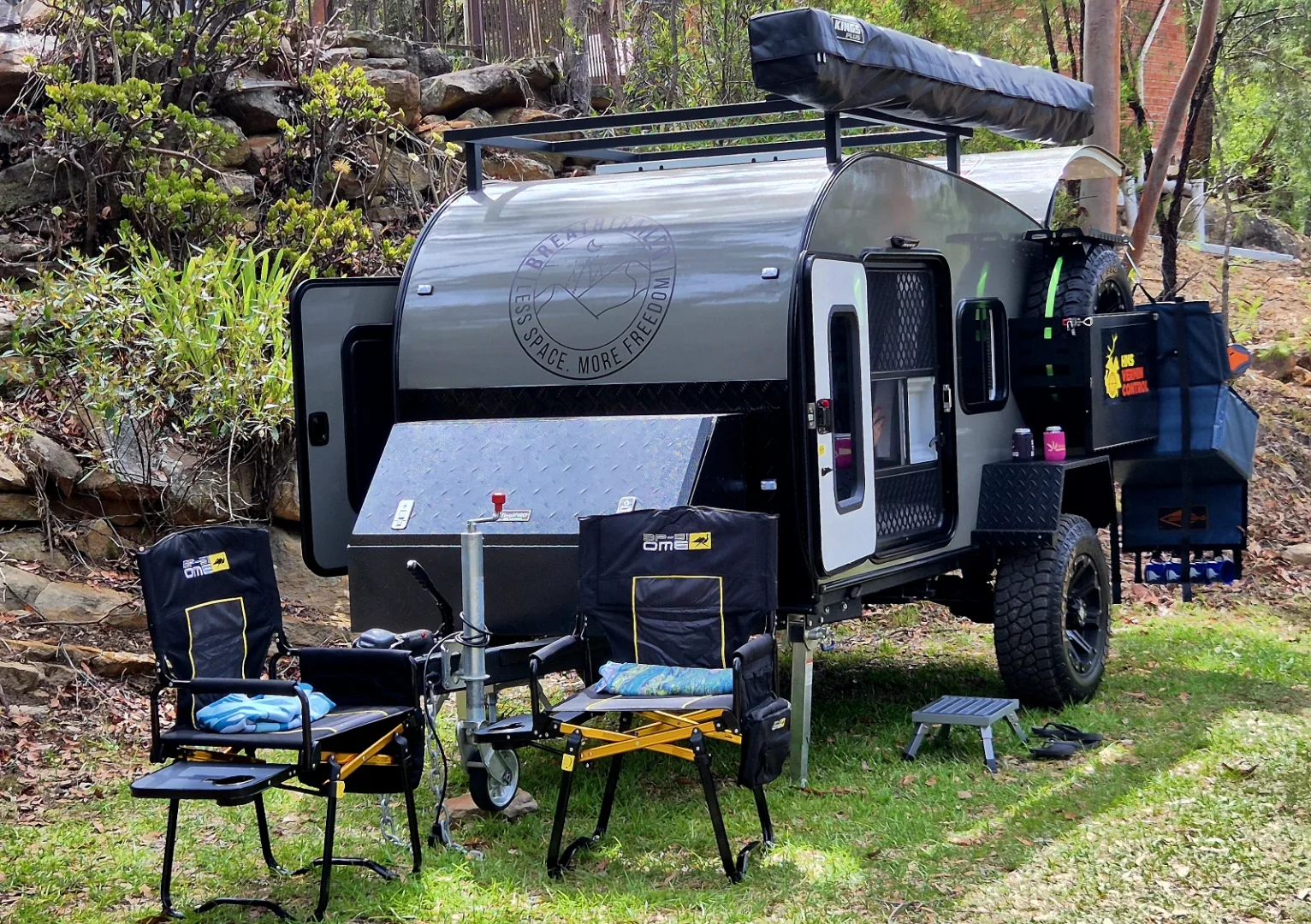
The Blue Mountains sit 100 kilometres west of Sydney’s CBD — close enough to reach on a Friday evening, far enough to feel genuinely remote by Saturday morning. At 268,000 hectares, the Blue Mountains National Park forms part of the Greater Blue Mountains World Heritage Area, a UNESCO-listed wilderness of sheer sandstone cliffs, eucalyptus-scented gorges, and walking tracks that connect one of the world’s great cities to one of its most dramatic escarpments.
For camper trailer owners, the Blue Mountains has a distinct character: this is base-camp country. Set up once at a trailer-friendly campground, leave the rig locked while you day-hike, return to a made bed and a functioning kitchen, and repeat for three or four nights. That rhythm suits a hard-shell teardrop better than almost any other setup — no canvas to stake, a lockable interior, and a galley you can open in under five minutes after a full-day walk.
This guide covers the campgrounds that can take a trailer in 2026 (with honest road and closure notes), the October 2026–March 2027 fire ban you must know about before you book, access from Sydney, the best seasons, and which Breath Trailer model makes the most sense for the terrain.
Quick numbers: 268,000 ha national park area · 140+ walking tracks · 100 km from Sydney CBD · 1,500+ plant species · no entry fee (camping fees apply at booked campgrounds) · open year-round.
Why the Blue Mountains Is Worth the Trip
The mountains’ appeal hasn’t faded. Three UNESCO-listed parks stretch from Richmond in the east to Lithgow in the west; the cliffs drop up to 700 metres into forested gorges; and the viewing platforms at Echo Point draw three million visitors a year. What most of those visitors miss is that the gorges below those lookouts hide campgrounds where you can wake to fog in the valley and a kookaburra on your awning arm.
For camper trailer owners coming from Sydney or the coast, the Blue Mountains solves a common problem: proximity. You don’t need a week off to get there. Leave Friday at 5 pm, pull into Dunphys by 8 pm, be walking through a valley by 9 am Saturday. The best camping spots near Sydney article covers the full spectrum of options within three hours; the Blue Mountains warrant their own deep dive because of the sheer density of things to do from a single campsite.
Why a hard-shell teardrop is the right tool here:
- Daypack and lock. Most Blue Mountains walks are day hikes — long ones. You need to leave your camp unattended for 6–10 hours. A hard-shell, lockable teardrop handles that; a canvas trailer does not.
- Compact footprint. NPWS campsites in the mountains are not wide open paddocks. Sites at Dunphys are grassy but not enormous. A teardrop tucks in where a large caravan could not.
- Damp climate resilience. The Blue Mountains receives up to 1,400 mm of rain per year. A hard shell sheds water from every surface; canvas absorbs it, holds mould, and requires drying after each wet night.
- No campfire required. The October–March fire ban (see below) prohibits campfires. A gas stove and 12V fridge make that irrelevant.
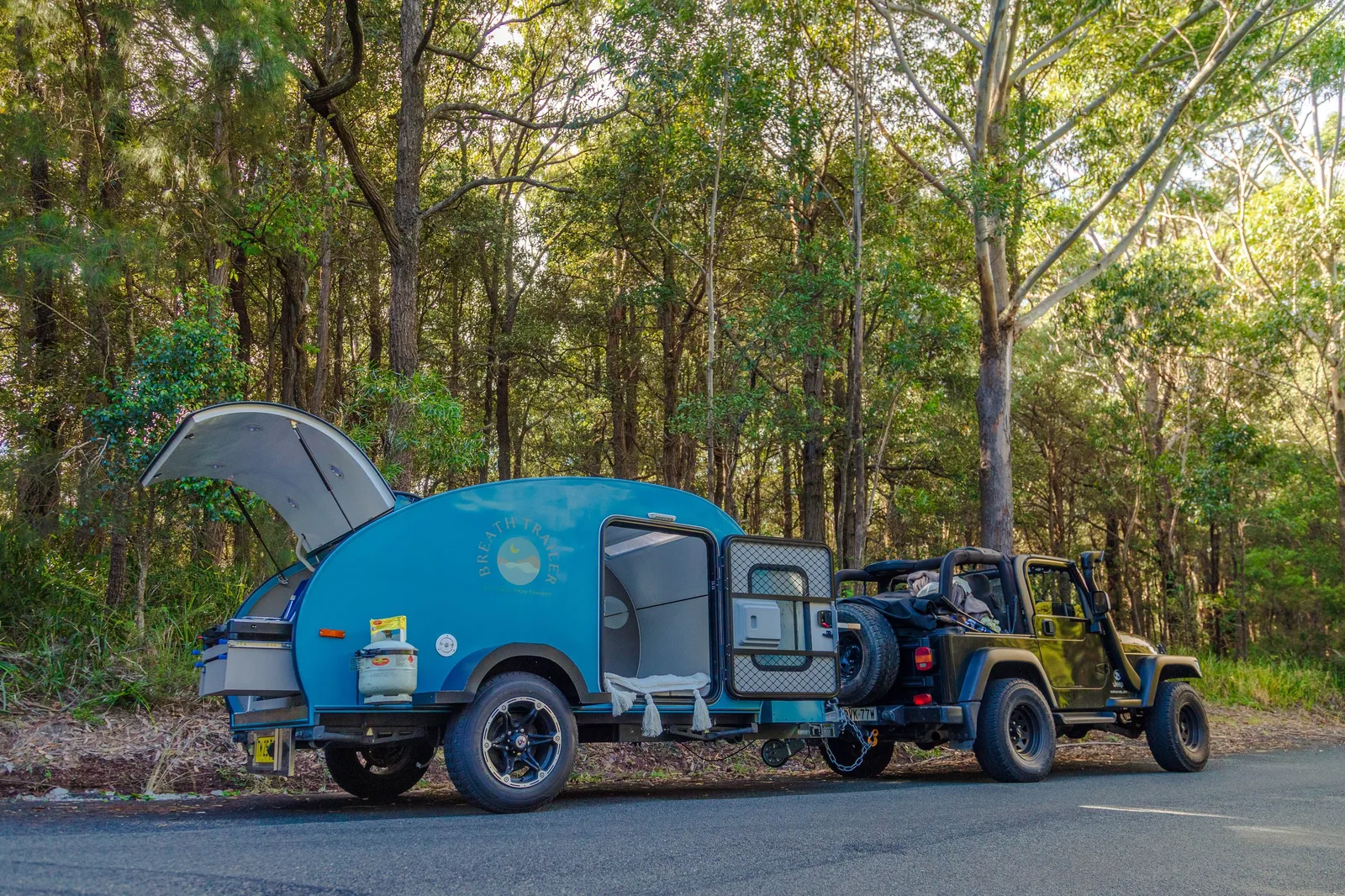
A lockable hard-shell teardrop is the right camp base for the Blue Mountains: leave it while you hike, return to a working kitchen.
Getting There: Distance, Roads and Current Detours
From Sydney: The Great Western Highway (A32) through Penrith and into the mountains is the standard route — roughly 100 km to Katoomba, 90 minutes without Sydney traffic. Allow 2–2.5 hours on a Friday afternoon.
Current road situation (2026): Infrastructure works on sections of the Great Western Highway near Medlow Bath and Leura have created intermittent single-lane sections and detours. Some guides note that travellers coming from Sydney may face a 45-minute delay via a diversion through Lithgow. Check Live Traffic NSW (livetraffic.com) before departure — this varies week to week.
From Canberra: ~220 km via the Federal Highway and Hume Highway to Mittagong, then over the mountains — approximately 2.5–3 hours.
Megalong Valley access: Campgrounds in the Megalong Valley (Dunphys, Old Ford Reserve) require turning south at Blackheath and descending Megalong Road — an unsealed descent with tight bends. Take it slowly. After heavy rain the road can become slippery; check conditions before committing a trailer to the descent.
| Route / Area | Distance from Sydney | Road Type | Trailer-Suitable |
|---|---|---|---|
| Katoomba / Echo Point | ~100 km | Sealed highway | Yes — sealed throughout |
| Blackheath and NPWS campgrounds | ~115 km | Sealed to Blackheath, gravel descent | Standard trailers in dry conditions |
| Megalong Valley (Dunphys) | ~120 km | Sealed to Blackheath, unsealed descent + private property track | Light trailers in dry conditions |
| Newnes (Wollemi NP) | ~165 km via Lithgow | Sealed to Lithgow, gravel final 15 km | Most trailers; slow on gravel approach |
| Glen Davis (Wollemi NP) | ~195 km via Lithgow | Sealed to Capertee, unsealed 18 km | Most trailers; gravel corrugations |
| Boyd River Campground (Kanangra-Boyd NP) | ~175 km | Sealed to Oberon, gravel 40 km | 4WD with off-road trailer recommended |
Blue Mountains Campgrounds for Camper Trailers (2026)
Not every campground in the Blue Mountains area takes trailers — several iconic spots like Euroka (Glenbrook) are walk-in tent sites only. The table below lists the campgrounds that can receive a camper trailer with realistic road notes.
Euroka Campground (Glenbrook) — tents only, no trailers. Frequently listed in camping guides but the NPWS classifies it as walk-in tent sites only. Do not attempt to drive a trailer down to Euroka.
| Campground | Park | Trailer Access | Road | Fee (2026) | Water | Toilets | Notes |
|---|---|---|---|---|---|---|---|
| Dunphys | Blue Mountains NP | Yes — 15 sites | Unsealed track, narrow, through 3 private property gates | Free camping + $6 booking fee | Tank water (treat before use) | Drop toilet | ⚠️ CLOSED 12–26 Oct 2026 for road works. Book via nationalparks.nsw.gov.au |
| Old Ford Reserve | Council-managed (Megalong Valley) | Yes — trailers & 4WD | Unsealed, Megalong Valley | Free | Creek only (treat) | Pit toilet | 10-day limit; first-come; popular weekends |
| Newnes | Wollemi NP | Yes — most trailers | Gravel, 15 km from Lithgow | Free | No — BYO | Flush toilets (at campground) | Near Glow Worm Tunnel; no booking required (first-come) |
| Glen Davis | Wollemi NP adjacent | Yes — trailers & caravans | Gravel 18 km from Capertee | ~$20/adult (2026 NPWS tier rates) | Drinking water | Flush showers | Spacious, good facilities; fires subject to ban |
| Boyd River | Kanangra-Boyd NP | Yes — 4WD + off-road trailer | Gravel 40 km from Oberon | Free | No | Drop toilet | Remote; off-road upgrade recommended; remote area — check NPWS alerts |
| Blue Mts City Council sites (Mt York, Cox’s River area) | Crown/Council land | Yes — trailers permitted | Sealed to township, gravel approach | Free | No water | Pit toilet | 10-day limit (4 days at Mt York); gas or fuel stoves only — no fires |
Booking and fees: NPWS campgrounds that require booking use nationalparks.nsw.gov.au. NSW moved to a six-tier fee structure from 1 July 2026; Dunphys sits at the basic tier (no nightly fee, $6 booking fee). Glen Davis and council-managed sites set their own fee structures. Always check current alerts before travelling — the Blue Mountains receives regular track and campground closures from weather and infrastructure works.
2026 Fire Restrictions: What You Need to Know
A total fire ban covering Blue Mountains National Park runs from 1 October 2026 to 31 March 2027. This means:
- All campfires and solid-fuel stoves (including wood and charcoal) are prohibited
- Gas stoves and electric appliances are permitted (LPG/butane camping stoves are fine)
- Some campgrounds or specific sites may be exempt — check the NPWS alert page for your campground before departure
- Penalties apply; park rangers patrol popular campgrounds
For camper trailer owners, this is less of a disruption than it sounds. A 12V fridge and a two-burner gas stove cover the full camping kitchen without needing a campfire. The Breath Plus and above include a built-in gas stove slide drawer — you arrive, set up, cook on gas, and the fire ban has no impact on your comfort.
What you lose is the campfire experience. For the October–March period, plan your Blue Mountains trip for evenings of trail fatigue, a warm meal on gas, and early lights-out rather than fire-side socialising. Consider the June–September window if campfires matter to your trip.
Current fire danger information: RFS (NSW Rural Fire Service) — rfs.nsw.gov.au.
What to Do: Hiking, Canyons and Glow Worms
The Blue Mountains rewards the base-camp approach better than almost any park in eastern Australia. One campsite — Dunphys is the standard — can fuel five days of completely different activities without moving the trailer.
Day walks from Dunphys and Blackheath:
- Prince Henry Cliff Walk (7 km, Katoomba to Leura) — 20 lookouts including Echo Point, the Three Sisters and Leura Cascades. Grade 3; no trailer access at the walk itself but drive 20 minutes to the trailhead.
- Six Foot Track (42 km, Katoomba to Jenolan Caves) — three-day trail through Megalong Valley, crossing the Coxs River at Old Ford Reserve campground. Dunphys sits midway on the track’s southern variant.
- Bellbird Point Walk (3 km, Blackheath) — easy family walk through forest and heath to a valley lookout. Listed by NPWS as a recommended short walk from Dunphys in spring.
- Kanangra Walls (30 km from Dunphys, day trip) — spectacular plateau lookout and waterfall, bushwalk to the base. No trailer access at Kanangra-Boyd NP visitor area; leave the rig at Dunphys and drive in.
- Narrow Neck Trail (mountain biking, Katoomba) — part of a designated mountain biking network including Faulconbridge Ridge and Woodford Oaks.
Glow Worm Tunnel (Newnes, Wollemi NP): A 400-metre disused railway tunnel through which thousands of bioluminescent glow worms light the roof. Access from the Newnes campground, 1 km walk. Free entry. Take a torch; turn it off inside. This is the main drawcard for camping at Newnes.
Jenolan Caves: Limestone cave system 60 km south-west of Katoomba. Not a camping destination in itself (accommodation is the historic Jenolan Caves House) but a logical day trip from a Dunphys base. Entry tickets from approximately $42–55 per adult for guided cave tours (2026 pricing; book ahead on busy weekends).
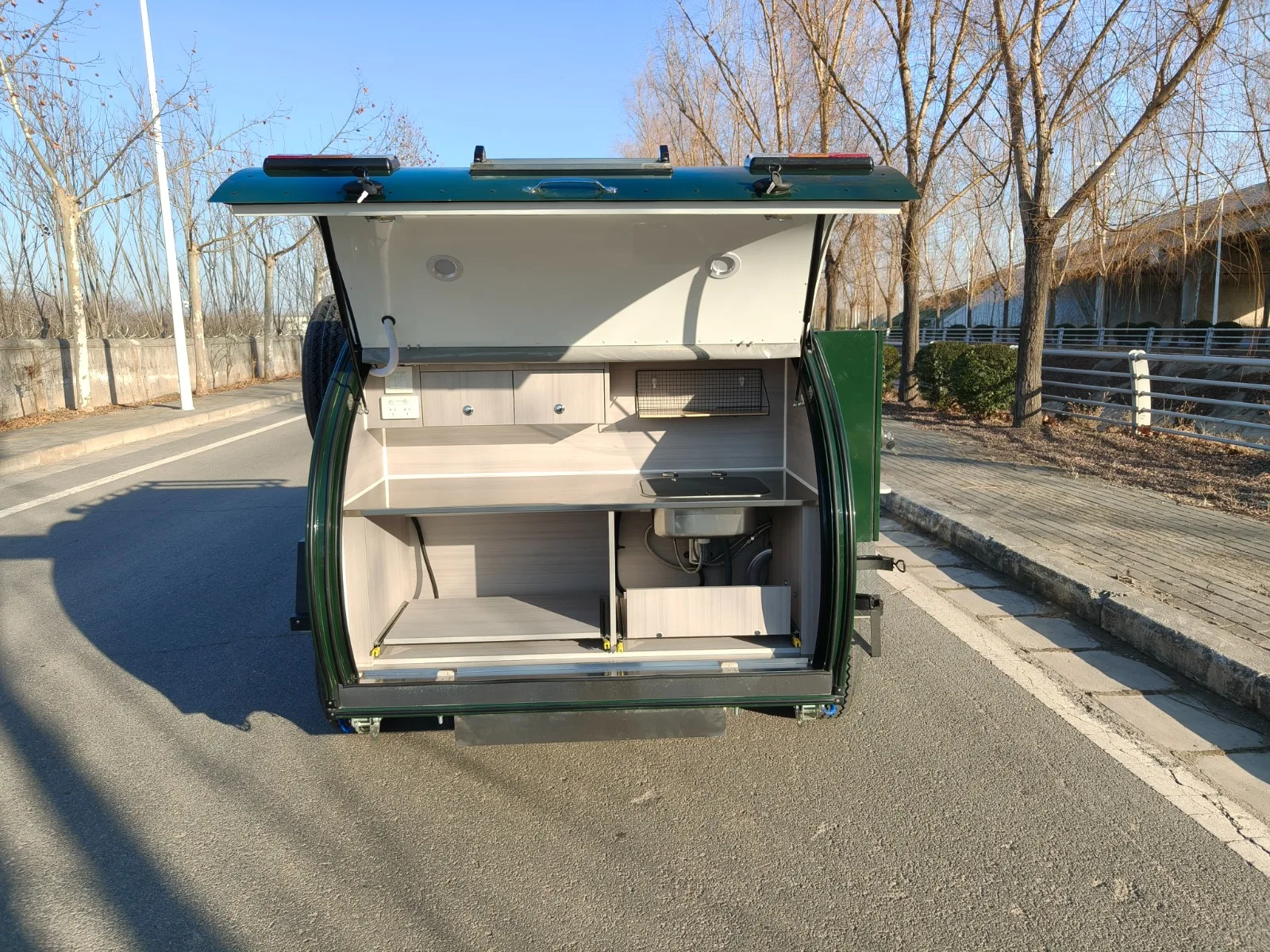
The Breath Plus rear kitchen keeps the full galley accessible for cooking after long day hikes — no need to unpack anything inside the trailer.
Best Time to Visit the Blue Mountains
| Season | Temperatures | Crowds | Notes |
|---|---|---|---|
| Spring (Sep–Nov) | 12–22 °C days, overnight lows 5–10 °C | Moderate, rising through October long weekend and school holidays | Best wildflower displays and waterfall flow; October long weekend books out fast |
| Summer (Dec–Feb) | 20–32 °C, occasional heat events | High through January school holidays | Fire ban in force Oct–Mar; can be uncomfortably warm in the gorges; afternoon thunderstorms common |
| Autumn (Mar–May) | 10–25 °C | Low–moderate | Best walking weather; Easter weekend fills campgrounds 6–8 weeks ahead |
| Winter (Jun–Aug) | 2–15 °C, frost possible overnight | Low | Campfires allowed (outside the fire ban period); fog in the valleys at dawn; excellent solitude; Dunphys and Old Ford can be muddy after June rain |
October–November is the sweet spot for spring. Temperatures are comfortable, the wildflowers in the heathland above the gorges are at their best, and the waterfalls carry the full winter-rain charge. The Saturday of the October long weekend is the single busiest night of the year at Dunphys — book as early as possible or aim for a Tuesday–Thursday arrival.
Winter strategy: Late June and July see very few visitors. Campfires are permitted (outside the October–March ban), and the mountains take on a completely different character — fog banks sitting in the gorges at dawn, wallabies coming into the campsites at dusk, and almost no other tents. Pack a diesel heater or heavy sleeping bag; overnight lows can hit 2°C at Dunphys elevation.
Self-Containment, Water and Dump Points
Is self-containment required? NSW does not mandate self-containment for national park campgrounds the way WA or some NT land types do. However:
- Free-camping sites (Old Ford Reserve, Boyd River, council crown land) have no toilet facilities or only a pit toilet. Self-containment means no grey water on the ground — take a portable grey water tote or tank with at least 8 litres per person per day.
- Remote campgrounds (Newnes, Boyd River) have no dump points. Your grey water comes back with you to the nearest caravan park or council dump point.
- Nearest dump points from Katoomba: Katoomba Caravan Park and Blackheath Caravan Park both have dump points. Check WikiCamps or CamperMate for the full Blue Mountains dump point map before departure.
Water: Dunphys has a tank but NPWS recommends treating all tank water before drinking. Old Ford and Boyd River have no drinking water supply — carry at least 15 litres per person as a minimum reserve. The Breath Ultra and Max carry an 80-litre water tank; the Essential and Plus carry a 60-litre tank. On a three-day trip for two, you will use 6–10 litres per day for drinking and cooking — that is well within tank capacity if you arrive full.
Grey water rules: No grey water into watercourses (Coxs River, Megalong Creek). At sites without dedicated grey water disposal, collect into a tote and empty at the caravan park dump point. Read the camper trailer water system guide for full grey water rules by NSW land type.
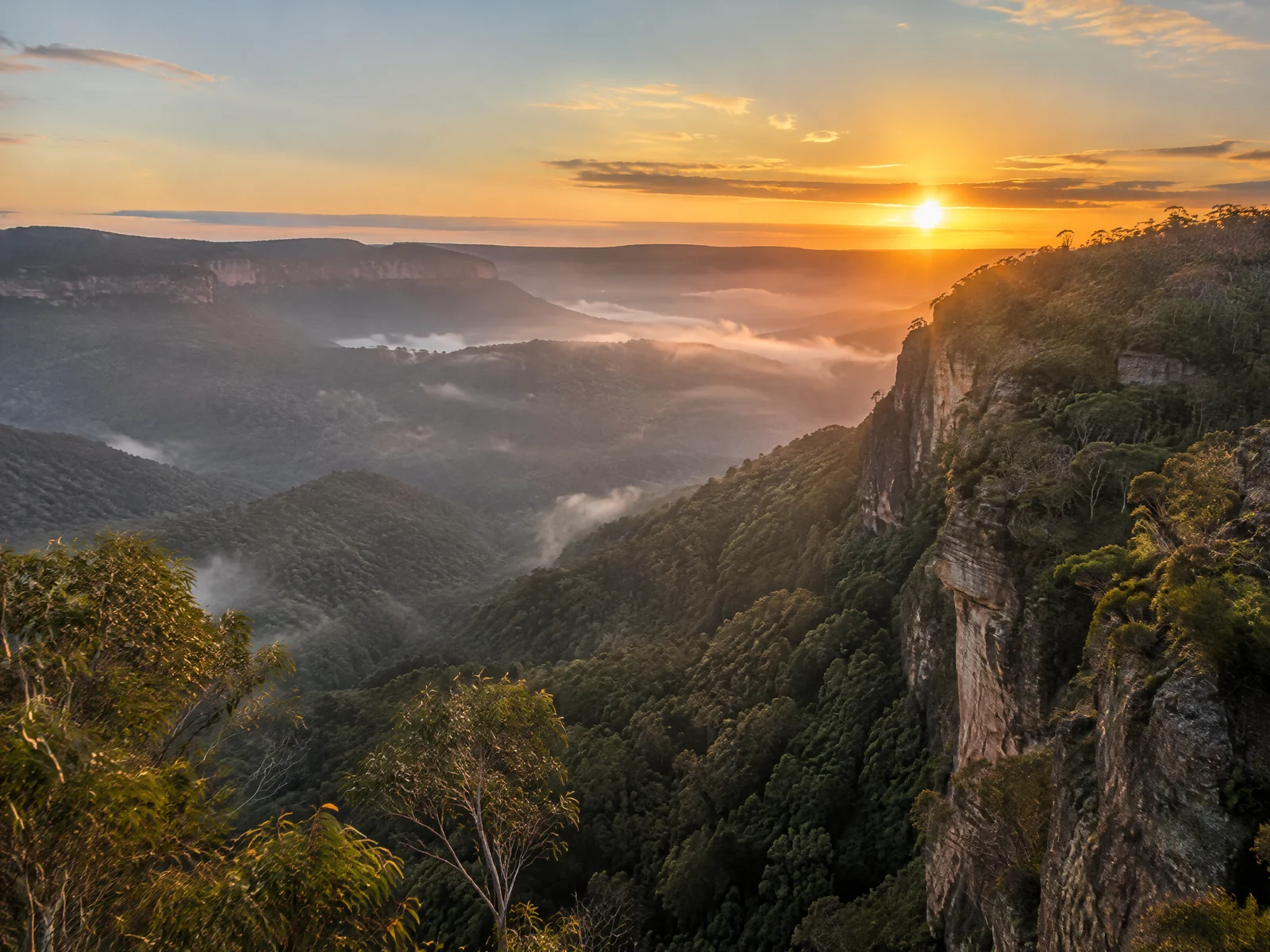
Illustration: The Greater Blue Mountains World Heritage Area protects 268,000 hectares of sandstone plateau, gorge and heath.
Towing Tips for Blue Mountains Roads
The Blue Mountains is not extreme 4WD territory, but the unsealed roads do have specific characteristics worth knowing before you back the trailer down a descent.
Megalong Valley descent (Megalong Road from Blackheath): This is the main pinch point for Blue Mountains trailer owners. The road narrows to single lane in sections, drops sharply, and has gravel that becomes loose over a wet winter. Take it at walking speed with low range if your vehicle has it. A camper trailer towing guide covers hill-descent technique; the key principle is engine braking before applying trailer brakes on a descent.
Reversing into Dunphys: The campground has a loop road with limited turnaround space. Practice reversing your camper trailer at home before attempting a narrow bush campground on a busy Friday evening. A rear camera makes this significantly easier.
Tyre pressure on gravel: Reduce tyre pressure from sealed-road settings (35–40 psi) to 28–32 psi for the gravel approach roads to Newnes and Glen Davis. This improves traction and reduces the risk of sidewall damage from sharp gravel. The camper trailer tyre guide covers pressure tables for different surface types. Reinflate before returning to the highway.
Weight and payload: The Megalong Valley descent concentrates any tail-heavy load. Pack the densest gear low and forward (over the axle). For a full Blue Mountains trip with hiking boots, day packs, food, and water, a typical couple will load 180–250 kg. All four Breath Trailer models carry payload capacity well above this — but weigh the payload before departure if you are close to the ATM limit. More on teardrop camper weight by model.
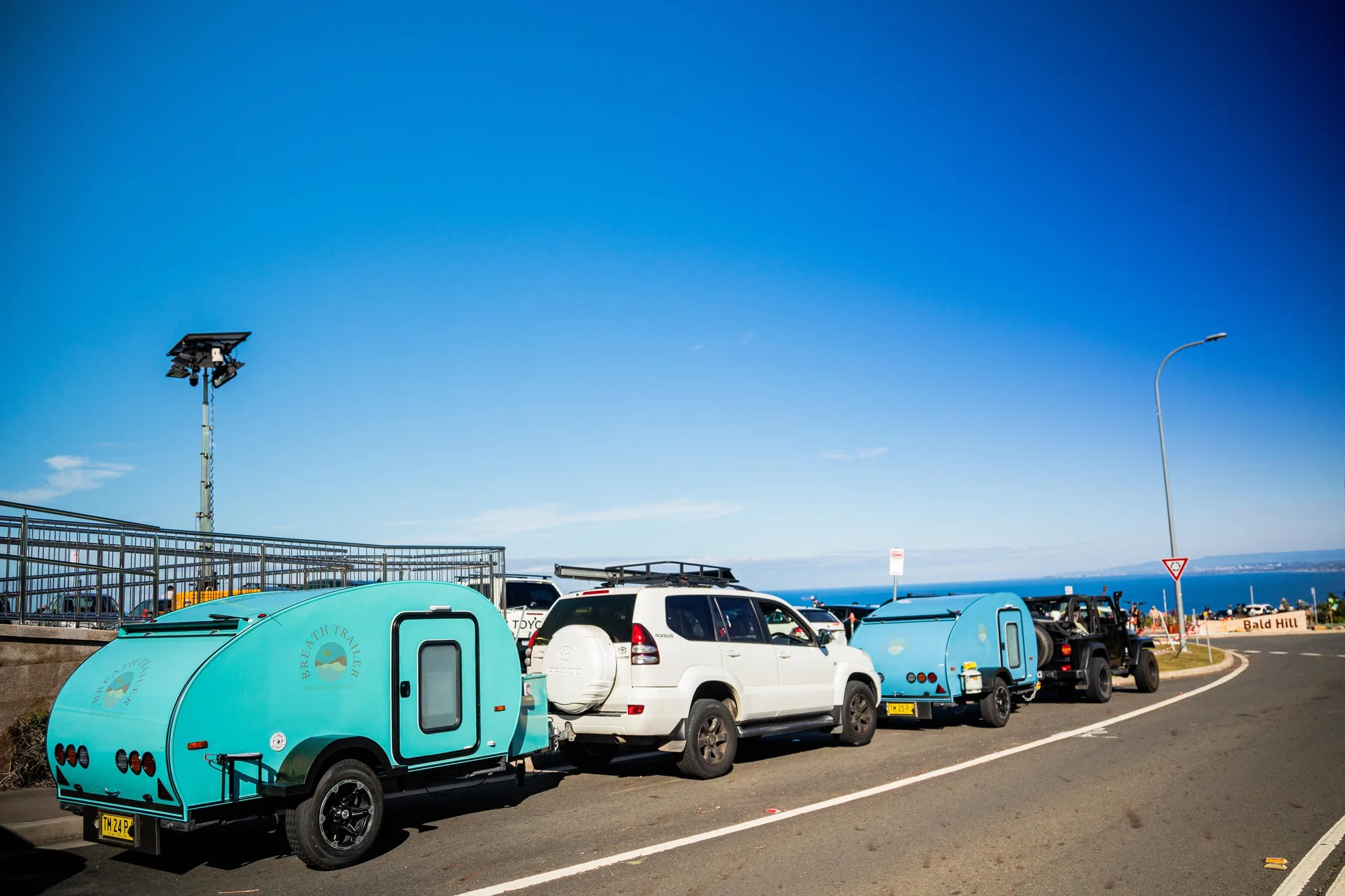
Both vehicles have sufficient ground clearance for the Megalong Valley descent — the key is speed, not hardware. Slow is right.
Which Breath Trailer Model for the Blue Mountains?
The Blue Mountains rewards self-sufficiency. You will be away from power and dump points for 2–4 nights, day hiking from the trailer, and possibly dealing with cold overnight temperatures.
| Model | Best for | Trade-offs |
|---|---|---|
| Breath Essential ($23,320, 700 kg tare) | Single nights, couples with a small SUV, day-trip base camp | 60 L water tank; no external shower; shorter range for multiple nights without top-up |
| Breath Plus ($29,766, 800 kg tare) | 2–4 night trips, couples, fridge standard, gas stove | External shower via optional add-on; no interior bathroom |
| Breath Ultra ($34,749, 900 kg tare) | 3–5 nights, couples wanting external shower, stronger off-road capability | No interior bathroom; 80 L tank |
| Breath Max ($42,900, 1,200 kg tare) | Extended base camp, self-contained free camping, families | Larger footprint (check your campsite dimensions at Dunphys) |
For most Blue Mountains trips (2–3 nights, standard NPWS campground): the Breath Plus is the practical answer. The fridge-included model means no ice or external cooler, the gas stove handles the campfire ban, and 800 kg tows easily behind any medium SUV.
If you want to extend toward free camping or more remote sites (Boyd River, wild sections of the Six Foot Track corridor): the Breath Ultra or Max adds the self-containment capability — 80 L water tank plus grey water tank — that lets you go several days further from services.
If driving a smaller SUV (Mazda CX-5, Subaru Forester, Toyota RAV4): all four Breath models are within the tow rating of these vehicles. Check your vehicle’s maximum tow rating against the ATM of each model in the best tow vehicle guide.
See the comparison page for a full side-by-side of all four models, or book a viewing at the Sydney showroom in Holroyd to walk through one before your Blue Mountains trip.
Blue Mountains Packing Checklist for Camper Trailer Owners
| Category | What to Bring | Notes |
|---|---|---|
| Navigation | Hema Maps app or physical Hema NSW map | No mobile data in many gorge locations |
| Safety comms | PLB or Garmin inReach Mini 2 | Mobile blackspots are common below the escarpment |
| Fire restriction | Gas stove (in-trailer or portable), lighter, backup lighter | Campfires prohibited Oct 2026–Mar 2027 |
| Water | Full tank + 10 L jerry can reserve | No drinking water at Old Ford, Boyd River or some free sites |
| Grey water | Grey water tote or tank | No ground disposal near watercourses |
| Hiking | Day pack, walking poles for knee-heavy descents | Prince Henry Cliff Walk has steep sections |
| Cold nights | Winter-weight sleeping bag or onboard diesel heater | June–August lows can reach 2–3 °C at elevation |
| Tyres | Minimum 4 mm tread; carry a spare | Megalong gravel is sharp |
| Torch | Head torch + spare batteries | Required for Glow Worm Tunnel (and campground toilets at night) |
Frequently Asked Questions
Can I take a caravan to Dunphys campground? Dunphys accepts camper trailers, but the access track is narrow, unsealed, passes through three private property gates, and is steep in sections. Large caravans (over 6 m) should not attempt it. Compact hard-shell trailers up to about 5.5 m handle it in dry conditions. Check NPWS current alerts before departure — Dunphys has road closures for infrastructure works several times a year.
Is there a park entry fee for Blue Mountains National Park? No. Unlike Kosciuszko or Kakadu, there is no vehicle entry fee to enter Blue Mountains National Park. Campground fees apply at booked sites (currently $6 booking fee at Dunphys; Glen Davis charges approximately $20/adult per night under the 2026 NPWS tier rates).
Can I have a campfire at Blue Mountains campgrounds? Not from 1 October 2026 to 31 March 2027. A total fire ban covers the park during this period, prohibiting all solid fuel fires including campfire rings, fire pits and solid-fuel stoves. Gas stoves and electric appliances are permitted. The ban is enforced; fines apply.
Which campground is best for families with children? Glen Davis (Wollemi NP, accessible from Capertee via Lithgow) has the best facilities for families: flush toilets, hot showers, and drinking water. The road is gravel for the final 18 km but manageable with a standard camper trailer. Dunphys is also family-friendly but has no showers or drinking water, and the access track requires more confidence on a descent.
Is the Blue Mountains suitable for off-road camper trailers? Most NPWS and council campgrounds in the mountains are accessible with a standard camper trailer in dry conditions — you don’t need a purpose-built off-road setup. Boyd River (Kanangra-Boyd NP) is the exception, with a 40 km gravel track from Oberon where an off-road trailer and 4WD combination is recommended. See the must-have accessories for off-road adventures guide for recovery gear to carry.
How far is the Blue Mountains from Sydney? Katoomba is approximately 100 km west of Sydney CBD, typically 90 minutes without traffic. Allow 2.5 hours on a Friday afternoon. Dunphys campground in the Megalong Valley adds another 20–25 minutes from Katoomba via the Blackheath descent.
Recommended Reading
- Best Camping Spots Near Sydney (Within 3 Hours) — covers the full spectrum of Sydney-accessible campgrounds by drive time
- Best Camping Spots in NSW — statewide guide including Blue Mountains, South Coast, Snowy Mountains and beyond
- Camper Trailer Towing Guide Australia — pre-trip hitching checklist, hill descent technique and speed limits
- Free Camping Australia: Camper Trailer Guide — using WikiCamps and CamperMate to find free sites near the mountains
Ready to get your rig sorted before the Blue Mountains trip? Book a viewing at the Breath Trailer Sydney showroom in Holroyd, or compare all four models to find the right fit for your towing setup and travel style.