The Ultimate Lap Around Australia Preparation Guide (2026)
Planning the Big Lap in 2026? Real distances, weekly budgets, season timing, vehicle prep, self-containment and the admin nobody warns you about.
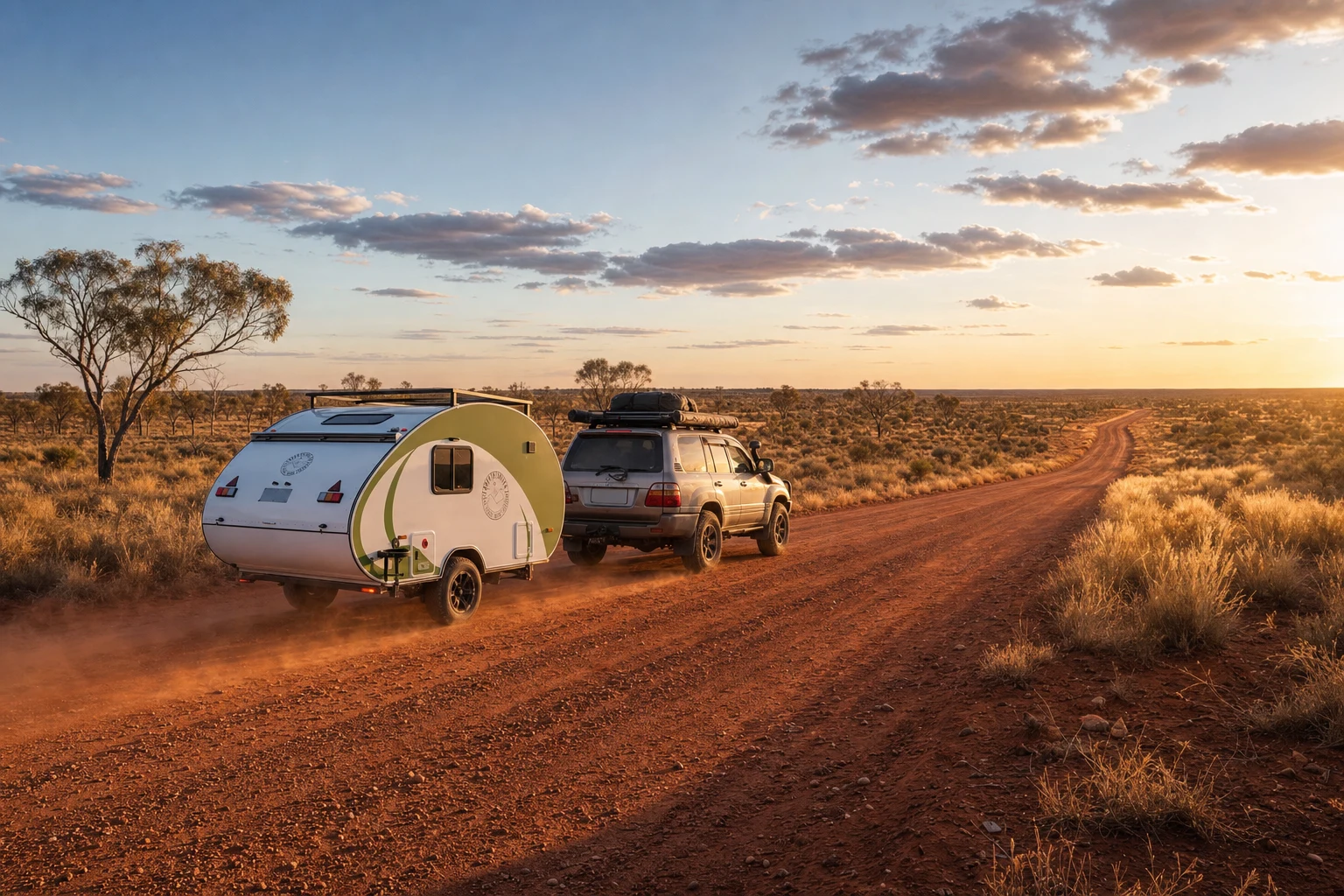
Highway 1 runs roughly 14,500 kilometres around the edge of this continent, which makes it the longest continuous national highway on earth. Add the detours almost everyone takes — Kakadu, the Karijini, the Great Ocean Road, a run up to Cape York — and a realistic lap lands somewhere between 15,500 and 30,000 km. Most people take between three months and a year to do it.
That is the easy part to research. The harder part is that a lap around Australia is not really a driving challenge. Highway 1 is sealed the whole way and any road-registered camper can complete it. What the Big Lap actually tests is your preparation, your budget discipline and your setup. With national diesel averaging about $1.99 a litre in mid-2026 — closer to $2.07 in regional areas and up to $3.00 at remote roadhouses — a heavy rig can burn through the difference between a six-month trip and a twelve-month trip in fuel alone.
This lap around Australia preparation guide covers what the planning articles usually skip: the honest weekly numbers, how your setup choice compounds over 20,000 km, the mechanical prep schedule, self-containment maths, and the administrative work you need to finish before you leave. Written from a Sydney workshop that has handed over 350+ campers, many of them to people leaving on exactly this trip.
What the Big Lap Actually Is: Distance, Duration and Route
“The Big Lap” is shorthand for circumnavigating Australia, usually following Highway 1. There is no single correct version of it. The variable is how far you stray from the ring road.
| Version of the lap | Approx. distance | Realistic duration | Driving days per week |
|---|---|---|---|
| Highway 1, minimal detours | 14,500–16,000 km | 3–4 months | 3–4 |
| Highway 1 + major national parks | 18,000–22,000 km | 6–8 months | 2–3 |
| Full lap + Cape York, Gibb River Rd, Red Centre | 25,000–30,000 km | 9–12 months | 2–3 |
| ”Fast lap” (holiday timeframe) | 14,500 km | 6–8 weeks | 5–6 |
The fast lap is possible and plenty of people do it, but it turns the trip into a driving job. Most experienced travellers say the same thing: the single biggest regret is moving too quickly. Slowing down also happens to be the cheapest way to travel, because fuel is the one cost you control by simply not driving.
A useful planning rule: budget 2–3 driving days per week, and no more than 300–400 km on a driving day when you are towing. That pace covers 16,000 km comfortably in six months and leaves genuine time in the places you came to see.
When to Leave and Which Direction to Travel
Direction is not a matter of preference. It is a consequence of your departure date, because you are chasing the dry season north and the mild season south.
The tropical north — Broome, Darwin, Cairns, the Kimberley — has a wet season from November to April and a dry season from May to October. Travelling the north in the wet means humidity, road closures, flooded creek crossings and closed national parks. Travelling the southern coast in mid-winter means cold, wet camping.
| Departure window | Recommended direction | Why |
|---|---|---|
| Feb–April (from NSW/VIC) | Anticlockwise (north up the east coast first) | Arrive in QLD/NT for the dry season, hit WA in winter, return south in spring |
| Sept–Nov (from NSW/VIC/SA) | Clockwise (west across the Nullarbor first) | Southern WA in spring, north-west WA before the wet, east coast in autumn |
| May–July | Anticlockwise, north immediately | Straight into peak dry season, but expect the busiest campgrounds |
| Dec–Jan | Head south only; delay the lap | Wet season north, extreme heat inland, school-holiday pricing everywhere |
Anticlockwise from the east coast in autumn is the most common pattern, and there is a practical reason beyond weather: it puts the long remote legs (Darwin to Broome, the Nullarbor) in the middle of your trip, once you and your rig have shaken out the faults that always appear in the first fortnight.
The ideal overall window is June to February: tropical north between June and September, everything else between September and February.
What the Big Lap Really Costs in 2026
Cost is where the Big Lap plans quietly fall apart. Caravan park pricing has moved sharply since 2023 — sites that were $50 a night are now $80–$120 in coastal hot spots during peak periods. Here is a realistic weekly budget for a couple travelling at a moderate pace:
| Category | Frugal / week | Moderate / week | Comfortable / week |
|---|---|---|---|
| Fuel (towing, 2–3 driving days) | $180 | $250–$400 | $450+ |
| Camping / accommodation | $60 (mostly free camps) | $200–$500 | $600+ |
| Groceries and essentials | $180 | $200–$300 | $350+ |
| Activities, tours, dining | $30 | $80–$200 | $400+ |
| Maintenance, repairs, incidentals | $50 | $50–$150 | $200+ |
| Weekly total (couple) | ~$500 | $700–$1,350 | $2,000+ |
Scaled up, that produces the numbers you should actually plan against:
| Trip length | Couple (moderate) | Family of four (moderate) |
|---|---|---|
| 3 months | $15,000–$18,000 | $12,000–$14,000 (frugal) to $25,000–$35,000 |
| 6 months | $22,000–$35,000 | $28,000–$45,000 |
| 12 months | $36,000–$70,000 | $50,000–$85,000 |
Two line items dominate, and both are controllable.
Fuel. A 25,000 km lap at 2026 diesel prices is roughly $7,500 to $12,000 before you find a single campsite. That figure is a direct function of what you tow — which is the next section.
Camping. Mixing free camps with paid parks is the single biggest lever on your weekly number. WikiCamps lists more than 65,000 sites, including free camps, rest areas, dump points and water taps, for a one-off fee of around $10. National park fees remain excellent value: Queensland charges about $7.75 per person per night, while NSW moved to a six-tier system from July 2026 ranging from free to $89 depending on the campground. Caravan parks are worth paying for roughly every fifth or sixth night — laundry, long showers, a proper battery top-up — not every night.
Budget an explicit maintenance fund. Corrugations, bulldust and 20,000 km of touring will cost you something: tyres, bearings, a windscreen, a suspension bush. Set aside $2,000–$4,000 for a long lap and treat it as spent.
Choosing Your Setup: Why Weight Decides Your Fuel Bill
Every Big Lap article tells you to “choose the right setup”. Almost none of them show you what the choice costs over the distance you are about to drive.
Here is the same 25,000 km lap, modelled at $2.05 a litre, with typical owner-reported towing consumption for a mid-size to large SUV or dual-cab ute:
| Setup | Typical tare | Typical towing economy | Fuel over 25,000 km | Setup time |
|---|---|---|---|---|
| 4WD + rooftop tent | +60–80 kg on the roof | 11–13 L/100 km | $5,600–$6,700 | 5–10 min, every night |
| Hard-shell teardrop camper | 700–1,200 kg | 12–15 L/100 km | $6,150–$7,700 | ~5 min |
| Forward-fold camper trailer | 1,200–1,800 kg | 14–17 L/100 km | $7,200–$8,700 | 10–20 min |
| Off-road hybrid caravan | 2,000–2,800 kg | 16–20 L/100 km | $8,200–$10,250 | 5–15 min |
| Full-size touring caravan | 2,800–3,500 kg | 18–24 L/100 km | $9,200–$12,300 | 10–20 min |
The gap between the lightest and heaviest options is $5,000 to $6,000 in fuel on a single lap — real money, and roughly a year of camping fees. It is also why weight is the first specification to check on any camper, not the last. If you are unsure how tare, ATM and payload interact, our camper trailer weight guide explains the numbers that actually matter on your compliance plate.
Weight is not the only consideration, though, and it would be dishonest to pretend otherwise:
- A caravan wins on living space. If you are travelling with two or more children, or you need an indoor space to sit out three rainy days, a caravan or hybrid earns its fuel bill.
- A rooftop tent wins on purchase price but loses on convenience: you cannot leave camp set up while you drive into town, and the roof load penalty follows you everywhere.
- A teardrop wins on the two things that matter most over a long trip: fuel, and the ability to unhitch in ten seconds and use the tow vehicle as a day-trip 4WD.
That last point is underrated. Over six months you will do perhaps sixty day trips — into Karijini gorges, up to a lookout, into town for supplies. Every one of those is easier when your accommodation stays behind at camp. Our comparison of camper trailer types works through the trade-offs by use case.
Preparing the Tow Vehicle and Trailer
A full mechanical service before departure is non-negotiable, and it should happen four to six weeks out, not the week before — you want time to fix whatever the service uncovers.
| System | Pre-departure action | On-the-road interval |
|---|---|---|
| Engine oil, filters, fluids | Full service, all fluids replaced | Per manufacturer, or every 10,000 km on dirt |
| Belts and hoses | Replace anything over 4 years or cracked | Visual check monthly |
| Brakes (vehicle) | Pads, rotors, fluid flush | Inspect every 10,000 km |
| Trailer electric brakes | Test controller gain, check magnets and wiring | Test at the start of every driving day |
| Tyres (vehicle + trailer) | Replace anything over 5 years regardless of tread; fit AT or LT construction | Rotate every 5,000–10,000 km; pressures daily |
| Spares | 1 full-size spare minimum, 2 for remote routes | — |
| Wheel bearings (trailer) | Repack and inspect before departure | Every 2,500 km on corrugations, 10,000 km sealed |
| Suspension | Inspect bushes, shocks, hangers | Visual check every fuel stop |
| Battery and 12V system | Load test batteries, check all terminals | Monitor state of charge daily |
| Water and gas systems | Sanitise tanks, pressure-test lines, gas compliance check | Sanitise every 3 months |
Two of these deserve emphasis because they cause the majority of roadside failures on long trips.
Tyres age out before they wear out. Australian UV degrades rubber faster than tread wears, so a five-year-old tyre with plenty of tread is still a liability on the Nullarbor. Check the four-digit DOT date code on every tyre, including both spares.
Wheel bearings are the number one trailer failure on a lap. Corrugated roads destroy them at a rate sealed-road owners never see, and a seized bearing 300 km from the nearest town is a very expensive tow. Carry a spare bearing kit and seals for your hubs, learn the hand-on-hub temperature test, and read our full breakdown of why wheel bearings matter on a camper trailer before you go.
Spares kit for remote legs: fan belt, radiator hoses, coolant, transmission fluid, engine oil, fuses, globes, trailer bearing kit and seals, tyre plug kit, 12V compressor, a length of 12V cable, hose clamps, cable ties, gaffer tape, and a basic toolkit you actually know how to use.
Water, Power and Self-Containment Over Six Months
On a two-week holiday you can get away with a marginal power system, because you are never more than a couple of days from a powered site. On a lap, your systems either work indefinitely or they dictate your entire route.
The maths is simple. A couple uses roughly 10 litres of water per person per day for drinking, cooking and washing — call it 20 L/day, or 140 L a week. A 12V fridge draws 45–60 Ah per day in warm weather, which is most of your daily power budget. Lighting is negligible by comparison at around 7.5 Ah a night.
| Requirement | What it means over a long lap |
|---|---|
| Water | 80–100 L tank = 4–5 days for a couple before a refill |
| Power | 100–120 Ah lithium + 200–300 W solar = effectively unlimited in sun |
| Fridge | 40–60 L compressor fridge; ice boxes are unworkable past a few days |
| Grey water | Increasingly required to be contained; a tank or bladder unlocks more sites |
| Toilet / shower | Determines whether free camps and remote parks are actually usable |
Self-containment is the difference between free camping being a pleasant option and free camping being a compromise you stop making by month two. A growing number of council-run and remote sites require vehicles to be fully self-contained, meaning you carry your own toilet and contain your grey water. Our guide to self-contained campers in Australia covers the CMCA rules and state-by-state grey water requirements in detail.
Here is how our four models handle a long lap:
| Model | Price (AUD) | Tare | Water | Bathroom | Suited to |
|---|---|---|---|---|---|
| Breath Essential | $23,320 | 700 kg | Onboard tank | External wash | Frugal laps, mostly paid or basic sites |
| Breath Plus | $29,766 | 800 kg | Onboard tank | External wash | Long laps with a fridge included as standard |
| Breath Ultra | $34,749 | 900 kg | Onboard tank | External hot shower | Extended remote legs, couples who camp off-grid |
| Breath Max | $47,190 | 1,200 kg | Onboard tank | Full interior bathroom — toilet and shower | Indefinite laps, free camping, 2.1 m standing headroom |
The Breath Max remains the only teardrop on the Australian market under $50,000 with a full interior bathroom, which is precisely the specification that makes a twelve-month lap sustainable for people who do not want to plan their days around amenity blocks. If bathroom access is not a dealbreaker for you, the Ultra’s external hot shower covers most touring comfortably at $8,700 less.
For sizing your own system rather than taking ours on faith, work through how much solar you actually need and how long you can realistically stay off grid.
Communications and Safety on Remote Legs
Mobile coverage on Highway 1 is better than it was, but there are still multi-hundred-kilometre stretches — the Nullarbor, the Barkly, much of the Kimberley — with nothing.
| Device | Approx. cost | What it does | Verdict |
|---|---|---|---|
| PLB (GME MT610G) | ~$389 | One-way distress beacon, no subscription | Minimum requirement for remote travel |
| Garmin inReach Mini 2 | ~$599 + plan | Two-way satellite messaging, tracking, SOS | Best all-round for a long lap |
| ZOLEO | ~$300 + plan | Two-way messaging via app | Good budget two-way option |
| UHF CB radio | $150–$600 | Road-train and convoy comms, channel 40 | Essential when towing |
| Starlink Mini | ~$599 + monthly | Genuine broadband at camp | Only if you are working remotely |
Carry an emergency water reserve of at least 20 litres separate from your main tank, a proper remote-area first aid kit including a snake bite compression bandage, and offline maps (Hema or a downloaded equivalent) that do not depend on reception. Our must-have accessories for off-road adventures covers recovery gear, tyre management and comms in full.
The Admin Nobody Talks About
This is the section that gets skipped, and it is the one that generates the panicked phone calls in month two. Sort all of it before you leave.
| Task | What to do | When |
|---|---|---|
| Australia Post redirection to a family member, or a mail-forwarding service; Post Restante for pickup on the road | 4 weeks out | |
| Residential address | Keep a permanent address for licence, rego and Medicare — a family member’s is fine and legal | 8 weeks out |
| Vehicle and trailer insurance | Confirm you are covered for off-road use and for long-term touring; many policies exclude unsealed roads | 6 weeks out |
| Contents cover | Insure what is in the camper — laptops, cameras, tools — separately if needed | 6 weeks out |
| Roadside assistance | Upgrade to a plan with remote-area towing limits that reflect actual outback distances | 4 weeks out |
| Banking | Two cards on two different networks, held separately; notify your bank of extended travel | 4 weeks out |
| Medicare and scripts | Extended prescriptions, My Health Record enabled, telehealth account set up | 6 weeks out |
| Rego renewals | Note the dates for both vehicle and trailer; set calendar alarms; confirm you can renew online | 8 weeks out |
| Your house | Rent it out, house-sit it, or lock it up — decide early, it drives your whole budget | 12 weeks out |
On insurance in particular: a standard trailer policy may not cover you for corrugated-road damage or long-term touring away from a home address. Read the product disclosure statement rather than the marketing page, and see our teardrop camper insurance guide for what the exclusions typically look like in practice.
The Packing System: Weight Discipline
Everyone overpacks. The consequence is not just inconvenience — it is exceeding your camper’s ATM or your vehicle’s GVM, which is both illegal and an insurance-voiding event if you have an accident.
Weigh your rig fully loaded at a public weighbridge before you leave. Not estimated. Weighed. Most people are surprised, and about a third are over.
| Category | Discipline rule |
|---|---|
| Clothing | 7 days’ worth, no more. You will do laundry weekly regardless |
| Kitchen | One pot, one pan, one kettle, plates for your party plus two |
| Tools | Only what you can actually use; skip the full workshop |
| Water | Full tank is 80–100 kg — account for it in your ATM |
| Recovery gear | MaxTrax, snatch strap, rated shackles, compressor. Not a winch unless you are going truly remote |
| Books, “just in case” items | This is where 40 kg hides. Be ruthless |
| Firewood, spare fuel | Carry only what the next leg requires |
A hard-shell camper helps here in an unglamorous way: with no canvas to fold, dry or re-proof, you are not carrying the maintenance kit or losing an hour to a wet pack-down in the rain.
A Realistic Six-Month Anticlockwise Itinerary
A worked example, departing Sydney in March. Distances are approximate Highway 1 legs.
| Leg | Distance | Suggested time | Highlights |
|---|---|---|---|
| Sydney → Brisbane | ~950 km | 3 weeks | Mid North Coast, Byron hinterland |
| Brisbane → Cairns | ~1,700 km | 5 weeks | Fraser Coast, Whitsundays, Mission Beach |
| Cairns → Darwin | ~2,800 km | 6 weeks | Atherton Tablelands, Savannah Way, Katherine, Kakadu |
| Darwin → Broome | ~1,900 km | 5 weeks | Litchfield, the Kimberley, Gibb River Road detour |
| Broome → Perth | ~2,200 km | 6 weeks | Karijini, Ningaloo, Shark Bay, Kalbarri |
| Perth → Esperance | ~700 km | 2 weeks | Margaret River, Valley of the Giants |
| Esperance → Adelaide | ~2,000 km | 3 weeks | Nullarbor, Eyre Peninsula |
| Adelaide → Melbourne | ~1,000 km | 3 weeks | Limestone Coast, Great Ocean Road |
| Melbourne → Sydney | ~1,050 km | 2 weeks | Gippsland, Sapphire Coast |
| Total | ~14,300 km | ~35 weeks | Trim to 26 weeks by shortening the QLD and WA legs |
Add Cape York as a five-week detour from Cairns if you are properly equipped — see our Cape York camping guide for the creek crossings and the Jardine ferry. If you want campground-level detail on the eastern legs, we have written up the best camping spots in Queensland and in NSW.
Pre-Departure Checklist
| Timing | Tasks |
|---|---|
| 90 days out | Decide house arrangement · confirm departure date and direction · set the budget · book the camper if you are buying (allow 3–4 months lead time) |
| 60 days out | Insurance reviewed and upgraded · mail redirection arranged · rego dates noted · scripts and Medicare sorted |
| 30 days out | Full vehicle service · trailer bearings repacked · tyres replaced if aged · comms devices purchased and registered · weighbridge run |
| 14 days out | Shakedown trip — one full weekend, camping exactly as you will on the road. Fix everything it exposes |
| 7 days out | Spares kit packed · first aid kit checked and in date · offline maps downloaded · WikiCamps and fuel apps installed |
| Departure day | Tyre pressures set · brake controller tested · hitch and safety chains checked · water tank full · fridge pre-cooled on 240V |
The shakedown trip is the item people skip and the item that saves the trip. Two nights away, 300 km from home, will surface every fault your rig has — and fixing them in your own driveway costs a fraction of fixing them in Halls Creek.
Frequently Asked Questions
How much does a lap around Australia cost in 2026? For a couple travelling at a moderate pace, budget $700–$1,350 per week, which is roughly $15,000–$18,000 for three months, $22,000–$35,000 for six months, and $36,000–$70,000 for a full year. Frugal travellers who free camp most nights and cook every meal manage closer to $500 a week. Fuel and camping fees are the two biggest variables, and both are within your control.
How long does the Big Lap take? Highway 1 alone is about 14,500 km and can be driven in six to eight weeks, but almost everyone who has done it recommends at least three months, with six to twelve months being the sweet spot. A slower trip is also a cheaper trip per week, because fuel is your largest controllable cost.
Should I go clockwise or anticlockwise? It depends entirely on your departure date. Leaving between February and April, go anticlockwise so you reach the tropical north in the dry season (May–October). Leaving between September and November, go clockwise to cross the Nullarbor and hit southern WA in spring. Avoid the tropical north between November and April.
Can you tow a teardrop camper around Australia? Yes. Highway 1 is fully sealed and any road-registered camper can complete the lap. A hard-shell teardrop with off-road suspension handles the popular unsealed detours — the Gibb River Road, Savannah Way, most national park access tracks — and its lower weight typically saves $2,000–$4,000 in fuel over a full lap compared with a touring caravan.
Do I need a bathroom in my camper for the Big Lap? Not strictly, but it changes where you can stay. Without one, you are planning around caravan parks and campgrounds with amenities. With an interior bathroom and contained grey water, you become fully self-contained, which opens up free camps and remote sites that increasingly require self-containment. It is the single specification that most affects the long-term feel of a lap.
What is the biggest mistake people make on a lap around Australia? Two, consistently: travelling too fast, which turns the trip into a driving job and blows the fuel budget; and leaving without a shakedown trip, which means every fault in the setup is discovered a long way from help. A close third is overloading — weigh your rig at a weighbridge before you go.
How much water do I need to carry? Around 10 litres per person per day covers drinking, cooking and basic washing. An 80–100 L tank therefore gives a couple four to five days between refills. Carry an additional 20 litres of emergency water stored separately from the main tank on remote legs.
Getting Ready to Go
The Big Lap rewards preparation more than it rewards equipment. The people who finish theirs — and there are plenty who do not — tend to be the ones who serviced everything six weeks early, did the shakedown trip, weighed the rig, sorted the admin, and then travelled slowly enough that the fuel budget lasted.
Setup choice compounds over 20,000 kilometres in a way it never does on a weekend away. Every kilogram you tow is fuel, every minute of pack-down is a morning, and every night you cannot free camp is $80. That is the honest case for a light, hard-shell, self-contained camper — not that it is better at everything, but that it is better at the specific things a long lap punishes.
If you are working out which setup fits your trip, our model comparison lays out all four side by side with real weights and prices, or book a viewing and see one hitched to a vehicle like yours. Lead time is three to four months — worth factoring into a 90-day departure plan.
Recommended Reading
- Camper Trailer Towing Guide Australia — towing capacity, ball weight and the legal limits before you load up
- Teardrop Camper Maintenance and Care — the service schedule that keeps a camper going for 20,000 km
- Common Camper Trailer Problems and How to Avoid Them — the ten failures that end trips, and how to prevent each
- The Complete Guide to Camper Trailer Power Systems — sizing batteries, solar and charging for indefinite off-grid travel
- Teardrop Campers for Retirees and Grey Nomads — the long-trip considerations specific to full-time touring